Mobile Sets All-Time Homicide Record With 50th Killing of 2021
Mobile Police opened the city's 50th homicide investigation of 2021 on Dec. 14, setting an all-time record and surpassing the previous high of 49 killings in 2017, as officials point to retaliatory violence and roll out new hotspot policing measures.
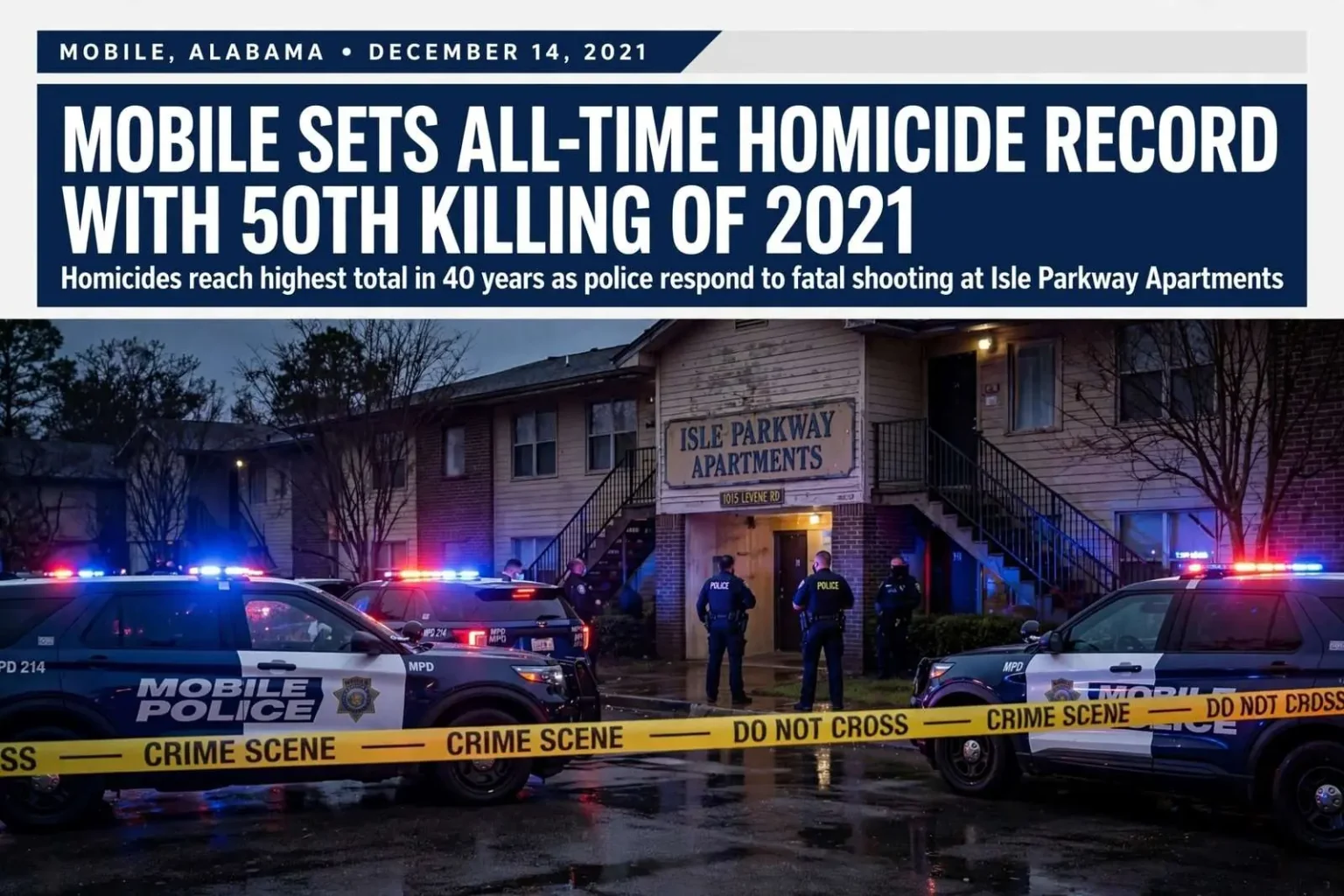
Homicides in the city of Mobile reached the highest total ever recorded, according to a review of police data spanning the last 40 years. On Tuesday, Dec. 14, the Mobile Police Department opened its 50th homicide investigation of the year, surpassing the previous all-time high of 49 homicides set in 2017. According to MPD spokesperson Charlette Solis, two additional possible homicide cases remained pending indictment by the Mobile County Grand Jury at the time, meaning the final total for the year could climb further.
The milestone case came after officers responded to a shooting at the Isle Parkway Apartments on Levene Road just after 1 a.m. on Dec. 14, where they found 69-year-old Robert Ragona shot to death. Breore Williams Jr., 23, was arrested later that day and charged with murder and first-degree burglary.
Law enforcement officials say the surge has been driven in significant part by retaliatory violence, with MPD Police Chief Paul Prine estimating that as many as 90 percent of the year’s shootings qualify as aggravated offenses. “A victim today is probably going to be an offender next week, or my victim today was an offender last week,” Prine said, describing how retaliatory cycles tend to compound because victims are often unwilling to cooperate with investigators, preferring instead to settle scores on their own terms.
Prine said the city’s homicide count is running about 6 percent higher than at the same point last year, a trend he described as consistent with a nationwide rise in violent crime rather than something unique to Mobile. Comparable cities were seeing similar or worse trends: as of early December, Birmingham had recorded 106 homicides and appeared on pace to surpass its 2020 total of 107; Montgomery had recorded 73; and Huntsville stood at 25.
Mobile Director of Public Safety Lawrence Battiste, in an interview earlier in the month, attributed much of the violence to ongoing conflicts between loosely organized “gangs” — in Mobile’s case, typically small groups of 10 to 15 people organized around neighborhoods, friendships and family ties rather than formal criminal organizations. Battiste described drive-up shootings targeting specific houses or vehicles as a recurring pattern in this kind of violence.
Prine has repeatedly said his officers’ greatest concern in these incidents is harm to uninvolved bystanders. On Dec. 3, a 9-year-old was hospitalized after being struck in the arm by a stray bullet while inside his home on the 100 block of Dobbs Avenue; police and the boy’s mother believe the shooters may have been targeting the house next door.
Mobile has also seen more organized, targeted forms of this violence. Court testimony has indicated the Oct. 15 shooting at Ladd-Peebles Stadium, which left five people injured, stemmed from a rivalry between the victims and the alleged shooters. The suspected shooter, 19-year-old Hezekiah Belfon, allegedly opened fire as a rival group attempted to confront him and two associates. Belfon remains at large and is being sought by U.S. Marshals.
Despite the record homicide total, Prine has sought to reassure residents that the spike does not reflect a broader breakdown in public safety. He points to other Class A felony offenses — burglary, vehicle theft, larceny, rape and sexual assault — which are down a combined 16 percent so far this year. “I don’t think that gets talked about enough,” he said.
City law enforcement leaders have spent months developing a response to the surge in killings. On Dec. 14, the same day the 50th homicide investigation opened, Prine briefed local media on a new rollout of targeted vehicle checkpoints at crime “hotspots” around the city. He described the checkpoints as a tool aimed at slowing the near-daily pattern of drive-by shootings into vehicles and homes, checking drivers’ licenses, registration and equipment while giving officers legal grounds to search for stolen or illegally possessed firearms and check for outstanding warrants.
Hotspot and intelligence-led policing have been centerpieces of Prine’s strategy since he took over as chief in October, a tenure that began with nearly a shooting a day. Under this approach, MPD concentrates patrol presence in the areas generating the most calls — corridors including Airport Boulevard and Interstate 65, St. Stephens Road in north Mobile, and the area around Duval Street and Michigan Avenue. Recent hiring has also brought MPD’s Precinct 1 and Precinct 3 — which cover the city’s northeast and southeast quadrants, respectively, and see the bulk of violent crime — to full staffing for the first time in roughly nine years. Prine said newly trained officers in those precincts should be running solo patrols by March 2022. The west side of the city, covered by Precincts 2 and 4, sees comparatively lower crime levels.
Technology is another piece of the department’s strategy. MPD plans to deploy ShotSpotter, a gunfire-detection system that uses acoustic sensors to alert officers in real time when shots are fired, with the goal of getting the system operating within the next several months.
Beyond homicides, other categories of violent crime also climbed in 2021. Aggravated assault cases in Mobile totaled 1,151 in 2019 and grew to 1,230 in 2020; by Dec. 22, 2021 had already surpassed both prior years with roughly 1,288 assaults reported, though aggravated assault figures are not limited to gun-involved incidents. Gun violence specifically also trended upward: Mobile recorded about 267 shooting cases in 2021 with roughly 240 victims, compared to 162 cases and 189 victims in 2020, 146 cases and 172 victims in 2019, and 157 cases and 182 victims in 2018.
As part of the department’s response, Chief Paul Prine announced on Dec. 22 that police cars would begin patrolling neighborhoods throughout the city with stationary blue lights activated, an effort intended to increase police visibility in addition to the targeted checkpoints already underway. Separately, officials said in November that as many as 130 homicide suspects had been able to make bail while awaiting trial, a figure tied to broader concerns about backlogged cases, COVID-19 court protocols and staffing conditions at the Mobile Metro Jail that have complicated efforts to keep violent offenders detained pending trial.
A review of 37 years of Mobile crime data beginning in 1984 found a total of 1,319 homicides citywide, an annual average of 33.8. Over the most recent five years, the city recorded 213 homicides combined. The lowest single-year total in that period came in 2000, when 16 murders were reported.
Officials also addressed longstanding discrepancies in how past years’ totals have been reported. Media accounts have consistently cited 50 homicides for 2017 rather than MPD’s official count of 49, and some reports have cited 56 homicides for 1990. Solis said the higher 1990 figure likely stems from reporters including a traffic fatality in which the driver was charged with manslaughter — a case MPD does not count in its official homicide total for that year.
The Mobile County Sheriff’s Office separately handled eight homicides of its own this year, according to spokeswoman Lori Myles, all of which have been solved; the office has not had an unsolved homicide since 2016.
Mobile County Chief Assistant District Attorney Keith Blackwood said the local DA’s office is currently managing just under 300 pending homicide trials, with this year’s efforts focused heavily on clearing a backlog of cases from 2016 and 2017. “It’s a tremendous amount of work,” Blackwood said. “We’ll keep putting our nose to the grindstone and working through them.”
Blackwood said he couldn’t point to any single local factor behind the increase, noting the trend is playing out nationally. FBI data published in September showed murders rose 30 percent nationwide in 2020 — the largest year-over-year increase since 1968, when the national homicide rate jumped 12.7 percent. As of mid-December, it remained unclear whether the two additional pending cases would be formally added to Mobile’s 2021 count before year’s end; Blackwood said grand jury proceedings are confidential and he could not offer a timeline for when jurors might take them up.
How pending cases move through the grand jury
In Alabama, felony cases such as murder generally go before a county grand jury before they can proceed to trial. The grand jury, drawn from county residents, hears evidence presented by prosecutors in closed proceedings, and at least 12 of its 18 members must agree before an indictment is returned. That secrecy is why Blackwood said he could not say when jurors might consider the two pending Mobile cases.