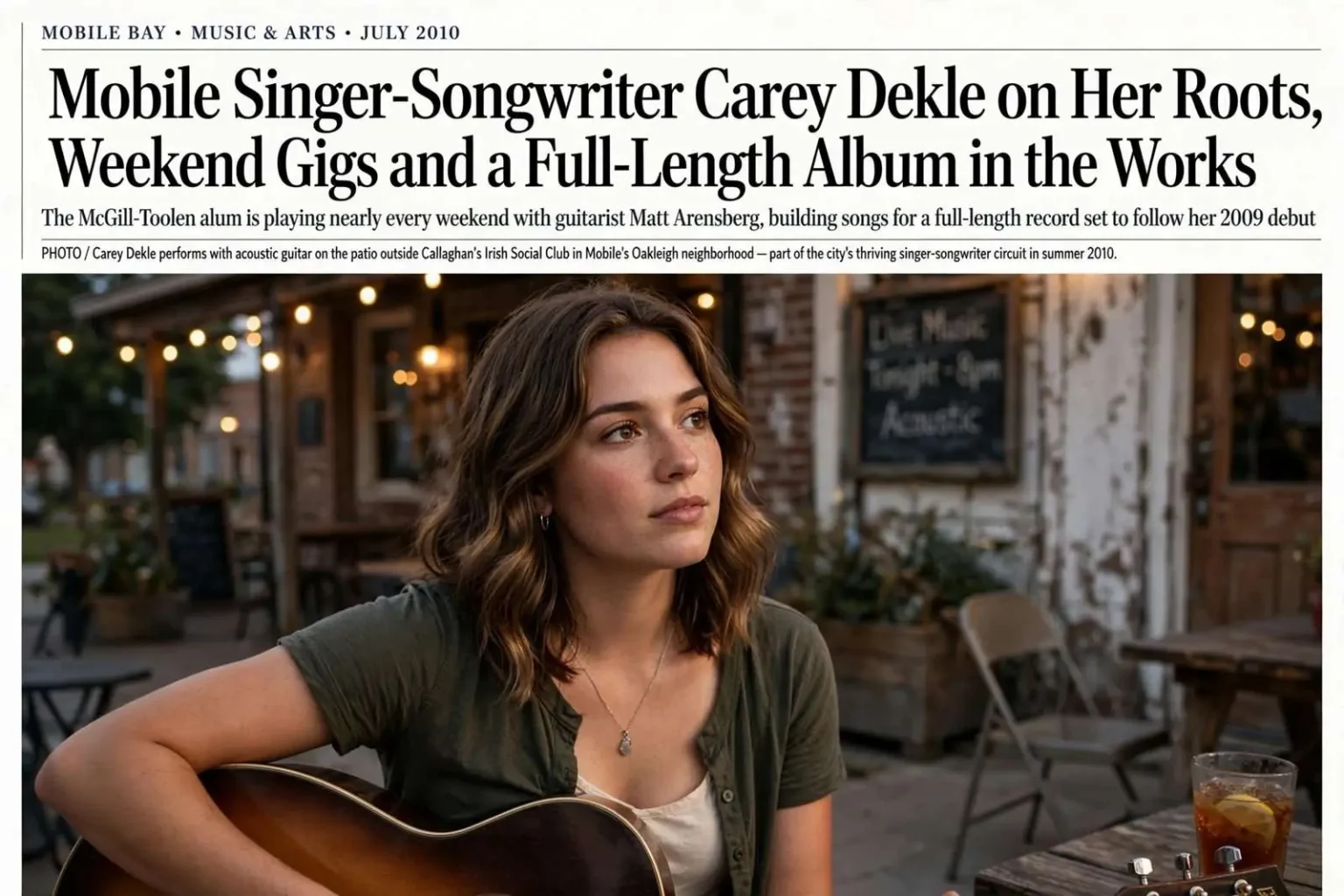
In mid-2010, Mobile singer Carey Dekle sat down to talk about her path in music — a journey that began in childhood and was steadily building toward her first full-length record. Like many songwriters on the Gulf Coast, her story ran through church, school and a string of small stages, and by that summer she was at the point every local musician recognizes: playing constantly, recording steadily and deciding what came next.
From McGill-Toolen to local stages
Dekle grew up surrounded by music. Her parents recognized early that she could sing, and by high school at McGill-Toolen she had begun writing songs of her own. McGill-Toolen Catholic High School, long one of Mobile’s central private schools, sits in the heart of the city’s Spring Hill Avenue corridor, and its music programs and talent showcases have fed the local scene for generations — a first audience for young singers long before they play a club.
It wasn’t until college, though, that she first performed her original material, playing shows around Mobile while studying. The step from singing to songwriting — from interpreting other people’s songs to standing on a stage with your own — is the threshold that separates hobbyists from working musicians, and Dekle crossed it while balancing classes, a decision that shaped everything that followed. Performing original songs for a hometown crowd is its own education: every night teaches a songwriter which verses land, which choruses hold and which lyrics belong to the writer’s notebook rather than the set list.
By the summer of 2010 she was playing out nearly every weekend, teaming up with guitarist Matt Arensberg, formerly of the band Color the Coast, for relaxed acoustic sets around town. The two-person format — voice and guitar, no drums, no amplifier walls — has long been the workhorse of the Mobile scene, filling restaurant patios, coffeehouses and neighborhood bars with music that complements a room rather than dominating it.
The Mobile scene that shaped her
Mobile’s music community in 2010 ran on exactly the circuit Dekle was working. Rooms like Callaghan’s Irish Social Club in Oakleigh, the Alchemy Tavern downtown and the neighborhood bars along Dauphin Street gave singer-songwriters weeknight and weekend slots, while festivals and church events offered larger audiences to those ready for them. The city’s musical roots run deep — from the Mardi Gras tradition that brought entertainment to the Gulf Coast, to the gospel and R&B heritage of the region — and local players often move between genres freely, backed by a pool of working musicians who all know one another.
What came next
Dekle said she hoped to assemble a full band again if she could find the right lineup of musicians to play with. In the meantime, more recording was on the horizon: once everything was in place, she planned to lay down additional tracks and follow her 2009 self-titled debut — a short release sold for seven dollars — with a full-length CD.
The arithmetic of that plan will be familiar to any independent musician. A first EP or short record establishes the material and gives listeners something to buy at shows; the full-length album requires more songs, more studio time and more money, all of which come from the steady round of weekend gigs. Playing out nearly every weekend was not just promotion — it was the funding mechanism for the record, the testing ground for the new songs and the way a local audience grows from curious to loyal.
Her trajectory reflected a familiar shape in the Mobile music scene: church-and-family beginnings, school talent, and weekend acoustic gigs that keep local songwriters sharp while they build toward bigger releases. The pattern has produced a remarkable share of the Gulf Coast’s working musicians, and it explains why the city’s stages punch above their weight — a culture in which singing starts early, family encouragement is assumed, and a songwriter can develop over years without ever leaving home.
The acoustic duo as proving ground
Working with a single guitarist, as Dekle was doing with Arensberg, is both the simplest and most demanding format in popular music. There is no rhythm section to mask a rough night and no production to carry a thin song; the arrangement lives or dies on the interplay between voice and strings. Arensberg’s background with Color the Coast, a band in Mobile’s rock scene, brought full-band instincts to the acoustic setting, letting the duo’s sets carry more energy than the format usually promises. For a songwriter preparing a full-band record, the duo is the ideal laboratory: songs learned on two instruments arrive at the studio already stripped to their essentials.
The weekend circuit serves the same purpose from the audience’s side. Regulars at the rooms around town come to know a writer’s songs before the record arrives, and by the time a full-length CD is ready, the release show has a built-in crowd. That relationship — built one Friday night at a time — is what local music scenes exist to create, and it is why a singer like Dekle could plan a record with reasonable confidence: the audience was already forming, one weekend at a time.
Building a record in a small-city scene
Making a full-length album from Mobile in 2010 meant working within the realities of a small-city market. Local studios charged by the hour, session musicians were hired per track, and duplication and packaging came out of the artist’s pocket. The seven-dollar price of Dekle’s 2009 debut reflected the economics of self-released music: enough to cover costs, cheap enough to sell from the merchandise table between sets. Every independent artist of the era knew the ledger — studio time, artwork, disc pressing, gas to the gigs — and the full-length CD Dekle was planning represented the largest such investment of her career so far.
Yet the same small-city scale offered advantages a bigger market would not. Studio availability was easier to secure, collaborators were a phone call away, and local media and venues were accessible to a young songwriter in a way they would never be in a music-industry town. Mobile’s scene operated on relationships — the guitarist who knew a drummer, the venue owner who gave an opening slot, the fans who bought a disc at a show and brought friends to the next one. An artist embedded in that network could build a career in increments, without relocating or waiting to be discovered.
Where the story pointed
Everything in Dekle’s summer of 2010 pointed toward the record: the weekend gigs funding the studio time, the duo sharpening the songs, the hoped-for band waiting on the right lineup. That last condition — finding the right musicians — is the piece small scenes cannot always supply on demand. A full band requires not just skill but availability, chemistry and shared commitment, and working songwriters often wait months or years for a lineup that fits. Until then, the acoustic duo remained the vehicle, and the songbook kept growing.
Her path also illustrates what the mid-2010s local scene was becoming. Independent recording had never been cheaper, online sales and social media were opening doors beyond the hometown, and artists who once needed a label deal could plan a full-length record on the strength of weekend gigs and a merchandise table. Dekle’s plan — a short debut in 2009, a full-length to follow — placed her squarely in that generation of Gulf Coast songwriters building careers on their own terms, from McGill-Toolen talent shows to the stages of Mobile’s neighborhood rooms, with the music grounded in the same place it started: home.
Songwriting starts at home
For songwriters who come up through the Gulf Coast scene, the earliest material is usually written long before anyone hears it — in bedrooms and church pews and high school notebooks. Dekle’s start, recognized by her parents and developed through McGill-Toolen, follows the classic pattern: a family that treats singing as a gift to be encouraged, a school that provides the first stage, and a hometown full of small rooms where a new writer can learn in front of a friendly crowd. By the time she was performing her originals in college, the craft had been developing for years, invisible to audiences who assumed the songs arrived fully formed.
That apprenticeship matters because songwriting, unlike singing, cannot be taught entirely in a classroom. A writer learns craft the way a fisherman learns the bay — through repetition, observation and the slow accumulation of judgment about what works. The weekend acoustic sets Dekle played through 2010 were that education in progress: two forty-five minute sets a night, each song measured against the room’s attention, each arrangement adjusted by the following weekend.
The full band question
The hope to assemble a full band — contingent, as she said, on finding the right lineup — captures a decision point every acoustic songwriter eventually faces. A duo can sustain a career indefinitely: the bookings are easier, the logistics simpler, the split agreeable. But a record with fuller arrangements, and the ambition that follows it, usually requires drums, bass and the textures a full band brings. In Mobile’s scene, where players float among multiple projects, the search for the right lineup is as much about personality and reliability as about skill — a bandleader is choosing bandmates, not hiring hands.
Until that lineup came together, the plan stood on the parts that were certain: more recording, more tracks laid down when the time was right, and a full-length CD to succeed the 2009 debut. The short record had already done its job — establishing her as a working songwriter in the Mobile scene, giving the weekend audiences something to take home and setting the seven-dollar price point that made buying easy. The next record, longer and more ambitious, would measure how far the path from church and school talent shows had taken her — and how much further the stages of her hometown could carry a songwriter on the way up.