
Mobile State School Board Member Pushes Back Against Amendment to Appoint Board Members
Alabama State School Board member Jackie Zeigler campaigns against Amendment One, which would replace elected board members with appointed positions.
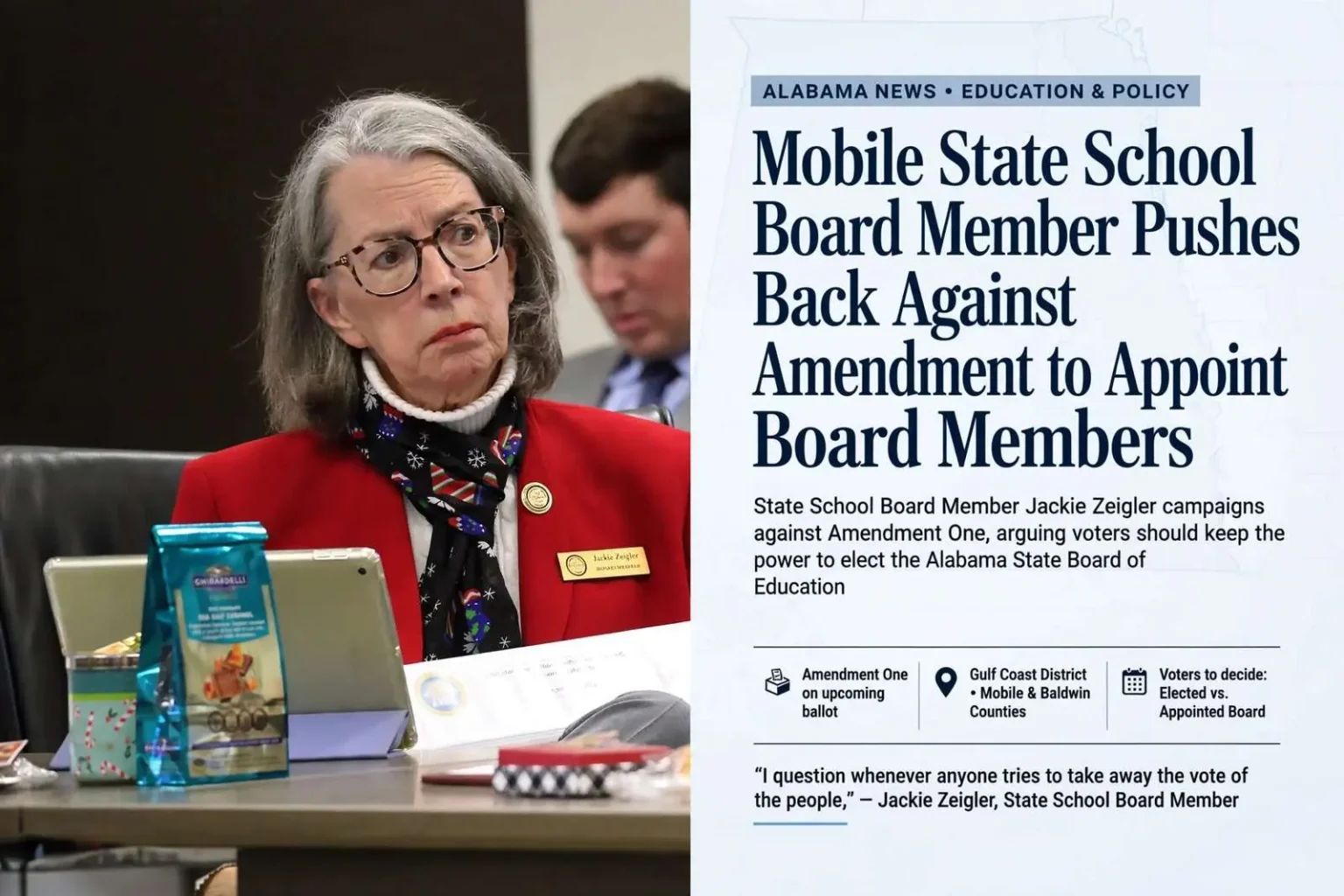
Alabama voters will soon decide one of the most consequential education-governance questions to reach a statewide ballot in years: whether to continue electing the members of the Alabama State Board of Education or to switch to an appointed system — and one Mobile-area board member is campaigning hard to keep the vote in the hands of the people.
State School Board Member Jackie Zeigler has launched a social media campaign against Amendment One, a constitutional measure that would change the Alabama Board of Education from elected positions to appointed ones as current members complete their terms. Under the proposal, the governor would appoint future members of the board, subject to confirmation, once the seats now held by sitting members open up. Zeigler, who represents the Gulf Coast district that includes Mobile and surrounding southwest Alabama communities, argues that the change would cut voters out of the process at exactly the moment the state is asking them to trust its schools.
“I question whenever anyone tries to take away the vote of the people,” Zeigler said. “If they want to get rid of me, let them do it at the ballot box and they can bring in someone else.”
Her argument rests on a simple claim about accountability: elected board members answer directly to the communities they serve, while appointed members would answer, at least ultimately, to the executive who picked them. In a state where education policy is a persistent front in politics — from school funding debates to testing standards to the leadership of the state department — Zeigler contends that the only reliable check is the ballot.
What the State Board of Education actually does
The Alabama State Board of Education sits at the top of the public school chain in the state. It sets policy for K-12 education, hires and fires the state school superintendent, approves standards and graduation requirements, and plays a central role in how the state education budget is shaped and administered. Its decisions reach every public school district in Alabama, from the largest systems in Huntsville and Birmingham to the coastal districts of Mobile and Baldwin counties.
Under the current structure, board members run in districts across the state, which means every region — the Tennessee Valley, the Black Belt, the Wiregrass, and the Gulf Coast — has its own elected voice at the table. Supporters of the elected model, like Zeigler, say that geographic accountability matters: when a board member votes on policy affecting local schools, the families in that member’s district can support or oppose that member in the next election.
Critics of the elected model have long countered that the board has presided over years of chronic underperformance, and that elected members are too quick to answer to political pressures rather than student outcomes. That criticism is precisely what the amendment’s backers point to in making the case for appointment.
The complaint over ballot language
Beyond the social media campaign, Zeigler has taken her objections into the formal process. She has filed a complaint with the Alabama Fair Ballot Commission and the Secretary of State’s office, pushing for clearer ballot language so voters understand the potential shift they are being asked to approve.
Her concern is that the wording of the amendment does not make its effect plain. Constitutional amendments in Alabama are often presented on the ballot as compressed summaries, and Zeigler believes the summary in this case leaves voters unable to tell what a yes or a no would actually do.
“Sometimes a yes vote is a no and a no vote is a yes, so with the wording of it, it just doesn’t clarify the intent,” Zeigler said.
The Fair Ballot Commission is the body responsible for writing the explanatory language that appears with statewide constitutional amendments, and complaints filed with the commission and the Secretary of State are the standard avenue for challenging that language before an election. Zeigler’s complaint seeks wording that would make clear to voters that approval of Amendment One would end the election of board members as seats turn over.
The governor’s position
Zeigler’s campaign runs directly against the stated preference of Alabama’s top elected official. Governor Kay Ivey has expressed support for switching to appointed positions, arguing that Alabama’s consistent placement near the bottom of national education rankings warrants a new approach to how the state governs its schools.
The governor’s argument is a familiar one: that an appointed board, chosen with an eye toward professional qualifications rather than electoral politics, would let the state pursue a more coherent, long-range education strategy. Zeigler rejects that logic. In her view, the state’s education struggles are not the product of the election method, and the remedy being proposed removes the public from the one decision that most directly shapes the board’s character.
“They met us, they understand us, they know from where we came,” Zeigler said of her constituents. “It was their desire to put us in that place because they’ve known us and they trust us, otherwise they would have elected someone else.”
That statement captures the core of her campaign: an elected board member is someone the community deliberately put in the position, and the community retains the power to remove that person. An appointed member arrives with no such mandate and leaves with no such review.
What appointment would mean in practice
If Amendment One were approved, the transition would not be immediate. The measure would convert seats to appointed positions as current members complete their terms, meaning existing elected members would finish serving the terms voters gave them. Over time, the board would gradually shift from an elected body to one named by the governor.
Supporters of the gradual transition point out that it avoids a disruptive, one-time turnover of the entire board. Opponents like Zeigler respond that the phase-in is precisely what makes the change easy to miss: each election that disappears is a small loss, and the cumulative effect — a board no voter anywhere in Alabama chose — arrives quietly.
The mechanics matter for more than symbolism. An appointed board would change the incentives around the board’s most significant powers, including the selection of the state superintendent and the approval of statewide standards. Whoever controls those appointments would hold enormous influence over the direction of Alabama’s public schools, and the accountability for exercising it would run through a single office rather than eight separate districts.
The debate in context
Alabama is not the first state to wrestle with this question. Around the country, states have experimented with different mixes of elected and appointed school governance — elected boards, appointed boards, and hybrids. Each model makes a different bet about where accountability should live. Alabama’s Amendment One asks voters to move that accountability from the electorate to the governor’s office.
Zeigler’s complaint about ballot language is designed to highlight the burden that comes with such a change. In her telling, the amendment’s supporters should have to make an affirmative case that appointment will improve schools, and the ballot summary should not obscure the magnitude of what is being surrendered. Her social media campaign and her complaints to the Fair Ballot Commission and the Secretary of State press the same theme: the vote itself is the thing being taken away, and voters should notice.
What Gulf Coast voters should watch
For voters in Mobile and southwest Alabama, the stakes are concrete. The district Zeigler represents includes one of the state’s largest school systems, and board decisions on standards, testing, and leadership reach every classroom from downtown Mobile to the Baldwin County line. Under the current system, Gulf Coast families can call their board member and vote them out. Under the proposed system, the region’s voice would depend on whom the sitting governor chooses to name.
Zeigler’s message to those voters is to treat the amendment as a question about their own power, not an administrative housekeeping measure. “I question whenever anyone tries to take away the vote of the people,” she said — a sentence that serves as both her argument and the organizing principle of her campaign. Whether Alabama voters agree will be settled at the ballot box, which is, as she points out, exactly where she believes the decision belongs.
How the campaign is being waged
Zeigler has chosen tools available to any officeholder: social media posts explaining the amendment, public statements to local reporters, and the formal complaint process. None of those require the apparatus of a statewide campaign, and that is by design — she is not running against a candidate, but against a question on the ballot.
The social media push matters because constitutional amendments frequently pass or fail with most voters knowing little about them. In a low-information contest at the bottom of the ballot, the language presented to voters often does the decisive work. That is why Zeigler has paired her public campaigning with the complaint filed with the Fair Ballot Commission and the Secretary of State: one effort reaches voters directly, and the other tries to fix the wording they will see when they arrive at the polling place.
Her position is also notable because of where she sits. Zeigler is not an outside critic of the board she serves on — she is one of its elected members, and the amendment would eventually eliminate the seat she holds. She has been explicit that the issue is bigger than her own position: if supporters of the change want her out, they should have to beat her in an election rather than wait for the office to be abolished.
“If they want to get rid of me, let them do it at the ballot box and they can bring in someone else,” she said.
The accountability argument, tested
The debate over elected versus appointed boards usually turns on one word: accountability. Both sides claim it. Zeigler’s side says accountability means the power to remove; the amendment’s supporters say accountability means results, and that the current method has not produced them.
Zeigler’s answer is that the remedy for an underperforming board member is a challenger and an election, not the elimination of the electorate. She points to the straightforward mechanics of her own position: voters in her district chose her, they know where she stands, and they can replace her. The complaint she filed over ballot language extends that logic to the amendment itself — if the change is good policy, its backers should be willing to describe it plainly and let voters judge.
Her emphasis on the wording also reflects a practical truth about Alabama ballots. The state’s constitution requires that voters be given a summary of each statewide amendment, and disputes over those summaries are common. A ballot question that reads as technical or neutral can mask a significant structural change; Zeigler’s complaint argues that this is such a case, and that “sometimes a yes vote is a no and a no vote is a yes” when the wording obscures the effect.
What happens next
Once the ballots are counted, either the elected system survives or the phase-in to appointment begins. If the amendment passes, sitting members would continue to serve out their terms, and future vacancies would be filled by appointment. If it fails, the board remains elected, and the debate over how best to govern Alabama’s schools would continue through legislation, policy, and the elections themselves.
Either way, the campaign is likely to stand as one of the clearest statements of the case for keeping education governance in voters’ hands. Zeigler’s argument does not deny that Alabama’s schools face serious challenges; it denies that removing the public from the selection of the board is the way to meet them. The governor’s argument, by contrast, is that the current method has had its chance. That is the choice before Alabama voters: an elected board they can hold accountable one district at a time, or an appointed board the governor can shape as a whole — and, whatever they decide, a ballot that says plainly what they are choosing.


