
Mobile Teacher Publishes Biography of Civil Rights Leader John LeFlore
Murphy High School teacher Ken Robinson published Port City Crusader, a biography of civil rights leader John LeFlore of Mobile.
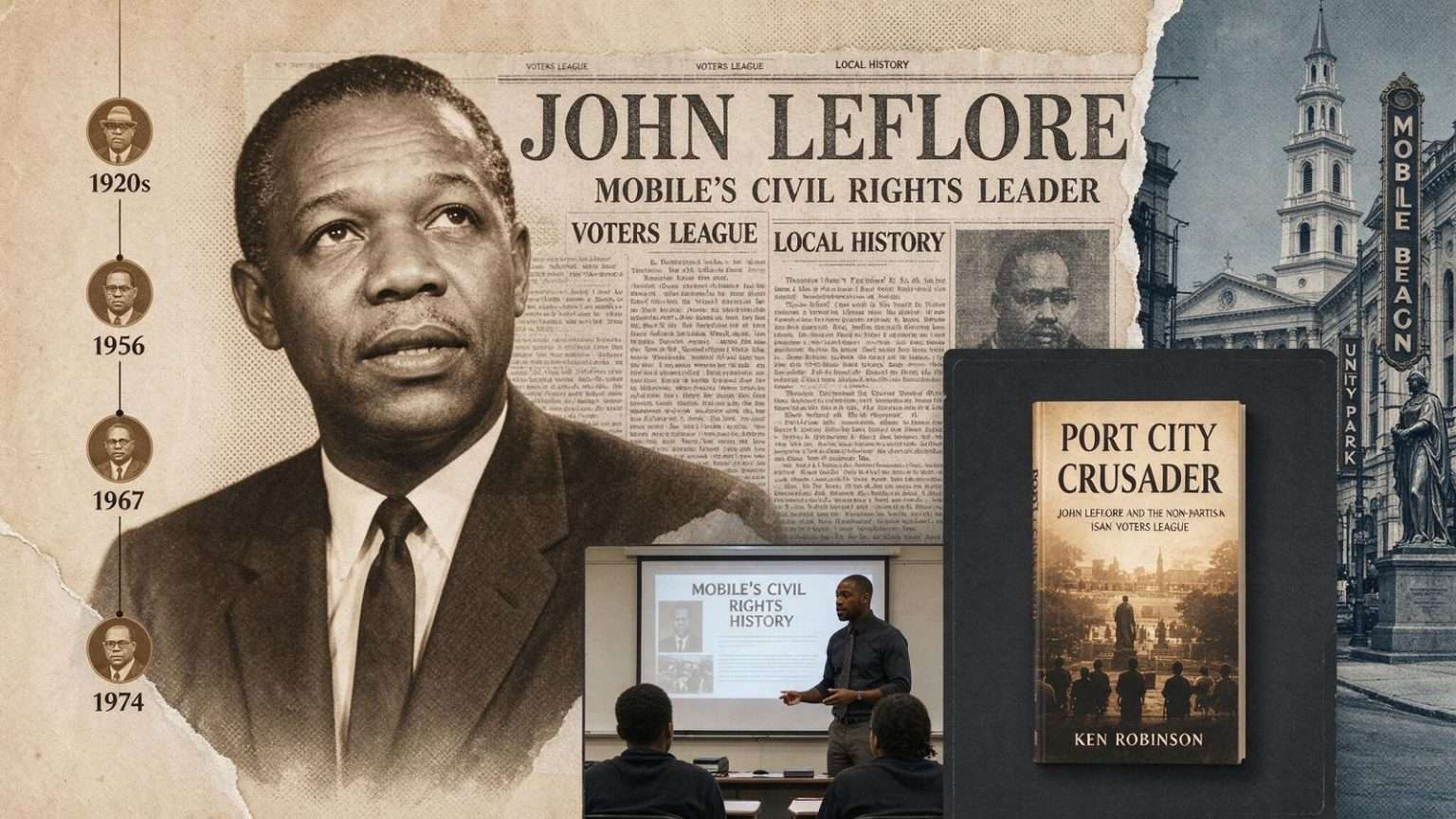
A Mobile educator has brought to life the story of one of the city’s most important yet often overlooked civil rights figures. Ken Robinson, a history teacher at Murphy High School, published Port City Crusader: John LeFlore and the Non-Partisan Voters League, a biography chronicling the life and legacy of John LeFlore, the man widely credited with helping Mobile avoid the violent upheaval that marked the civil rights era in Birmingham, Selma, and Montgomery. The book gives readers the fullest accounting yet of a leader whose name is attached to one of Mobile’s best-known schools but whose full story has remained outside the classroom canon.
Robinson’s subject is not a household name outside south Alabama, but his imprint on Mobile is hard to miss. The city’s civil rights history unfolded differently than the better-known battles to the north, and historians have long pointed to a style of interracial negotiation — led in large part by LeFlore — as the reason Mobile’s schools, buses and workplaces integrated without the bombings and mass confrontations that bloodied other Alabama cities. Robinson’s biography places that story in the hands of the man who shaped it, from the 1920s through his death in 1976.
For a classroom teacher, the project doubles as a teaching tool. Murphy High School, where Robinson teaches, is itself one of Mobile’s most historic public schools, and its students walk the same city streets that LeFlore’s organizations transformed. Bringing a published biography of Mobile’s central civil rights figure into local classrooms connects the state’s textbook narrative to the neighborhoods students know firsthand.
A Life Devoted to Civil Rights in Mobile
John LeFlore was born in Mobile and spent his career working for racial equality through civic engagement rather than confrontation. While employed as a postal worker, LeFlore helped organize the Mobile chapter of the NAACP during the 1920s, establishing one of the earliest branches of the organization in the Deep South. Building a branch in that era required persistence in the face of open hostility; chapters across the South operated under surveillance and pressure, and Mobile’s took root decades before the movement’s famous campaigns, sustained by meetings held in churches and lodge halls across the city.
When Alabama outlawed the NAACP in 1956, LeFlore pivoted his efforts to the Non-Partisan Voters League, an organization focused on voter registration and political participation among Black residents in Mobile. The state’s ban on the national organization could have ended decades of organizing; instead, LeFlore rebuilt the work under a new banner aimed squarely at the ballot box. Voter registration drives, candidate forums and endorsements through the league gave Mobile’s Black voters a vehicle for political power at a moment when registration rolls were the battleground itself.
He also worked as a journalist, contributing to both the Chicago Defender and the Mobile Beacon, using the press as another avenue to advocate for civil rights. The Defender, the legendary Chicago-based Black weekly with national reach, carried Southern news to readers across the country, while the Mobile Beacon served the local community directly. Writing gave LeFlore a platform his organizing work reinforced — and an outlet for commentary that preserved his arguments in print.
LeFlore’s approach to activism emphasized cooperation and dialogue, which at times put him at odds with more confrontational groups such as the Neighborhood Organized Workers (NOW) during the 1960s. The tension between negotiated progress and direct protest divided movements in cities across the South, and Mobile was no exception, as younger activists pressed for faster, louder action while LeFlore worked the channels of city hall and the ballot. In 1967, his home was firebombed — a reminder that even a strategy built on negotiation drew violent opposition. Despite the dangers, LeFlore continued his work and was elected to the Alabama House of Representatives in 1974. He passed away in 1976, having served only part of a single term in the Legislature.
A Legacy Written Into the City
Today, LeFlore’s legacy is honored through the John LeFlore Magnet School, and a statue of LeFlore alongside Joseph Langan stands in Unity Park as a testament to their contributions to Mobile’s civil rights history. The pairing of the two men in bronze is deliberate: Langan, a longtime city commissioner and mayor, worked with LeFlore across the color line at moments when such cooperation was rare in Alabama, and their partnership is remembered as a model of what interracial negotiation made possible in Mobile. Unity Park, in the heart of downtown, places that partnership in the path of everyone who moves through the city center.
The magnet school that bears LeFlore’s name carries his story to each new class of students, many of whom know the building’s name without knowing the man behind it. Robinson’s biography is aimed directly at that gap — a resource for teachers, students and longtime residents who have seen the statue and the school name and wondered about the history attached to them. In a city where civil rights landmarks are scattered through downtown neighborhoods, the book functions as a guide to why those markers exist.
Mobile’s relative calm during the movement years has often been described as an exception in Alabama, and LeFlore’s preference for coalition over confrontation is central to that reputation. Robinson’s account does not soften the friction: the firebombing of LeFlore’s home in 1967, and the running disagreements with NOW, show a city where progress came through conflict as well as conversation. The biography’s contribution is to put the negotiation strategy on the record in full, with its costs as well as its results.
From Master’s Thesis to Published Book
Robinson’s biography began as his master’s thesis at Alabama State University, a project that took a year and a half to complete in 2005. Alabama State, founded in Montgomery in the nineteenth century and home to one of the state’s most significant archives of Black history, gave the project an academic grounding, and the thesis format forced the research discipline a full-life biography requires — newspaper archives, organizational records, and the memories of Mobilians who worked alongside LeFlore.
The work remained unpublished for several years until a local publisher issued a call for authors, and an editor recognized the significance of LeFlore’s untold story. That path from thesis to bookshelf is an uncommon one; most academic theses sit in university libraries, read by a handful of researchers. The decision to bring Robinson’s manuscript to print reflects the growing appetite for local history titles that document the people behind the places and buildings a community names every day.
Robinson made his first public appearance with the book at Mobile’s monthly LoDa Artwalk, signing copies in front of local boutique Lunatix & Co. on Springhill Avenue. LoDa — the Lower Dauphin entertainment district — fills with crowds on artwalk nights, giving local authors, artists and musicians a downtown audience, and the Springhill Avenue storefront put the book in front of exactly the Mobile readership its subject belongs to. The setting was fitting in another way: the artwalk route runs through the same downtown whose public spaces, businesses and politics LeFlore spent half a century working to open up.
The book was made available at selected local retailers and through Amazon, giving readers both a hometown purchase option and national access. For Mobile teachers, the local availability matters — Robinson’s dual role as author and educator means the biography is positioned to move from the bookstore shelf to the classroom reading list, where the story of the city’s most consequential civil rights leader can finally reach the students who walk past his name every school day.
Why LeFlore’s Story Stayed Untold
The gap between LeFlore’s importance and his obscurity has an explanation rooted in how civil rights history has been preserved. The movement’s national memory was built around televised confrontations — the dogs and fire hoses of Birmingham, the bridge at Selma — and the quieter cities that negotiated their way through the era generated fewer dramatic images to anchor documentaries and textbooks. LeFlore’s strategy, by its nature, produced meetings and ordinances rather than marches and arrests, and stories told through meeting minutes are harder to pass down. Biographies like Robinson’s recover that record, and Mobile’s story is among the most consequential of the recovered ones.
The state’s 1956 ban on the NAACP also scrambled the historical record. With the national organization’s files and chapters forced underground or out of existence in Alabama, the paperwork of a generation of organizing was scattered, and figures like LeFlore had to be documented through newspapers, court files and interviews rather than a single organizational archive. Robinson’s year and a half of thesis research navigated exactly that problem, and the published book preserves the results in a form that will not depend on the memories of aging participants.
Mobile’s Civil Rights Landscape Today
Readers walking Mobile with the book in hand will find the city’s civil rights geography intact. Unity Park’s statue of LeFlore and Langan stands downtown, the magnet school carries his name across the city, and churches and neighborhood institutions that hosted league organizing half a century ago remain active. The Mobile Beacon, the paper LeFlore wrote for, belongs to the same era of Black-owned press that carried the community’s news when daily papers largely ignored it. Each of these landmarks becomes more legible with the biography’s context — the story of who did the work, and what it cost.
For educators, the timing is useful as well. Alabama students encounter the state’s civil rights history in required coursework, and the curriculum’s Alabama figures are dominated by a short list of famous names. A classroom-accessible biography of Mobile’s central figure gives local teachers a way to make the movement concrete — a leader from their own city, a strategy they can discuss in civic terms, and a legacy students can visit. Robinson’s position at Murphy High School puts the book at the center of that effort, and its availability through local retailers and Amazon keeps it within reach of classrooms and general readers alike.
Port City Crusader: John LeFlore and the Non-Partisan Voters League joins a small shelf of books documenting Mobile’s distinctive civil rights experience, and it is the first full-length biography devoted to the man at the middle of that story. From a 1920s postal worker organizing an NAACP branch in the Deep South, through the 1956 state ban, the founding of the Non-Partisan Voters League, the firebombing of 1967 and a seat in the Alabama House in 1974, Robinson traces a single sustained career of civic work — the career that helped Mobile pass through the civil rights era more peacefully than any city its size had a right to expect.


