
Mobile therapist offers tips for managing anxiety, stress during turbulent times
A Mobile mental-health professional, Kari Whatley of the Equine Therapy Group, shares ways to manage anxiety and stress as daily protests fuel heightened.
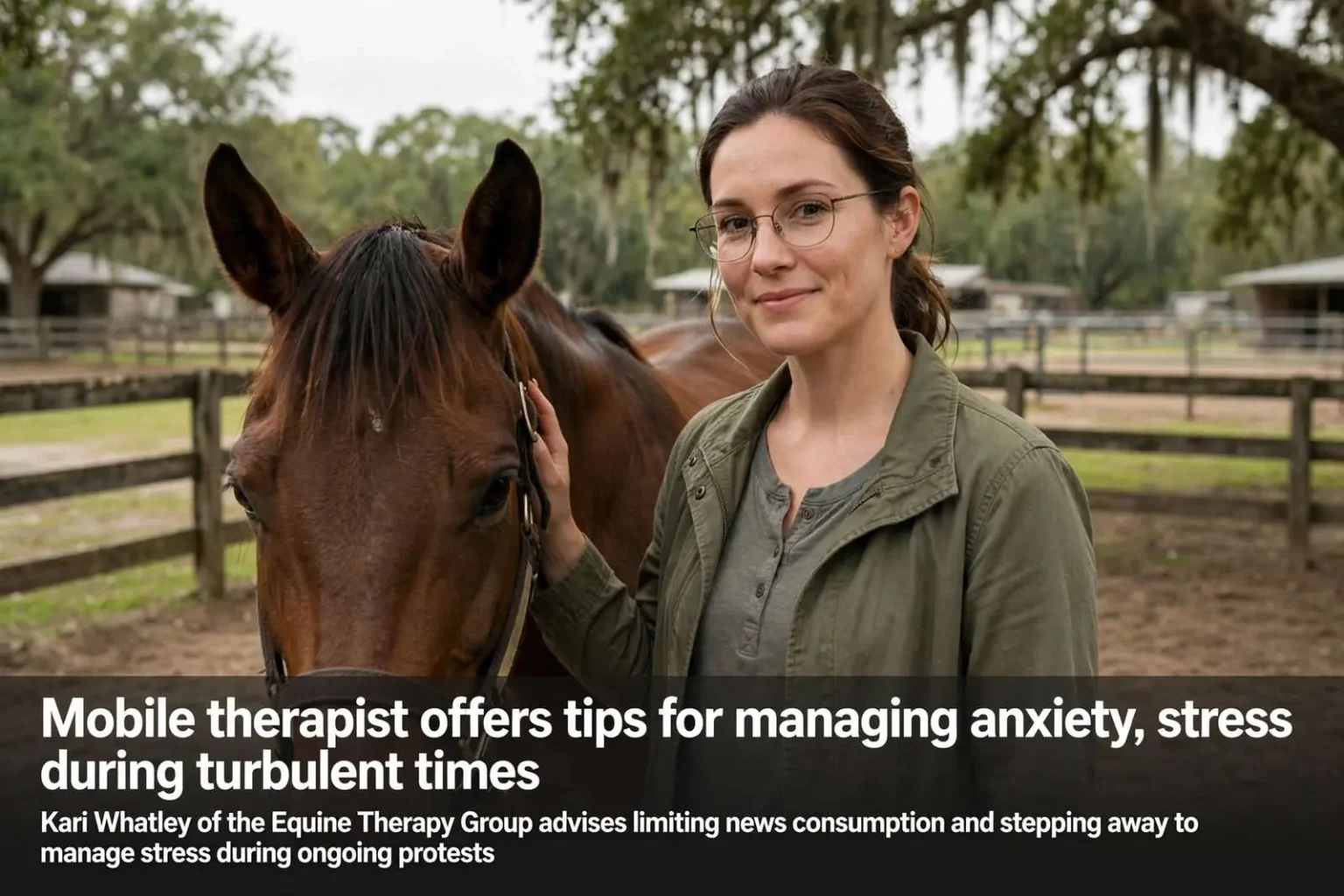
The anxiety from protests playing out daily — both locally and across the country — can take a real toll on a person’s stress level, a Mobile mental-health professional says, and she is urging residents to be deliberate about how much of it they take in. Kari Whatley, with the Equine Therapy Group, said the unrest is affecting people sharply because negative emotions tend to spread faster than positive ones, a dynamic that mental-health researchers have observed repeatedly in the social media age.
Seeing troubling images repeatedly can bring back a person’s own memories of feeling fearful, helpless or angry, she said. Those feelings can linger through the day — coloring conversations at work, sleep at night and the patience parents bring home to their children. Whatley’s point is one that clinicians have emphasized during periods of civil unrest: repeated exposure to disturbing footage is not a neutral act of staying informed, but a real psychological input that the mind processes the same way it processes direct stress.
Why Negative Images Stick
The science behind Whatley’s observation about negative emotions traveling faster is well established. Human attention is weighted toward threat: images of confrontation, conflict and danger register more deeply and are shared more readily than calm, positive content, which is why a protest video can reach millions of screens in hours while footage of the same event’s peaceful resolution barely travels. Social media platforms amplify the effect by design, rewarding engagement that provocative clips generate and serving viewers more of whatever holds their attention — which, in turbulent weeks, is often more of what is disturbing them.
For people with their own history of trauma or anxiety, the loop can be more powerful still. A clip of chaos can evoke a viewer’s memory of a time they felt afraid or powerless, and the mind responds to the recalled threat much as it responded to the original one — with the racing heart, the tight chest and the short fuse that characterize a stress response. The feeling then lingers, as Whatley said, through the rest of the day, even though the danger itself is on a screen and not in the room.
The Remedy: Stepping Away
To cope, Whatley recommends stepping away from the news for a while. “It’s a good thing to be informed but not over informed,” she said, encouraging people to limit how much social media and news they take in — a distinction that gets at the difference between being a citizen and being a doomscroller. Being informed means knowing what is happening; being over-informed means watching the same disturbing clip a dozen times across an evening, from sources that add nothing new except repetition.
Her advice fits squarely within the playbook mental-health professionals offer during sustained periods of unsettling news: set specific times to check the news rather than leaving it on continuously; turn off notifications that push breaking headlines into every quiet moment; put the phone down well before bedtime, since late-night scrolling is both a sleep-killer and an anxiety amplifier; and replace some of that screen time with activity that occupies the body and calms the mind — a walk, exercise, cooking, or time outdoors.
Signs It Is Time to Unplug
Mental-health professionals suggest watching for the signals that news consumption has crossed from awareness into harm: checking the phone first thing upon waking and last thing before sleeping; feeling a spike of dread at each notification; noticing irritability, restlessness or trouble concentrating that tracks with time spent scrolling; and talking about little else with family and coworkers. When those signs appear, the recommended step is not ignorance but boundaries — the deliberate limits on consumption that Whatley describes. People who impose them often report the anxiety easing within days, even while they continue to follow major developments at a sustainable pace.
Parents carry an added responsibility during turbulent news cycles. Children see the same images adults do, but without the context to place them, and clinicians advise talking with children about what they are seeing in age-appropriate terms, limiting their exposure to looping coverage, and watching for behavior changes — sleep problems, clinginess, new fears — that suggest a child is carrying more worry than they can express. The household’s overall media diet, in other words, is a family matter, not just an individual one.
Equine Therapy and Alternative Approaches
Whatley’s work with the Equine Therapy Group points to the broader range of therapeutic options available to Mobile residents whose anxiety does not resolve with self-help measures alone. Equine-assisted therapy uses structured work with horses — grooming, leading, riding and ground exercises — as part of mental-health treatment, and it has grown in popularity across the Gulf Coast for children and adults dealing with anxiety, trauma and attention difficulties. Practitioners describe the value in the immediate, honest feedback horses provide: a large, sensitive animal that responds to a person’s tension and calm alike, teaching clients in real time how their own emotional state affects the world around them.
The approach is one of several alternatives to traditional talk therapy, alongside art therapy, outdoor and adventure-based programs and group counseling, all of which are represented in the Mobile area’s mental-health landscape. For people whose stress is rooted in the news cycle rather than a clinical condition, such structured programs may not be necessary — but Whatley’s underlying message holds at every level of need: anxiety fed by constant exposure to troubling images responds to deliberate change, starting with the simple act of stepping away.
The daily protests, locally and across the country, are not likely to stop appearing on screens any time soon. What residents can control, Whatley’s advice suggests, is how much of that stream they invite into their own day — enough to be informed, and no more than it takes to steal a night’s sleep.
The Local Context: Protests and the News Cycle
Whatley’s remarks came during a stretch when protests were a daily presence both nationally and in local communities, part of a wave of demonstrations that dominated headlines and social feeds for weeks. That environment presented residents with an unusual challenge: the news was not an occasional intrusion but a continuous stream, with fresh footage, commentary and argument arriving by the hour on phones, televisions and car radios. For many people, the constant hum of crisis created a low-grade stress that never quite switched off — the background anxiety of a country that appeared, on every screen, to be in conflict with itself.
Mental-health providers across the Gulf Coast reported the same phenomenon during that period: patients arriving with sleep trouble, irritability and dread tied not to events in their own lives but to the news they were consuming. The observations echoed guidance issued by the American Psychological Association and other professional bodies, which warned during sustained news cycles that heavy consumption of troubling coverage was associated with measurable increases in stress and recommended the same practical limits Whatley described — scheduled check-ins rather than continuous exposure, and attention to how the content makes you feel.
Practical Steps, Summarized
The first habit is intentional substitution. A person who decides to step away from the news for a while does better with a plan for the freed-up time than with willpower alone — a walk scheduled where the scrolling used to be, a phone charged outside the bedroom, a newspaper checked once a day instead of a feed checked fifty times. Clinicians note that the compulsion to check fades faster than people expect once the loop is interrupted, usually within days.
Distilled from Whatley’s advice and the broader clinical consensus, the coping strategies come down to a handful of habits. Limit the time and the number of sources devoted to the news each day, and stick to the limit. Avoid the endless scroll of social media feeds, where troubling clips repeat without context and commentary sharpens anger. Give the mind time away from the subject entirely — exercise, hobbies, worship, family time and work all compete successfully with anxiety when given the chance. Protect sleep by cutting off news and social media well before bed. And when the feelings of fear, helplessness or anger stirred up by the images do linger, talk about them — with friends, family or a professional — rather than letting them sit.
If anxiety persists despite those steps — if it interferes with work, sleep or relationships for weeks at a time — the next step is a conversation with a mental-health professional, and Mobile’s network of counselors, therapists and programs like the Equine Therapy Group exists for exactly that purpose. Seeking that help carries no more stigma than seeing a doctor for a lingering cough; it is simply the practical response to a problem that will not resolve on its own.
The turbulence on the news may be beyond any individual’s control. What is within reach, Whatley’s message emphasizes, is the boundary each person draws around it — informed but not over-informed, engaged without being consumed.


