Mobile to Set Up Portables and Feeding Stations for Homeless Residents
Mobile is installing portable restrooms and feeding stations on Washington Avenue, at Three Circle Church and the Business Innovation Center within days.
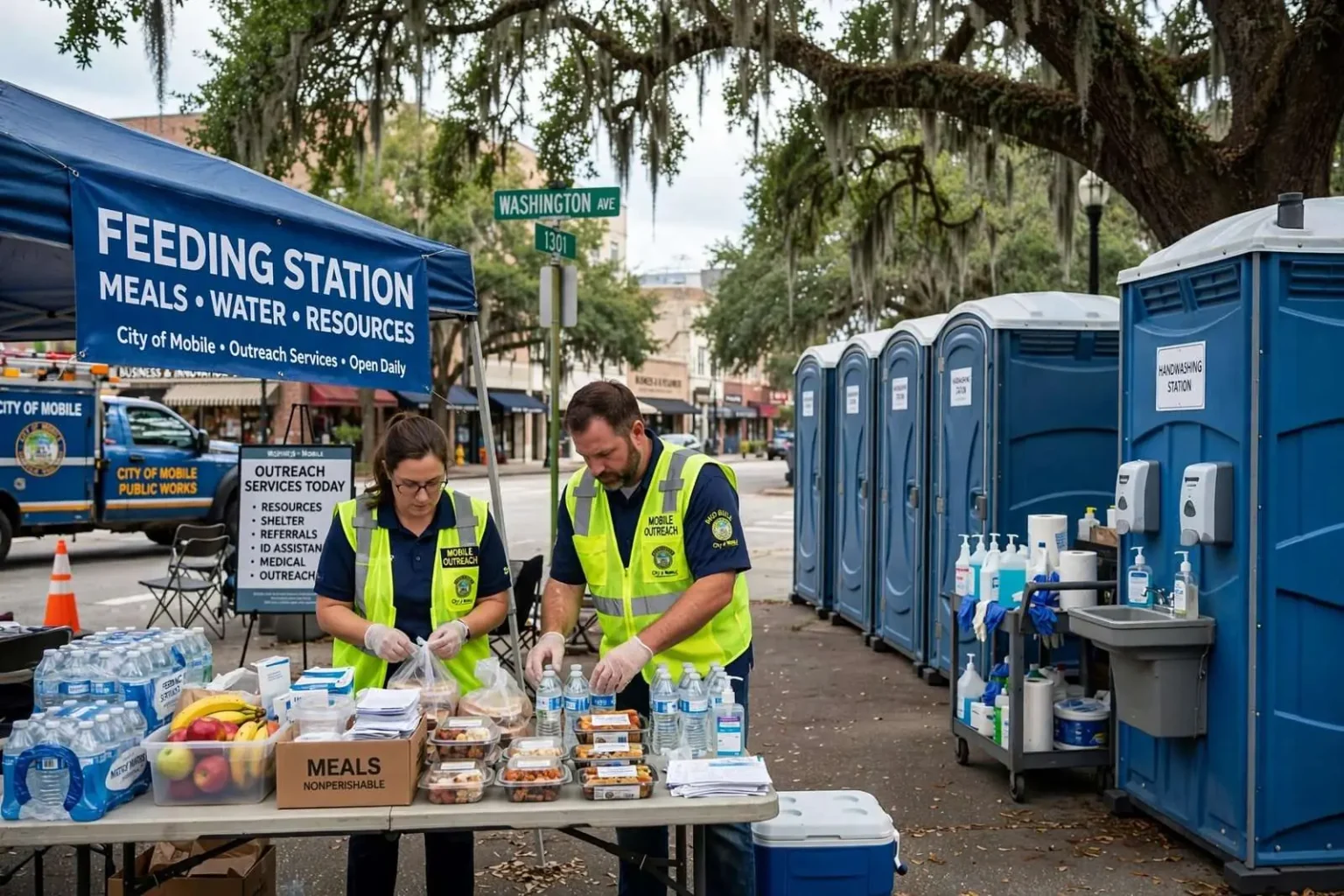
The City of Mobile is expanding its outreach to people experiencing homelessness, with Mayor Sandy Stimpson announcing that portable restrooms and feeding stations will be set up at locations across the city. Sites named for the effort include a location on Washington Avenue, Three Circle Church at Sage and Emogene, and the Business Innovation Center at 1301 Azalea Road. Stimpson said the installations should be in place within about a week of the announcement.
The announcement addressed a set of needs that city outreach workers encounter every day. People living unsheltered in Mobile face a daily scarcity of the basics that housed residents rarely think about — access to restrooms, places to wash, and reliable meals — and the lack of those basics shapes everything from public health to how unsheltered residents interact with the businesses and neighborhoods around them. By placing portable restrooms and feeding stations at fixed sites across the city, the city’s approach treats those needs as infrastructure, something to be provisioned deliberately rather than improvised.
The three named sites trace a deliberate geography. The Washington Avenue location sits near the downtown-adjacent neighborhoods where unsheltered populations have long concentrated, close to services and shelters. Three Circle Church at the corner of Sage and Emogene avenues anchors the midtown area, where churches and community organizations have historically filled gaps in services. And the Business Innovation Center on Azalea Road extends coverage westward, toward the commercial corridors where people living in cars and camps are less visible but no less present. Together, the sites give outreach workers and service providers touchpoints on the city’s east, center, and west sides.
Why restrooms and meals matter
Public health is the argument that has moved cities across the country toward this kind of provision. Without restrooms and handwashing, unsheltered residents have no practical way to manage basic hygiene, and the consequences surface in outbreaks of hepatitis A and other diseases that have hit homeless populations in cities across the United States in recent years. Health departments that studied those outbreaks converged on a straightforward conclusion: sanitation access is one of the most effective public health interventions available for unsheltered populations, and it costs far less than treating the illnesses that follow when it is absent.
Feeding stations serve a need that is as constant as it is basic. Mobile’s network of churches, soup kitchens, and nonprofits has long provided meals, but hunger does not confine itself to the hours and locations those providers can staff. Fixed feeding stations extend the map of where a person can eat, and they give outreach teams reliable places to find people — which matters because a meal site doubles as a contact point for services, ID replacement, shelter referrals, and medical outreach. The sites where people eat are, in practice, the sites where the pipeline from street to housing begins.
For housed residents and businesses, the installations answer a different concern. Cities that lack public restroom access push the burden onto parks, business restrooms, and parking decks, and complaints about public urination and defecation are a recurring flash point in downtown neighborhoods. Providing facilities gives the city a more humane and more workable answer than enforcement alone, and it acknowledges what municipal governments have learned repeatedly: sanitation infrastructure for unsheltered residents is also sanitation infrastructure for the city as a whole.
Mobile’s approach to homelessness
The Stimpson administration has made homelessness a visible policy focus in recent years, with the city’s work organized around coordinated outreach, shelter expansion, and the longer-term push to move people into permanent housing. Mobile’s continuum of care — the network of shelters, service providers, and housing programs that operates under federal frameworks — coordinates with city departments on outreach and data, and the portable restroom and feeding station initiative fits squarely within that model: meet immediate needs, build contact, and connect people to the services that end homelessness.
The geography of homelessness in Mobile shapes that work. Unsheltered residents concentrate near downtown and the medical district, along corridors where services and street life converge, and in camps tucked into wooded areas and under highway interchanges across the city. Encampment clearances, when the city conducts them, are now generally paired with outreach offers, reflecting both federal guidance and local practice — the understanding that moving people without offering somewhere to go simply relocates the problem. Fixed sites like the ones announced give outreach teams places to continue serving people after encampments are closed.
The mayor’s timeline — installations in place within about a week — reflects the operational character of the initiative. Portable restrooms can be ordered, delivered, and sited in days; feeding stations, depending on their form, may be as simple as a covered serving point staffed by the city or a partner organization. The week-scale timeline signals that the city regards the need as urgent, and it sets an expectation that residents will see the installations appearing at the named sites almost immediately.
What the sites will look like
The partners involved in operating the sites will bear much of the daily responsibility. Cities that run such programs successfully typically lean on organizations already doing street-level work, since those groups know where people are, what they need, and how to deliver services without judgment. Mobile’s network of providers — shelters, faith communities, and outreach nonprofits — has accumulated that knowledge over years of service, and the city’s decision to spread the sites across partner locations rather than a single downtown point reflects the value of that distributed capacity.
Portable restroom installations in city outreach programs typically include regular servicing — pumping, cleaning, and restocking — on a schedule that keeps them usable, along with handwashing stations or sanitizer dispensers beside them. Maintenance is the make-or-break variable: cities that install facilities without servicing them watch them become unusable within weeks, while programs that budget for routine upkeep keep them in service for years. The city’s announcement did not detail the servicing schedule, but the effort’s placement on city property and partner sites suggests a managed program rather than a one-time drop.
Feeding stations operate differently, and their design varies with the partner running them. A station can serve pre-packaged meals on a daily schedule, host rotating nonprofit providers, or function as a fixed point where mobile feeding trucks stop. Churches like Three Circle, which already sits at the intersection of faith-based service and neighborhood life, are natural hosts, and the Business Innovation Center site on Azalea Road gives the program a westside anchor near commercial areas where the unsheltered population is scattered rather than concentrated.
Siting decisions of this kind always balance need against neighborhood impact. Facilities for unsheltered residents draw concern from nearby businesses and homeowners, and cities that site them well — on properties with space, away from residential edges where possible, and with clear management — see fewer problems than cities that treat them as afterthoughts. The three announced sites span city-owned or partner properties across the city, a distribution that spreads both the service and its burdens rather than concentrating either in one neighborhood.
The larger picture
Restrooms and feeding stations do not end homelessness, and no one involved in the effort describes them as more than a first rung. The interventions that actually resolve homelessness are housing-focused — permanent supportive housing, rapid rehousing, and the rental assistance that keeps housed people housed. What sanitation and food access do is keep people alive and healthy while they wait for those interventions, and build the trust that brings someone from a camp or a car into a shelter bed or a housing program. Outreach workers describe that trust as the currency of their work, and fixed sites are where it accumulates.
Mobile’s effort also reflects a broader shift in how mid-sized Southern cities have approached unsheltered homelessness. The region’s warm climate, its stock of inexpensive older motels, and its position along interstate corridors make it a destination and a waypoint for people living unsheltered, and cities along the Gulf Coast have had to build responses with limited shelter capacity and stretched nonprofit networks. Provision of basic infrastructure — water, sanitation, food — has emerged across the South as a pragmatic layer beneath the housing work, driven by public health data and by the simple recognition that human needs do not pause while housing programs wait for funding.
The measure of the initiative will be visible quickly. Within a week of the announcement, the installations should be appearing on Washington Avenue, at Sage and Emogene, and on Azalea Road, and residents of those areas will see whether they are maintained, staffed, and used. For the city’s unsheltered residents, the arrival of restrooms and meals at fixed locations changes daily life in small but concrete ways — a place to wash, a reliable meal, a known point of contact with people who can help. For the city, it is a statement that outreach extends to the most basic needs, and that the path from the street to housing runs through places that treat people with dignity on the way.
The city said the sites would be in place within about a week of the mayor’s announcement, with the locations on Washington Avenue, at Three Circle Church on Sage and Emogene, and at the Business Innovation Center at 1301 Azalea Road.