
Mobile Venues Glow Red in National ‘Red Alert’ Protest for the Struggling Live Events Industry
Alabama Music Box, GulfQuest and other Mobile venues glowed red in a national Red Alert protest for the pandemic-devastated live events industry.
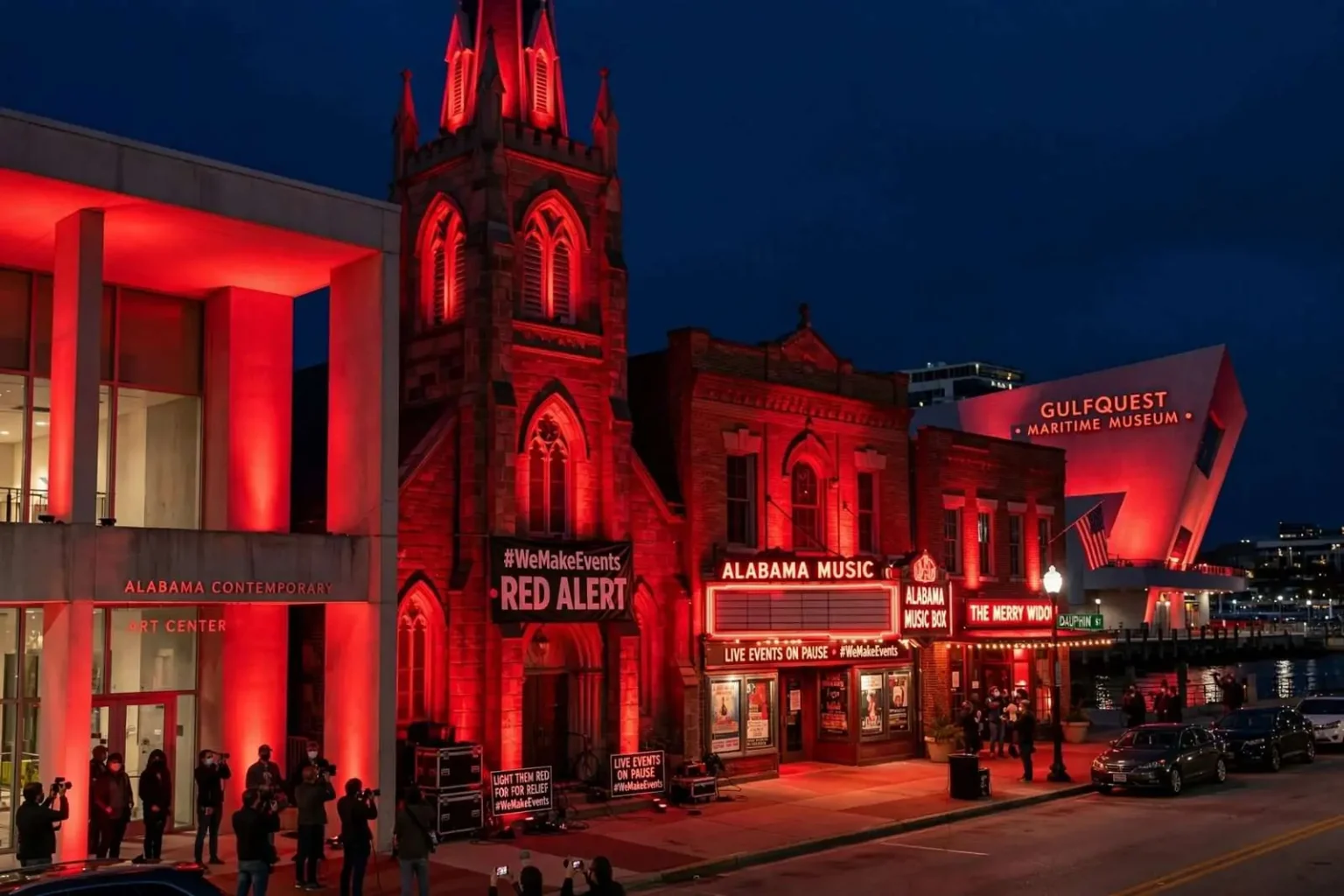
Downtown Mobile turned red Tuesday night as local venues joined a coast-to-coast lighting demonstration aimed at drawing attention to an industry fighting for survival during the coronavirus pandemic. The display was part of the #WeMakeEvents Red Alert campaign, a coordinated effort by production workers, venue operators, and performers to make visible — quite literally — an industry that was largely invisible in federal relief debates. Organizers timed the illumination for evening hours, when the red glow on marquees and building facades could be photographed, shared on social media, and carried into the next day’s news cycle.
Part of a 1,500-Building Nationwide Action
Mobile’s participants included the Alabama Contemporary Art Center, GulfQuest museum, The Steeple, Alabama Music Box, and The Merry Widow. They were among as many as 1,500 buildings across North America lit in red as part of the campaign, which organizers hoped would create pressure on Congress to deliver relief for entertainment workers and venues. The choice of red was deliberate: a universal signal of emergency, projected onto structures from concert halls to museums. Participating buildings posted the #WeMakeEvents hashtag and encouraged patrons to share photos, turning a single night of lighting into a nationwide rolling news event.
The North American action followed a similar day in the United Kingdom on August 11, when more than 700 buildings glowed red for the same cause. The British campaign drew attention to landmark venues and theaters and helped push government support programs into the headlines, and organizers replicated the playbook across the United States and Canada. In each city, the goal was the same: to remind legislators and the public that behind every dark stage is a workforce of technicians, designers, and service staff with no stage to return to. London’s Shard, theaters across the West End, and concert halls in Manchester and Glasgow all took part, giving the movement a transatlantic visual signature.
An Industry Nearly Shuttered
The stakes behind the lights were stark. Industry estimates put roughly 96 percent of live events workers — as many as 12 million people — out of work, furloughed, or down to a fraction of their normal income since concerts and events shut down in March of 2020. The world’s largest concert promoters reported revenue losses near 98 percent since the pandemic began, figures that dwarf the losses of most other sectors and that arrived with no clear reopening date. Unlike restaurants or retailers, live events businesses earned nothing during the shutdowns, yet still carried fixed costs: rent on venues, insurance, equipment payments, and payroll for core staff.
The live events economy is unusual in how broadly one shutdown ripples. A single concert supports not just the band but sound engineers, lighting designers, stagehands, truck drivers, riggers, security staff, bartenders, ticket takers, and parking attendants, most of whom are freelance or hourly workers with little access to savings or benefits. Federal programs including the Shuttered Venue Operators Grant — championed by senators from both parties — and extended pandemic unemployment benefits eventually targeted the sector, but advocates argued the aid moved too slowly to keep many venues and production companies solvent. Trade associations estimated that without intervention, a large share of independent venues across the country would not survive to see a reopening.
What It Means for Mobile’s Stages
For Mobile’s music halls and cultural venues, the campaign was a visible reminder that stages have stayed dark and crews, sound engineers, bartenders, and performers have had little to fall back on while gatherings remain limited. The city’s venues range from small clubs like Alabama Music Box and The Merry Widow, which anchor the local touring circuit for independent acts, to larger rooms like The Steeple, a converted church that hosts national touring artists. The Alabama Contemporary Art Center and GulfQuest represent the city’s cultural and museum sector, which has faced its own capacity limits and revenue shortfalls. Each relies on gatherings — shows, exhibits, rentals, and events — that the pandemic curtailed or canceled outright.
Local operators have said the pandemic forced cancellations of entire seasons of programming, and the loss of touring revenue extends beyond the venues to downtown restaurants and hotels that depend on event-night traffic. Mobile’s downtown revival over the past two decades has leaned heavily on entertainment — from Mardi Gras events to concert series — making the health of these businesses a broader economic question for the city. The effects reached freelance technicians and musicians who make their living show to show, some of whom left the industry entirely for jobs in other fields during the shutdown.
Organizers of the Red Alert campaign urged residents to contact their representatives in support of relief legislation and, where possible, to buy merchandise, gift cards, and tickets to future shows. The red glow over downtown faded at the end of the night, but the industry it highlighted remained waiting for the lights to come back on — and for audiences to return when they did.
The Red Alert campaign grew out of #WeMakeEvents, a coalition of entertainment industry organizations that formed in the early weeks of the pandemic to advocate for production workers who fell through the gaps of federal relief programs. Freelancers — who make up a large share of stagehands, engineers, and designers — initially struggled to qualify for unemployment benefits in many states, and early relief bills offered little for venue operators. The coalition’s leaders borrowed the language of emergency services deliberately: red lights, distress signals, and a warning that an entire skilled profession was at risk of dissolving if its practitioners had to find other work.
Why Venues Matter Beyond Show Nights
Venues function as small businesses with large footprints in local culture. A club like Alabama Music Box or The Merry Widow books dozens of acts a year, giving touring musicians a stop in Mobile on routes that run from New Orleans to the Florida Panhandle. Larger rooms like The Steeple bring national tours that draw audiences from across the central Gulf Coast. Museums and contemporary art spaces anchor the cultural calendar for schools and families. When these rooms go dark, the loss is measured not just in revenue but in the network of working relationships — sound engineers who trained on the job, bartenders who know the regulars, booking agents who plan regional tours around the stops that remain open.
The campaign’s organizers also emphasized the pipeline problem: live events skills are learned on the job, and an extended shutdown breaks the chain of apprenticeship that turns newcomers into experienced technicians. Industry groups warned that if a generation of stagehands and engineers left the field, the recovery would be slowed by a shortage of qualified crew even after demand returned. That argument — that the damage would outlast the pandemic itself — became a central theme of Red Alert messaging to Congress, alongside the raw numbers of unemployment within the sector.
In Mobile, as in other cities, the response to the Tuesday-night illumination was largely supportive, with patrons sharing photographs and venue operators thanking staff and audiences. Whether the demonstration would move Congress remained an open question that night, but organizers said the point was to make sure no lawmaker could claim ignorance of the industry’s condition. The buildings glowed red on a scale designed to be impossible to ignore — from the waterfront museums to the clubs on Dauphin Street — a single color, in a thousand places, standing in for millions of interrupted careers.
Mobile’s participation also connected the city to a broader Gulf Coast wave of Red Alert lighting. Venues in New Orleans, Pensacola, and along the Mississippi Gulf Coast joined the same night’s action, reflecting how intertwined the region’s entertainment economies are — booking circuits, sound companies, and crews that cross state lines for every job. A stagehand in Mobile might load a truck in Pensacola on Friday and mix sound in New Orleans the following week, so a shutdown of live events anywhere along the coast idled the same regional workforce everywhere along it.
The Road to Reopening
By late summer 2020, some venues had experimented with limited-capacity shows, livestreamed concerts, and outdoor events, but operators said the economics rarely worked at reduced attendance. A club that seats a few hundred people cannot break even at a quarter capacity when touring acts, crews, and fixed costs all expect full houses. Insurance exclusions for communicable diseases left venues bearing the full financial risk of any outbreak traced to their premises, another reason many chose to stay closed even where rules allowed partial reopening.
The Red Alert night closed with the same ask it opened with: federal relief sized to the actual collapse of the industry, extended unemployment support for freelancers, and a clear timeline for safe reopening. Organizers pointed to the Shuttered Venue Operators Grant, modeled on emergency economic injury programs, as the specific measure venues needed Congress to fund. For the workers standing outside the red-lit buildings on Dauphin Street and the waterfront, the hope was simpler — that the next time the lights came up in Alabama Music Box, The Steeple, or The Merry Widow, the crews who ran them would still be there to run them.


