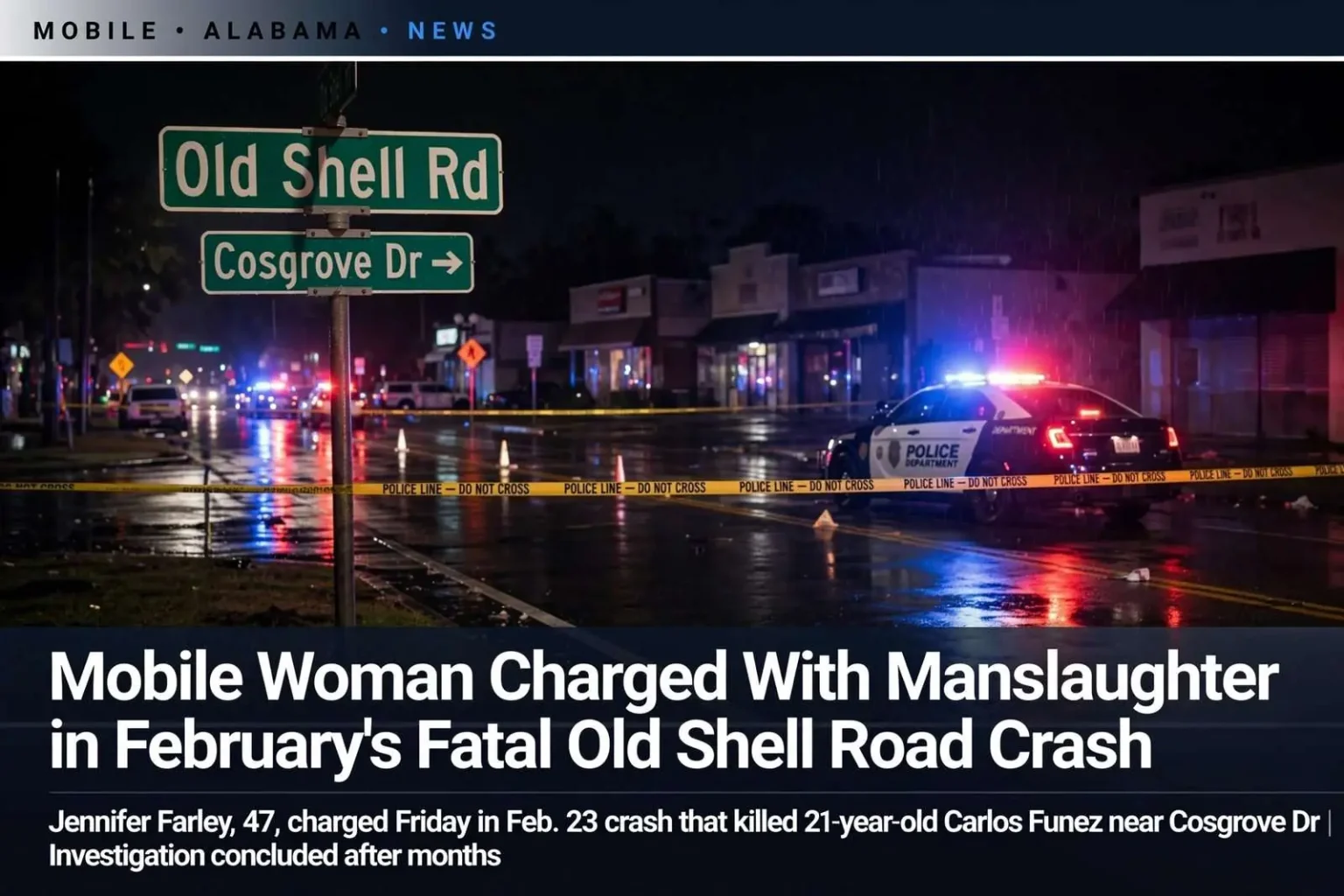
A Mobile woman has been charged with manslaughter in connection with a February crash that killed a 21-year-old man on Old Shell Road, according to police. Jennifer Farley, 47, was charged Friday, months after the fatal wreck, capping an investigation that spanned the better part of a season between the night of the crash and the day charges were filed. The announcement closed one chapter in a case that began in the early-morning darkness on one of west Mobile’s busiest corridors and left a young man dead beside his own vehicle.
Police said the crash occurred Feb. 23 near the intersection of Old Shell Road and Cosgrove Drive, a junction in the heart of the city’s western residential and commercial sprawl. Officers responded to the area around 3:15 a.m. after a vehicle struck 21-year-old Carlos Funez, who, according to police, was standing beside his own vehicle with its hazard lights on at the time. The scene, in the middle of the night on a wide thoroughfare, captured the kind of roadside danger that drivers rarely think about until it strikes: a disabled or stopped vehicle, its hazards blinking, and a motorist outside the car in the path of oncoming traffic.
Police said the vehicle that struck Funez was traveling westbound on Old Shell Road when the collision occurred. Funez died as a result of his injuries. The circumstances described by investigators, a pedestrian standing outside his own stopped vehicle in the pre-dawn hours, underscore how quickly ordinary roadside situations can turn fatal when a driver fails to see or stop for a person in the roadway, even one whose vehicle is signaling its presence.
The corridor where the crash happened
Old Shell Road is one of Mobile’s principal east-west arteries, carrying traffic through a corridor lined with homes, businesses, schools, and churches as it runs from the central city westward through expanding suburbs. The stretch near Cosgrove Drive sits in a section where the road carries substantial volumes of traffic at all hours, including late-night trips through a landscape of storefronts and residential side streets. Intersections along the corridor, like the one at Cosgrove Drive, mix through traffic with turning movements and driveway access, the kind of environment that demands constant attention from drivers, particularly in darkness.
Crashes involving pedestrians who are outside their own stopped vehicles are a recognized hazard on multi-lane roads across the country. A driver approaching at night may fixate on the vehicle ahead and fail to register a person standing beside it, or misjudge how much room remains in the travel lane. Emergency responders and highway safety organizations have long urged motorists whose vehicles become disabled to remain alert to traffic, stand clear of the roadway when possible, and make themselves visible, but the fundamental protection rests with approaching drivers, who must see and yield to people on or near the roadway.
The timing of the wreck, around 3:15 a.m. on a late-February night, added the additional risks that come with darkness and the reduced visibility of early-morning hours. Investigators in cases like this typically work to establish the full picture, including vehicle speeds, sight lines, lighting conditions, roadway evidence, and any factors involving the driver, before presenting findings to prosecutors for a charging decision. The months that elapsed between the February crash and Friday’s charge reflect that deliberate pace.
The charge filed against Farley, manslaughter, occupies a specific place in Alabama criminal law. Under Alabama statutes, manslaughter generally involves causing the death of another person recklessly, a standard that falls short of the intent required for murder but goes beyond ordinary accident. The offense is classified as a felony, and a conviction carries a potential prison sentence measured in years. Prosecutors weigh evidence gathered during the investigation, including the circumstances of the collision and any factors involving the driver, when deciding whether the facts of a fatal crash support the charge.
In addition to manslaughter, Farley faces charges of possession of a controlled substance, possession of drug paraphernalia, and driving with a suspended license, according to police. The additional counts indicate that investigators’ work extended beyond the mechanics of the collision itself to the condition and legal status of the driver involved. Driving on a suspended license is an offense that begins in traffic court but takes on heavier significance when it coincides with a fatal crash, while drug possession charges are typically filed based on what investigators allege was found in connection with an arrest. Each charge will be adjudicated on its own evidence as the case moves through the court system.
How fatal crash investigations unfold
The gap of months between a fatal crash and a charging decision is a familiar rhythm in cases like this one. In the hours and days after a wreck, police document the scene, photograph and measure the roadway, examine the vehicles, and interview witnesses. Laboratory work, including any toxicology testing, can take weeks or months to complete, and investigators often wait for those results before forming a complete account of what happened. Once the investigation file is assembled, it goes to prosecutors, who review the evidence against the elements of potential charges before authorizing an arrest or filing. Only then does the case become a matter of public charging documents rather than an open investigation.
For the family of the victim, that timeline can feel agonizing, but it exists to protect the integrity of the case. Evidence gathered methodically in the months after a crash forms the foundation of any prosecution, and premature conclusions drawn from an incomplete picture are precisely what the process is designed to avoid. The Friday charge against Farley, coming after that deliberate investigation, marked the point at which the case moved from the investigation phase into the courts.
Farley remains in Mobile County Metro Jail, the downtown Mobile facility that serves as the primary detention center for people arrested in the city and booked into county custody. The jail processes thousands of bookings each year, holding defendants awaiting trial, arraignment, or transfer to state custody. Her status in custody pending the resolution of the charges reflects the seriousness with which the system treats a manslaughter allegation arising from a fatal crash.
As with any pending case, the charges against Farley are accusations, and she is presumed innocent unless and until proven guilty in court. The manslaughter count and the additional charges will be tested through the criminal process, where prosecutors must prove their case beyond a reasonable doubt and the defense will have every opportunity to challenge the evidence.
Behind the legal process, the crash on Old Shell Road stands as a reminder of the human cost of roadside collisions. Carlos Funez was 21 years old, standing beside his own vehicle with its hazard lights on when he was struck and killed. Whatever brought him to the roadside in the early hours of Feb. 23, the circumstances described by police, a young man outside a stopped and signaling vehicle, are ones that drivers everywhere should register the next time they approach a car stopped on the shoulder or in a travel lane at night. The vehicle’s flashing lights mark exactly the spot where a person may be standing, and approaching drivers bear the responsibility of slowing down, moving over when possible, and looking for people, not just machines.
Safety advocates have pressed for years to make that lesson standard practice. Many states have enacted move-over laws requiring drivers to change lanes or slow down when passing stopped emergency and service vehicles with flashing lights, and the principle extends to any stopped vehicle: a hazard flasher on the roadside may signal a driver changing a tire, checking an engine, or waiting for help, often just out of sight of the driver behind. On corridors like Old Shell Road, where traffic volumes stay high around the clock, the few seconds a driver spends giving a stopped vehicle a wide berth can be the difference between a close call and a tragedy.
What happens next in the case
With charges filed and Farley in custody at Mobile County Metro Jail, the case now enters the court system, where an initial appearance and subsequent proceedings will set the schedule for the litigation ahead. Prosecutors will present the evidence gathered in the months since the crash, and the defense will respond through the ordinary machinery of pretrial motions, hearings, and, if the case proceeds, trial. Each of the four charges, manslaughter, possession of a controlled substance, possession of drug paraphernalia, and driving with a suspended license, carries its own elements and its own potential penalties, and the outcomes are determined case by case.
For the community along Old Shell Road, the resolution of the investigation answers some questions while leaving others to the courts. What remains fixed is the sequence of events police described: a Feb. 23 crash near Cosgrove Drive, a 21-year-old man struck while standing beside his own vehicle with its hazard lights on, a westbound vehicle that failed to avoid him, and a death that followed from his injuries. The Friday charge brought the case into the open after months of investigation, and the courts will now determine what the evidence supports.
The case also joins the long ledger of fatal crashes on Mobile’s arterial roads, each of which leaves behind a family, a neighborhood, and a corridor of drivers who pass the intersection where it happened. The charges filed Friday, serious as they are, cannot restore what was lost on that February night, but they represent the system’s answer to the question of who bears responsibility for the death of Carlos Funez, and the process that answer sets in motion will run its course in the months ahead in Mobile County’s courtrooms.