Mobile’s Animal Ordinance Gets a Makeover After Pet Owners Push Back: ‘They Listened’
After weeks of community feedback, Mobile's proposed animal ordinance drops breed-specific rules in favor of behavior-based standards — and even loses the ferret clause.
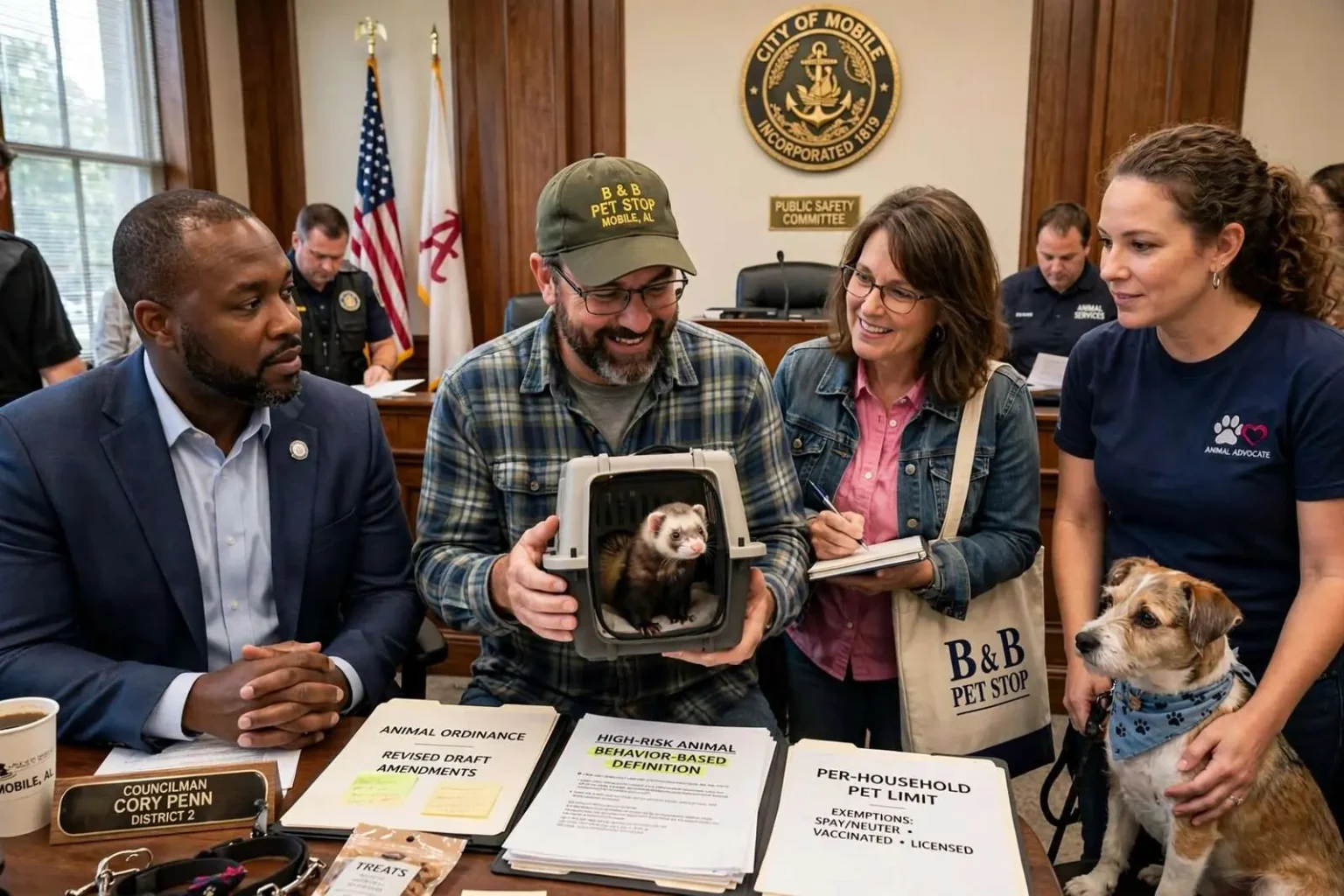
A proposed overhaul of Mobile’s animal ordinance looks far different than it did a few weeks ago — and pet owners, animal advocates and local business owners are claiming credit. After weeks of emails, phone calls and public comments, the Mobile City Council’s Public Safety Committee worked through a stack of amendments Tuesday that soften some of the proposal’s most controversial language.
“We sent it to committee and we got feedback from the community,” said Councilman Cory Penn. “They sent emails, they came down and they expressed their concerns, and by doing that we were able to create those changes.” Penn, whose district includes parts of west Mobile and who has been a leading voice on the ordinance’s review, said the willingness of residents to show up and speak shaped nearly every line item the committee revisited.
The ‘High-Risk Animal’ Redefinition
Among those who spoke up were the owners of B & B Pet Stop, the long-running Mobile pet store. Bill Trufant said his family supported much of the ordinance but believed some original definitions were so broad they could accidentally turn responsible owners into violators.
“The biggest thing was we didn’t agree with some of the language, particularly some of the definitions,” Trufant said. “When they started being so broad and basically covering every animal in the world, literally, it just didn’t make any sense.” The Trufant family has run B & B Pet Stop in Mobile for decades and frequently fields customer questions about local animal rules, making them a natural sounding board when new regulations are proposed.
The biggest change: the definition of a “high-risk animal.” The original version listed specific dog breeds — a list Animal Services officials said was borrowed from breeds commonly restricted by homeowners insurance policies. Under the amended language discussed Tuesday, the designation would instead apply to an individual animal with a prior unprovoked bite or attack on a person or another animal — a behavior-based standard rather than a breed-based one.
Trufant said the old broad definition had even worried owners of birds and reptiles: “You wouldn’t be able to take your bird out of your cage. You wouldn’t be able to hold your snake.” That kind of unintended reach, he argued, was precisely the opposite of what an animal ordinance should be doing.
How Many Pets Is Too Many?
City leaders also clarified the proposal’s limits on the number of animals per household. Animal Services officials said the caps were meant as a tool against hoarding, neglect and nuisance cases — not a way to force responsible owners to give up well-cared-for pets. The amended version would exempt households from the limit if they meet requirements including spaying or neutering, current rabies vaccinations, required city licenses, and no public nuisance or unsanitary conditions.
Officials stressed that bringing more animals into the city shelter is the last thing they want; the first response to an over-limit home would be to work with the owner to fix problems before any punitive action.
Even the Ferret Made News
The collaborative spirit produced a moment of levity: after questioning whether ferrets truly belonged in the high-risk definition, council members struck them from the language. “All right, ferret is out,” one council member said as the room laughed. The exchange offered a small reminder that writing a workable city ordinance is often as much about practical definitions as it is about public safety goals.
“We started getting with these guys and telling them, suggesting other ways to phrase things,” Trufant said. “And interestingly enough, they did. They listened. They fixed everything.” For Trufant and other local pet store operators, the experience reinforced the value of showing up at Mobile City Hall when big-picture animal policies are being debated.
What’s Next
The amended ordinance could appear on the City Council agenda as early as next Tuesday, though members stressed they won’t rush a vote if the final language needs more review. Penn said he believes the sides are now largely aligned: “They sent their request in, they shared their concerns and even today we created some changes. I think we’ll be ready to go.”
Why a Modern Animal Ordinance Matters
Mobile’s existing animal ordinance dates back decades and has been updated piecemeal over the years, leaving gaps that animal welfare advocates, law enforcement and city prosecutors have long asked the council to address. A wholesale rewrite gives Mobile a chance to align local rules with modern best practices for shelter operations, dangerous dog hearings, spay and neuter programs and public safety responses to animal-related incidents.
What the Behavior-Based Approach Changes
Shifting from a breed-based to a behavior-based definition of “high-risk animal” reflects a wider shift in animal policy across many U.S. cities, which have found that breed-specific rules are difficult to enforce fairly and often miss the actual causes of serious incidents. Instead, modern ordinances focus on documented behavior, training, secure containment and owner responsibility — factors that can be evaluated case by case rather than assumed based on appearance.
For Mobile’s Animal Services staff, that change is expected to streamline dangerous animal hearings, which currently require evidence about a specific incident rather than assumptions about an animal’s breed. It also gives officers a clearer path to follow when responding to complaints about a particular pet, while leaving everyday owners free from worry that their family dog could be classified based solely on how it looks.
Limits, Exemptions and Hoarding Concerns
The per-household cap on animals is a more sensitive part of the ordinance because it cuts to a long-running concern in Mobile: pet hoarding. Animal Services has handled a number of large-scale hoarding cases in recent years, often involving dozens of animals living in unsanitary conditions and requiring weeks of recovery and rehoming. The exemption for households that keep up with vaccinations, licensing and spay or neuter procedures is intended to make clear that the cap targets neglect, not responsible multi-pet families.
Officials said they expect the revised wording to also clarify what counts as a public nuisance, giving the city a more consistent framework for responding to complaints about barking, waste or unrestrained animals. The committee reviewed that section line by line on Tuesday to make sure the standards were easy for both officers and residents to understand.
Local Businesses and the Broader Pet Community
Mobile’s pet community is broader than just pet owners. The city is home to multiple long-established pet retailers, veterinary clinics, grooming shops, boarding facilities and rescue groups that interact with animal rules every day. Several of those businesses raised concerns during the public comment period and submitted suggested language changes to the committee.
Penn and other council members have signaled they expect the final ordinance to strike a workable balance that keeps dangerous animals off the streets, protects animal welfare and respects the many responsible Mobile households and businesses that care for pets. They have also indicated they are open to additional technical adjustments before the final vote, particularly if any unintended consequences surface as the language is reviewed again.
Mobile’s Animal Services and the Road Ahead
Mobile’s Animal Services division operates the city’s open-admission shelter and fields animal-related calls across Mobile County’s largest population center. Officers respond to reports of stray animals, neglect, dangerous dog incidents and bite cases, and they partner with rescue groups that pull adoptable pets from the shelter. A modern ordinance gives the division clearer authority to manage chronic problem cases while avoiding the kind of over-broad language that earlier drafts had drawn criticism for.
For residents who want to weigh in before a final vote, council meetings are open to the public and include a designated public comment period at the start of each regular session. Pet owners, veterinarians, rescue volunteers and anyone with a stake in Mobile’s animal welfare system can sign up to speak or simply attend to follow the discussion. Several local rescue groups have also set up email alerts so supporters know exactly when animal-related items are scheduled for a council vote.
A Push and Pull Years in the Making
The rewrite has been years in the making, with successive councils taking up parts of the ordinance while leaving other sections untouched. Animal welfare advocates have argued for a comprehensive overhaul to address everything from tethering rules to the sale of animals in retail settings, while industry voices like B & B Pet Stop have asked the council to be careful not to criminalize the everyday work of pet owners and the small businesses that serve them.
Tuesday’s committee meeting suggested both sides were able to find common ground, and the willingness of council members to make line-by-line changes appears to have eased some of the concerns raised by the pet community. Penn said he expects the council to take up the amended ordinance on the agenda as soon as next week, though members are prepared to delay a final vote if more cleanup is needed.
Animal Services Director Robert Bryant walked the committee through the specific revisions his office made after the public feedback. The breed list that defined “high-risk animals” in the original draft is gone, he said, and so is the phrase “exotic animals,” which the new draft replaces with a narrower list: monkeys, snakes, ferrets, and any poisonous or venomous animal. The definition otherwise turns on behavior — any animal with a history of biting a person or another animal without provocation.
The restraint language was also clarified to spell out that an animal inside a building is considered properly restrained, a change made after residents questioned whether the original wording meant a pet could not roam its owner’s own house. Bryant said the intent was never to require animals to be caged indoors.
The provision aimed at hoarding was rewritten as well. The old draft discouraged more than five dogs or five cats on parcels smaller than half an acre. Under the new language, owners of multiple cats and dogs are exempt from that section as long as every animal is spayed or neutered, has current vaccinations, and is either microchipped or licensed by the city.
Anna Bush, a District 2 resident who previously spoke against the ordinance, told the committee she was pleased the city listened. “It’s encouraging the responsible pet ownership we really want without being a bludgeon,” Bush said.
Sally Truffant, who owns B&B Pet Stop with her brother Bill, said the city removed most of the language the store had objected to — but she pushed back on one remaining detail. “Ferrets are no risk,” she said. “I would be more worried about a cat bite than a ferret bite.” Bill Truffant commended the revisions and asked the council to add pet stores to the ordinance’s list of entities that can help citizens adopt animals, to ensure full coverage. Councilors said they would fold the Truffants’ suggestions into the updated ordinance, which could come up for a final vote in the coming weeks.
How the fight started
The overhaul has been contentious from the moment it was introduced in late July, when the council took up a revised version of the city’s longstanding pet rules that raised fines for violations to between $100 and $500 — covering everything from failing to pick up pet waste to allowing an animal to run at large. The original draft drew immediate criticism at the council’s Aug. 4 meeting, when District 2 resident Anna Bush pressed members on the definition of “high risk animals,” which lumped doberman pinschers, pit bulls and wolf dogs into a restricted category alongside nondomesticated animals.
“Risk belongs in the realm of underwriting, not legislation,” Bush told the council. “This is absurdly arbitrary and doesn’t address dogs that are actually dangerous.” She urged the city to prioritize spaying and neutering instead, arguing that step would resolve many animal control issues at the source. B&B Pet Stop owner Bill Truffant, whose family business has operated in Mobile for decades, said the proposal contained good provisions but criticized the “overly broad definition of ‘high risk animal'” — noting that the undefined term “exotic species” and the phrase “nondomesticated cat or animal” could sweep in virtually every species on the planet, and asking how, exactly, an owner would tether a snake.
District 7 Councilwoman Gina Gregory, the council’s vice president, said at the time that members had received a steady stream of constituent emails about breeds, aggressive dogs and animal limits, and that the public deserved a fuller explanation of how the administration arrived at the proposal. “We need to take a look at those and allow the administration an opportunity to explain better how we arrived where we are,” Gregory said.