
Mobile’s Indian Community Celebrates Holi at Chickasabogue Park
The India Association of Greater Mobile celebrated Holi with colors, pakoras and games at Chickasabogue Park in March 2011.
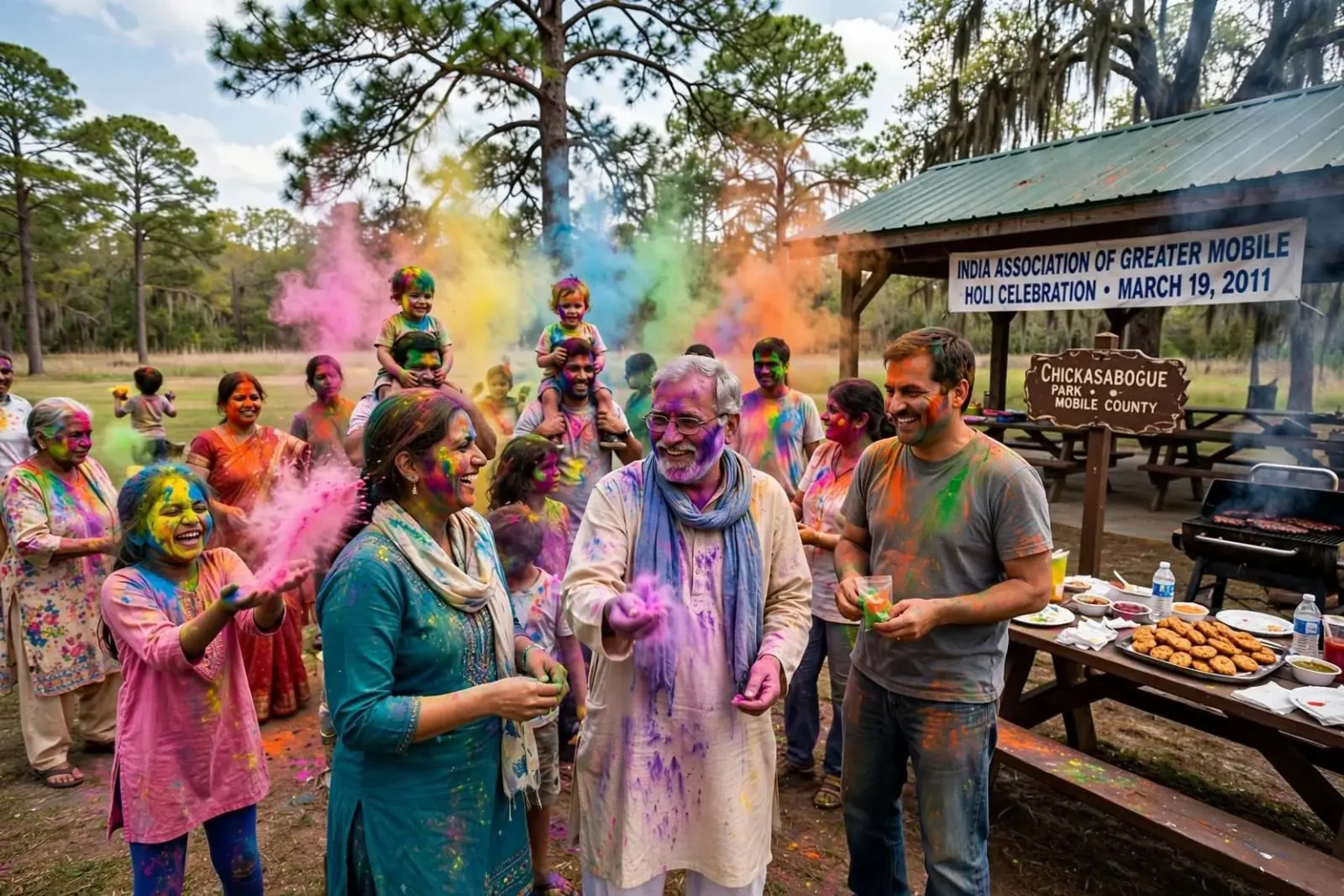
MOBILE, Ala. — The India Association of Greater Mobile brought the Hindu festival of colors to Chickasabogue Park on Saturday, March 19, 2011, hosting its annual Holi celebration from 11 a.m. to 2 p.m. The park’s picnic grounds filled with families from across the Mobile area — longtime members of the Gulf Coast’s Indian community alongside curious newcomers — for an afternoon of color throwing, food and games that has become one of the association’s signature events on the spring calendar. By midday, the crowd at the Mobile County park wore every color of the rainbow, the visible result of a ritual that turns strangers into conspirators within minutes.
The association supplied the holi colors for the traditional powder-throwing, ensuring everyone from the smallest children to the most dignified elders got drawn into the fun. The gathering doubled as a cookout, with pakoras off the grill alongside barbecue — a menu that stitched together the flavors of the subcontinent with the cookout traditions of the American South. Alongside the food came a full slate of games for attendees of all ages, keeping the park’s open spaces busy with contests and laughter through the three-hour celebration.
The annual event serves as much as a community gathering as a religious observance. For the Indian families who have made their homes across the Mobile area — drawn by the region’s hospitals, universities, shipbuilding and industry — gatherings like Holi weave the community’s cultural threads tighter, giving children born on the Gulf Coast a direct experience of the festivals their parents and grandparents grew up with, and giving neighbors of other backgrounds a warm introduction to one of the world’s most joyful holidays.
The Story Behind the Colors
Holi is a spring religious festival celebrated by Hindus worldwide, also known in Sanskrit as Dhuli Vandana. The signature ritual is joyful abandon: celebrants douse one another in colored powder and colored water, erasing social boundaries for a day. On Holi, the usual gradations of age, class and status dissolve in clouds of gulal — the vividly dyed powder that gives the festival its English nickname — as everyone in the crowd becomes fair game for a splash of color. The leveling effect is the point: a festival in which the whole community, regardless of who they are the other 364 days of the year, celebrates together in the same rainbow of hues.
The festival’s roots reach deep into Hindu tradition. Bonfires are traditionally lit the night before Holi, recalling the young devotee Prahlad’s miraculous escape after the demoness Holika carried him into a fire. In the story, Holika — the sister of the demon king Hiranyakashipu, who demanded worship as a god — possessed a boon that fire could not harm her, and she used it to attempt the destruction of Prahlad, whose crime was his unshakable devotion to Vishnu. Seated on her lap in the flames, the boy emerged unharmed while Holika was consumed, protected by his faith.
The Holika Dahan bonfire — burned on the eve of Holi across India and in Hindu communities worldwide — commemorates that victory of devotion over arrogance, of good over evil. When the sun rises the next day, the somber ritual gives way to the celebration: the color throwing, the sweets, the music and the visiting of friends and relatives that make Holi the most carnival-like of the Hindu calendar’s festivals.
A Festival Timed to the Moon
The holiday falls on the last full moon day of the lunar month of Phalguna, landing in late February or March at winter’s end. The timing is no accident: Holi marks the seasonal turn from winter to spring, a celebration of the end of cold and scarcity and the beginning of the growing season. In India, the festival’s regional variations run from the massive street celebrations of the north to the tradition-bound observances of temple towns, but everywhere the theme is the same — the world made new, in color.
That springtime symbolism travels well. On the Gulf Coast, where late March already carries the greens and blooms of an early spring, Holi’s arrival feels less like hope than confirmation. The India Association of Greater Mobile’s decision to hold the celebration outdoors at Chickasabogue Park — rather than in a rented hall — connected the festival to the season it marks, with the park’s open fields giving the powder-throwing room to roam and the picnic setting matching the communal meals that anchor Holi celebrations in India.
The date also matters practically for the local community. A Saturday afternoon event, running 11 a.m. to 2 p.m., made the celebration accessible to families with young children and to members driving in from across the region — from Mobile and Baldwin County and the Mississippi Gulf Coast — for a celebration that has become a fixture of the association’s annual calendar alongside its Diwali and other cultural events.
Colors, Cookouts and Community at Chickasabogue
Chickasabogue Park, the Mobile County park spread across more than 700 acres of woods and wetlands near Eight Mile, provided the backdrop. The park’s trails, lake and picnic facilities make it a favorite for family reunions and community gatherings, and its sheltered picnic areas gave the Holi celebration a home base while the surrounding fields absorbed the clouds of color. The park’s natural setting — longleaf pines, bayous and the bogue that gives it a name — framed an afternoon that felt less like an organized event than a sprawling family reunion, which is precisely the spirit the festival calls for.
The food line told the story of the community itself. Pakoras — the crisp, spiced vegetable fritters that are a staple of Indian street food — came off the grill beside barbecue, the Gulf Coast’s own contribution to the afternoon’s table. The pairing reflected the hybrid identity of a community celebration held in Alabama: traditions carried from home, traditions adopted from the new one, and the shared understanding that a festival is measured by what it feeds people. The games that followed — organized contests for children, casual competitions for everyone else — kept the park’s fields busy through the afternoon’s final hours.
For attendees experiencing Holi for the first time, the association’s members served as guides — explaining the story of Prahlad and Holika behind the bonfire tradition, demonstrating the etiquette of the powder-throwing, and ensuring that no newcomer left the park without a generous coat of color. The welcoming atmosphere is deliberate: the association has long used its public celebrations to build bridges with the wider Mobile community, and Holi — with its built-in spectacle and its message of shared joy — is the ideal ambassador.
The Growing Indian Community on the Gulf Coast
The India Association of Greater Mobile’s annual Holi celebration reflects the growth and roots of the Indian community across the greater Mobile area. Indian families have settled along the Gulf Coast over recent decades, drawn by the region’s medical community, universities, engineering firms, shipbuilding and chemical industries, and by the same Gulf Coast qualities that attract newcomers of every background. With that growth has come an institutional fabric — cultural associations, places of worship, language schools and student groups — that keeps traditions alive in the second and third generations.
Events like the Chickasabogue Park celebration do the work of that fabric. A child who throws colored powder at a park in Eight Mile is participating in a ritual their grandparents observed thousands of miles away, on streets where the whole neighborhood turns out for the festival. The association’s supply of colors, its organization of games and food, and its insistence on welcoming newcomers are the mechanisms by which a tradition survives transplantation — adapted to a picnic shelter instead of a village square, a barbecue grill beside the pakoras, but the same abandon underneath.
The celebration also adds a thread to the broader cultural tapestry of Mobile, a city whose identity has always been layered — French, Spanish, British, African, Caribbean, Catholic, Carnival. A Hindu festival of colors unfolding in a Mobile County park fits naturally into a city that has spent three centuries absorbing traditions from around the world and making them its own.
Until Next Spring
By 2 p.m. Saturday, the crowd had thinned and the park’s picnic areas settled back into their usual quiet, the evidence of the afternoon’s celebration still visible on every face and shirt that headed for the parking lot. The annual celebration had done what it always does: marked the turn of the season, told the old story of Prahlad and the fire, fed the community from two culinary traditions at once, and covered an Alabama park in the colors of a spring festival half a world away.
The India Association of Greater Mobile will carry the tradition forward, as it has each year — the next Holi falling, as always, with the last full moon of Phalguna at winter’s end. For the families who attended the 2011 celebration, and for the newcomers who stumbled onto a rainbow in the park, the afternoon at Chickasabogue offered a simple, accurate picture of what Holi means wherever it is celebrated: the social boundaries erased, the old grievances forgiven in the spirit of the day, and a community — however far from its origins — laughing together in the sun.


