
Mobile’s Only Satanist Coven Calls It Quits This Halloween
After seven years and 28 members, the Black Coven of Sathanas — Mobile's only organized Satanist group — dissolves this Halloween.
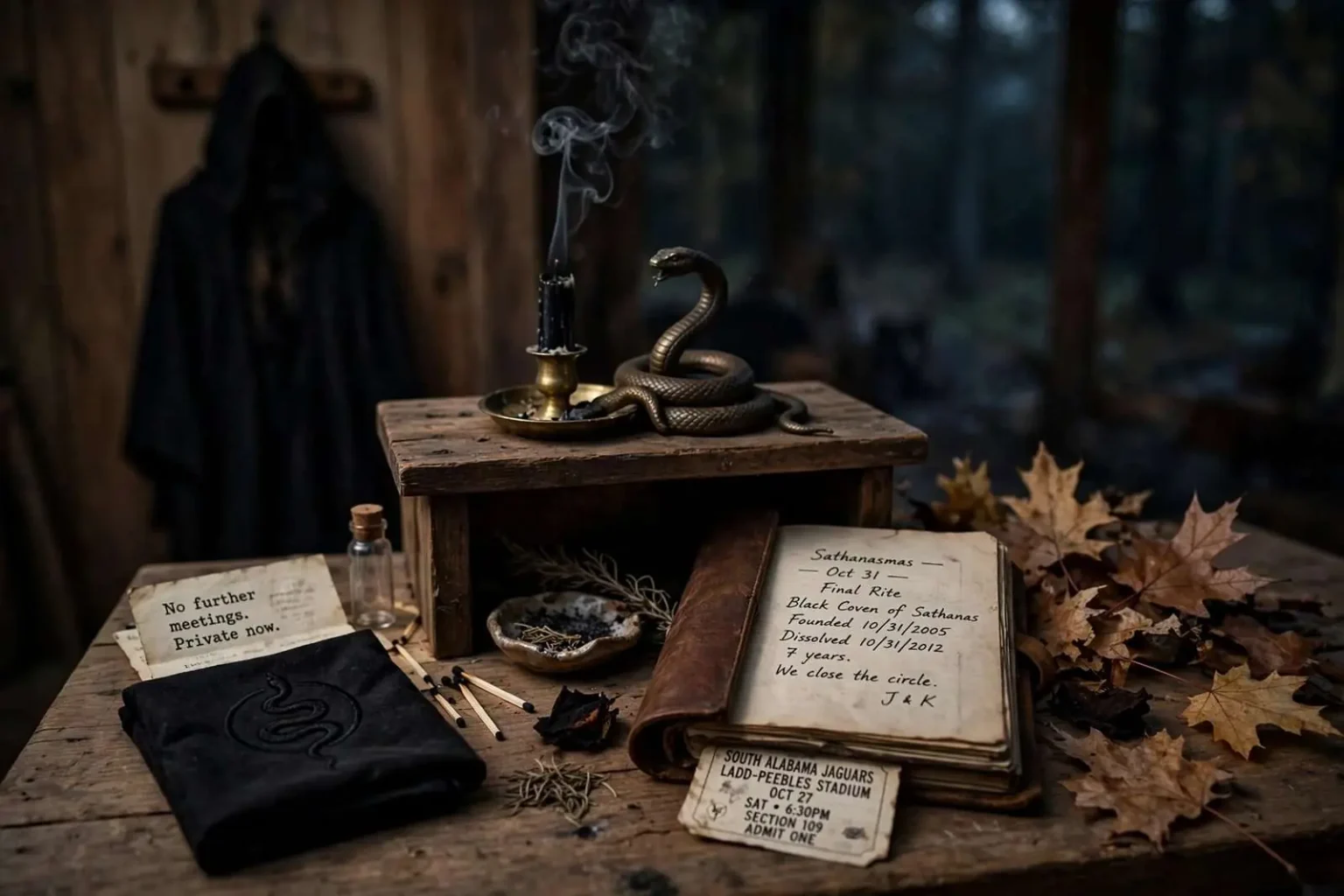
After seven years, the Black Coven of Sathanas — to the best of local knowledge the only organized Satanist group in Mobile — will officially dissolve this Halloween, a date its members marked as their high holiday, “Sathanasmas.”
The coven’s founder, identified here by the pseudonym Joe K at his request, says twenty-eight members passed through the group since its founding on October 31, 2005. Schisms driven mostly by personal differences steadily drained the rolls until all that remained were Joe, his wife Katrina and one occasional participant. He jokes that football season didn’t help Saturday attendance either — a small grievance in a college football town, where autumn Saturdays belong to the Crimson Tide, the Auburn Tigers and the South Alabama Jaguars, not to candlelit rites.
The group’s passing marks the end of an unusual chapter in Mobile’s religious landscape — a port city better known for its Mardi Gras traditions, its historic churches, and its deep Catholic roots than for occult congregations. Organized Satanism of the structured, small-group variety has always been rare in the Deep South, and Mobile’s coven operated for its entire existence without public meeting places, public identities, or any of the visibility that larger groups in major cities sometimes court.
An unlikely spiritual lineage
Joe traces his path from a strict Christian childhood through agnosticism to The Satanic Bible, Anton LaVey’s 1969 blend of ritual and philosophy, which he picked up expecting lark reading and found instead a worldview that stuck.
LaVey’s book, published the same year he founded the Church of Satan in San Francisco, reframed the figure of Satan as a symbol of individualism, skepticism, and indulgence rather than a being to be worshipped. It became the founding text of modern religious Satanism and, over the following decades, spawned both a widespread literary following and a scattering of groups that took its ideas in different directions — some retaining LaVey’s atheism, others building literal theistic devotions around the figure his book was named for.
When Joe formed his own group, he modeled it not on LaVey’s church but on an older and far more obscure ancestor: the Our Lady of Endor Coven of the Ophite Cultus Sathanas, widely considered the first American Satanist group, founded in the 1940s by Herbert Sloane, a retired barber in Toledo, Ohio.
“The kind of coven leader I wanted to be,” Joe says of Sloane. “Not a LaVey, not Crowley, but just a nice, friendly, neighborhood Devil Worshipper.”
Sloane’s group occupies a peculiar place in the history of American occultism. Long before the 1960s counterculture made Satanism a household phrase, the Toledo coven was practicing its own synthesis of Ophite Gnosticism — the ancient current that revered the serpent of Eden — with devotional worship of Satan as the serpent. Little documentation of the group survives beyond the recollections of those who visited Sloane’s home and the scattered mentions in occult histories, which is precisely the small, unpretentious scale that Joe says he admired.
What the coven actually believed
In practice, members describe their reverence as directed toward the serpent of the Eden story — the giver of knowledge and free will — rather than a literal devil. That distinction places the Mobile group in the Ophite lineage it claimed: in the Gnostic reading of Genesis, the serpent’s promise that eating the fruit would open human eyes is treated not as humanity’s fall but as its liberation, the moment people gained the knowledge and autonomy the story’s authorities wanted withheld.
Their closest thing to a central tenet borrows from Aleister Crowley: “Do what thou wilt shall be the whole of the law,” understood to mean that harming others separates a person from their own true purpose.
The Crowley maxim, from the early 20th-century occultist’s Thelema, is often caricatured as a license for selfishness, but the coven’s interpretation ran the opposite direction. Members read “wilt” as the authentic purpose of a person’s life — something deeper than appetite — and held that cruelty, deception, and harm to others are precisely what pull a person off the path toward it. It is a reading common among small devotional groups that borrow Thelemic language while rejecting Crowley’s personality and excesses.
Ritually, the group kept to a scale its founder considered appropriate: home altars, seasonal observances built around Halloween as the high holiday, and private rites rather than public ceremonies. The coven never sought tax-exempt church status, never incorporated, and never appeared on any register of religious organizations — a deliberate anonymity that shaped both its privacy and, members say, its eventual isolation.
Why it ended
Joe is candid about the group’s troubles. Early years ran too formal, with an initiate hierarchy and required coursework; later, run-ins with self-styled Satanists he considers cranks and even a white-supremacist sister coven soured him on recruitment.
The formality problem is a familiar failure mode for small occult groups. Degrees, tests, and curricula borrowed from lodges and esoteric orders can give a new group structure, but they also create gatekeeping, resentment, and departures — and in a group of a dozen or two members, each departure is a measurable loss. By Joe’s account, the coven’s most durable years came after it shed the hierarchy and treated membership as association among equals.
Scholars of new religious movements have long noted that such groups rarely dissolve because members stop believing. The burning questions are practical: who leads, who hosts, who does the unglamorous work, and whether the interpersonal cost of belonging outweighs what the group provides. In a tradition with no central authority, no funding stream, and no institutional memory beyond its members, each conflict risks becoming final. The Black Coven’s trajectory — founding enthusiasm, early formalism, mid-life schisms, and a final contraction back to the founding family — tracks the classic lifecycle almost exactly.
Saturday scheduling, the subject of Joe’s football-season joke, was more consequential than it sounds. Weekend evening observances competed against family obligations, second jobs, and — each fall — a regional devotion to college football that functions with the regularity of a liturgical calendar. For a group whose members needed anonymity, discretion, and dependability, missing the high holiday weekends of autumn was a recurring, structural strain.
The recruitment problems cut deeper. The internet age made it easy for anyone to claim the Satanist label, and Joe says the coven encountered self-styled practitioners whose behavior — in his account, grandiosity, instability, and simple crankery — made association a liability. Worse, the group at one point drew attention from a white-supremacist coven claiming kinship, an encounter Joe describes as the moment he understood how badly the public label of “Satanist” could be misused, and how important it was for a small group to control who entered its circle. The experience soured him on recruitment entirely; rather than court new members, the coven let attrition take its course.
That attrition followed a pattern recognizable to anyone who has studied small religious movements: schisms over personality rather than doctrine. Of the twenty-eight people who passed through the Black Coven of Sathanas over seven years, the departures Joe describes were driven by interpersonal conflicts, competing ambitions, and the ordinary frictions of close association — not by disputes over belief. What remained at the end was the founder’s own household, plus one occasional participant.
A quiet end rather than a collapse
Rather than keep up a shell organization, he and his family will observe their rites privately from now on — this Halloween with a holiday dinner and, in keeping with tradition, offerings left at their home altar.
That is a common ending for covens: the formal structure dissolves, but the practice continues at household scale. Joe frames the decision as honesty rather than defeat — an organization of three, meeting occasionally around football schedules, was no longer a coven in any meaningful sense, and pretending otherwise would have been a shell maintained for its name. The high holiday itself will continue, since the observance never depended on the organization’s existence.
For Mobile’s broader religious community, the coven’s dissolution will pass without ceremony — which is how the group operated throughout. Its founder’s account, offered under a pseudonym, describes a tiny subculture that most residents never knew existed: a group that traced its ideas through a 1969 San Francisco church back to a 1940s Toledo barber, read Genesis through Gnostic eyes, kept Crowley’s law with an ethic attached, and lasted seven years on Mobile’s religious margins before the ordinary gravitational pulls of personality and privacy drew it closed. The names in this story were changed at the subjects’ request.
Whether another organized Satanist group ever forms in Mobile is, by Joe’s own account, unlikely to come from him. The home altar, the Halloween dinner, and the private rites will carry on what the organization cannot — a reminder that in religious history, small groups rarely end so much as contract back into the households that began them.


