
Mobile’s Scraepers Papers serve up scuzzy, fun psych-punk
Mobile psych-punk band Scraepers Papers plays loose, scuzzy, fun rock in the tradition of the city's DIY music scene.
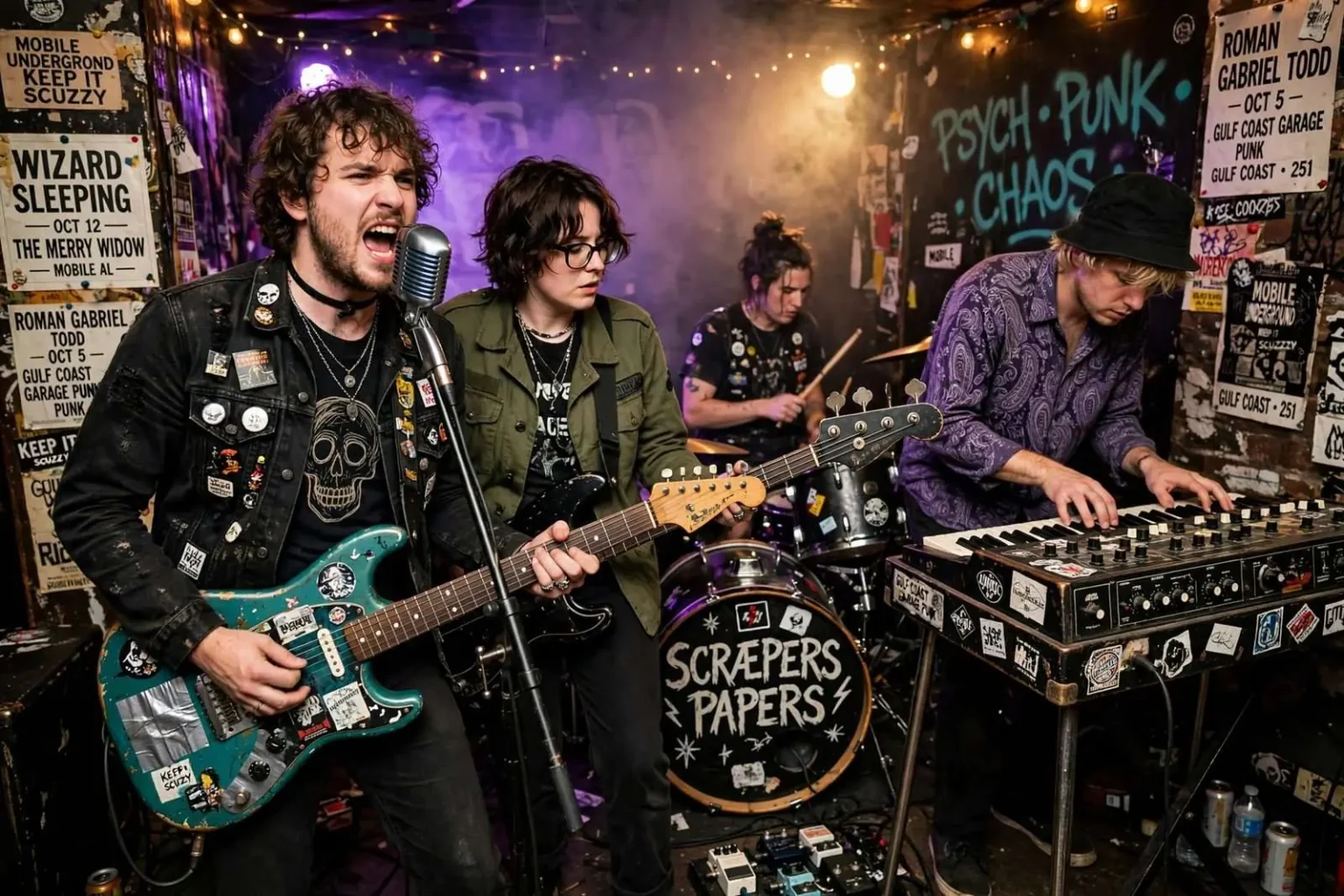
Mobile band Scraepers Papers carries on the noble tradition of the intentionally misspelled band name — but that’s where any comparison to the deliberately quirky ends. The group plays bite-sized, scuzzy-but-fun psych-punk that’s equal parts messy and memorable, and in the crowded field of Gulf Coast garage rock, that combination has earned them a reputation worth paying attention to. The name may be a puzzle, but the music makes its intentions clear from the first song: loud, fast and too much fun to overthink.
For local scene-watchers, their sound lands somewhere near acts like Wizzard Sleeve and Roman Gabriel Todd, yet Scraepers Papers manage to stay distinct and arguably more engaging than the names they get compared to. Imagine if Mobile had its own Butthole Surfers and you’re in the right neighborhood — a band that treats punk’s rulebook as a suggestion, leans into the strange, and comes out the other side with songs that lodge themselves in your head. The band has built a following through social media and a string of shows around the Gulf Coast, and their set is the kind that turns an ordinary night into the one you half-remember: loud, weird, and impossible to ignore.
Scraepers Papers are part of a deep bench of Mobile musicians keeping the city’s basement-and-club circuit lively. Keep up with them online to catch the next show.
The Sound: Psych-Punk, Explained
For anyone who has not waded into the genre, psych-punk is the intersection of psychedelic rock’s experiment and punk rock’s impatience. Take the fuzzed-out guitars, organ swirls and disorienting effects of the psychedelic tradition, compress them into songs that rarely stretch past the two- or three-minute mark, and run the whole thing at punk velocity. The results tend to be raw by design — recordings that capture a band playing loud in a room rather than layered into studio polish — and the best of it manages to be both loose and precise at once, the messiness itself part of the composition.
The “bite-sized” quality of Scraepers Papers’ songs is one of the genre’s signature virtues. Short songs suit the music’s energy: there is no time for a song to overstay its welcome, no drawn-out jam that assumes the audience is as enchanted as the band. Each track lands, delivers its distorted hook or moment of controlled chaos, and gets out. In a live setting that economy compounds — setlists move quickly, momentum builds, and a half-hour set can feel like twice its length in the best sense. Bands in this tradition often pack more ideas into a two-minute song than a conventional rock act spreads across five.
The “scuzzy but fun” balance is harder to achieve than it sounds. Punk and garage music can tip into joylessness when the aggression becomes the whole point, and psych experimentation can disappear up its own effects pedals when the fun goes missing. The bands that build durable local followings are the ones that keep both dials up — sloppy enough to feel dangerous, catchy enough to sing along with by the second chorus. That is the territory Scraepers Papers occupy, and it is what separates a band people remember from a band people once saw.
Where They Fit in Mobile’s Scene
The comparisons that follow the band around are themselves a map of Mobile’s underground. Wizzard Sleeve, one of the city’s most notorious garage-punk exports, built a national underground reputation on exactly the kind of amp-abuse and Southern-gothic weirdness that Mobile’s scene does well, and Roman Gabriel Todd represents the city’s vein of theatrical, sharp-edged rock and roll. Being mentioned in that company marks Scraepers Papers as part of a lineage rather than an isolated act — a scene with continuity, history and a shared vocabulary of noise that stretches back decades.
Mobile’s underground music infrastructure is easy to underestimate from the outside. The city supports a rotating cast of house-show basements, dive bars, art spaces and occasional all-ages venues that host touring punk and garage acts alongside local bills, and its position on I-10 makes it a natural stop for bands running between New Orleans and the Florida Panhandle. A Mobile band can gig year-round without leaving the Gulf Coast — Pensacola, Biloxi, New Orleans and Baton Rouge are all within a short drive — and Scraepers Papers’ string of shows around the region reflects exactly that circuit.
The Butthole Surfers comparison, meanwhile, is a serious compliment wrapped in a joke. The Texas band built a legendary reputation on chaos-as-entertainment: shows that might include-fire, films projected behind the drums, songs that veered from surf guitar to screeching absurdity, all held together by genuine musicianship underneath the madness. To say a band occupies that neighborhood is to say they understand that weirdness works only when the songs underneath it are real — that the goal is not noise but memorable noise.
Building a Following Without a Label
Scraepers Papers’ growth through social media and live shows is the standard playbook for underground bands in the streaming era, and it works because it matches how scenes actually function now. A local band no longer needs radio or a label to reach listeners; it needs a reliable page, clips that capture what a live set feels like, and the patience to play every show offered until the audience that shows up on purpose outnumber the friends who came along. Word of mouth then does the rest — in a scene city like Mobile, a band that delivers live develops a reputation quickly, and reputations are the only currency that matters on a DIY flyer.
That model also explains why bands like Scraepers Papers matter to the health of the local scene. Every functioning basement venue and dive-bar stage depends on a steady supply of local acts that can pull a crowd on a weeknight, and each band that builds a following strengthens the infrastructure every other band uses. Musicians in Mobile’s circuit tend to play in multiple projects, book each other’s shows and share equipment, so a band’s success is never only its own. Keep up with Scraepers Papers online to catch their next show — and catch a piece of the Gulf Coast’s noisy, weird, stubbornly alive underground while it’s in the room.
A Night Out With a Band Like This
Part of what a band like Scraepers Papers sells is the evening itself. A night out to see a local psych-punk act is a different proposition from a concert at a big venue: the tickets are cheap or free, the room is small enough that the band is standing three feet away, and the boundaries between performer and audience thin out accordingly. Crowd and band share the same air, the same spilled beer and the same sudden collective delight when a song kicks in. For the price of a neighborhood bar tab, the audience gets something an arena show cannot manufacture at any price — proximity, surprise and the feeling of being present while something happens rather than consuming something pre-packaged.
The sensory profile of psych-punk live shows also sets them apart. Expect volume as a physical fact, guitars running through fuzz and reverb until the notes blur, maybe a keyboard or organ coloring the edges of the songs. Expect songs to end abruptly rather than fade. Expect the band to look like it is having a strange time, because it is. Newcomers to the genre sometimes need a song or two to recalibrate, and then the hook of the music reveals itself underneath the distortion — melodies are still melodies, rhythms still move bodies, and the “fun” half of scuzzy-but-fun asserts itself once ears adjust.
The Bands That Raise a City’s Profile
Cities across the country have learned that a distinctive local music scene is a civic asset with measurable effects. Athens, Georgia; Olympia, Washington; and Memphis across the state line all built cultural identities that drew visitors, musicians and creative businesses long after their most famous acts moved on. Mobile has the raw material for that story — a port city with a deep musical tradition spanning blues, jazz, carnival krewe bands and a stubborn underground rock lineage — and the current generation of garage and punk acts is the latest custodian of it. Coverage of bands like Scraepers Papers, Wizzard Sleeve and their peers is part of how that story gets told outside the rooms where it happens.
The economics also favor small acts more than they used to. Home recording equipment puts a serviceable album within reach of any band with a laptop, streaming platforms distribute it globally at no cost, and social media lets a Mobile band build listeners in Berlin or Los Angeles without ever leaving Dauphin Street. What still cannot be digitized is the thing local bands actually do: play the room. A band that can turn a Tuesday-night crowd into believers has a skill no online platform replicates, and Gulf Coast venues depend on musicians who have it.
Why Local Coverage Matters
An article like this one serves a purpose beyond reviewing a single band. Local music scenes survive on attention: the high schooler who reads about a Mobile band and shows up at their next show is the pipeline that keeps the scene supplied with audiences, and eventually, with new musicians. Writing that tells residents what a band sounds like, where they fit among the city’s acts and how to follow them functions as connective tissue — it converts the scene from something insiders know about into something a curious newcomer can enter.
So consider this the entry point. Scraepers Papers play scuzzy, fun psych-punk in the tradition Mobile does well, they are worth arriving early for, and they are part of a larger community of Gulf Coast bands keeping the circuit loud. Follow the band’s social media for show announcements, bring a friend to the next gig, and support the venues that host this music — because scenes are not accidents. They are the compound interest of small, repeated decisions by people who show up, and Mobile’s is very much alive.


