
Mobilians Hauled Away More Than 257,000 Pounds of Litter in 2022
City crews, partners and volunteers removed more than 257,000 pounds of litter from Mobile's streets and waterways in 2022, city officials announced.
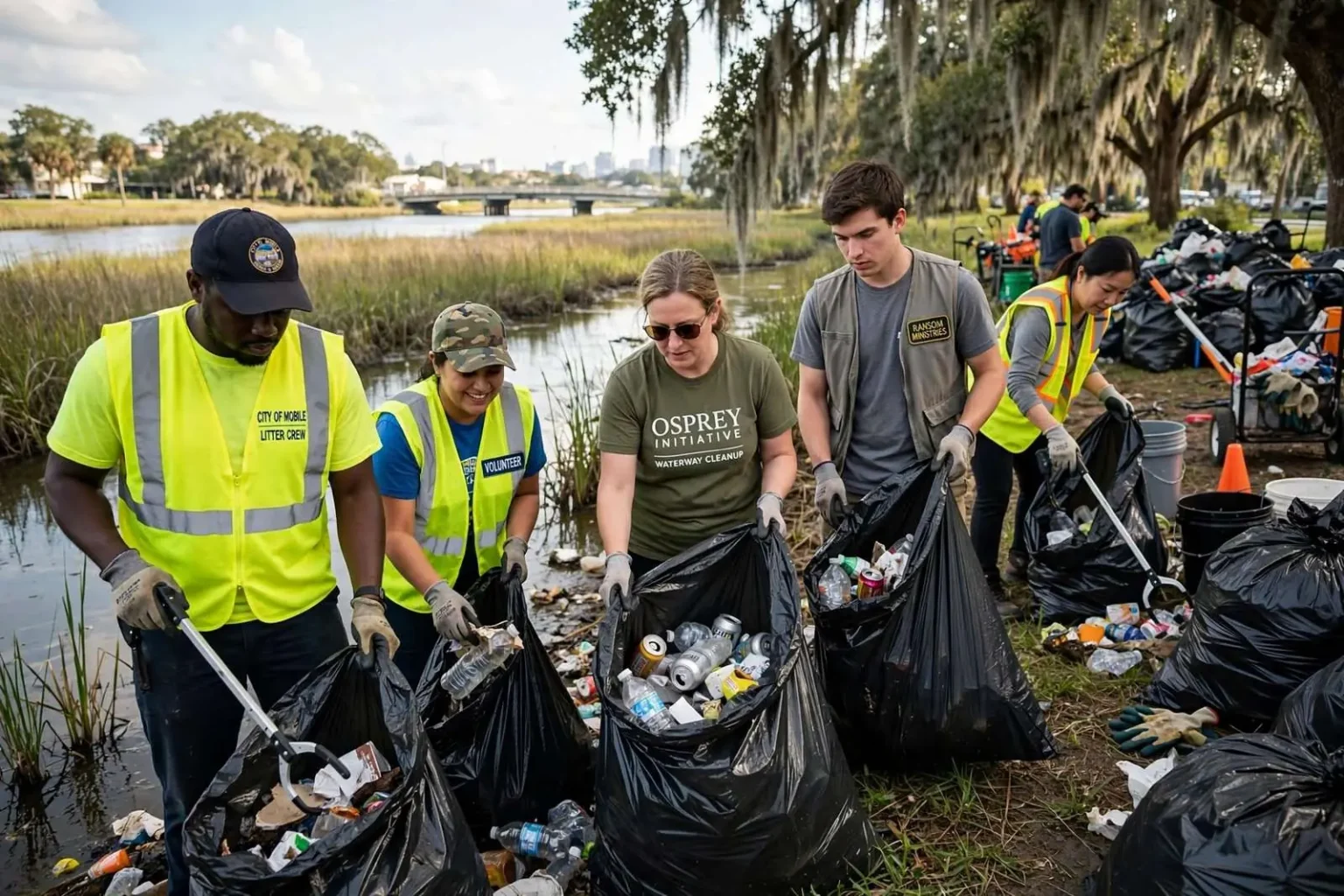
Mobile’s fight against litter reached a milestone in 2022, when residents, city crews and partner organizations together removed more than 257,000 pounds of trash from the city’s streets and waterways. The figure, released by the City of Mobile, marked one of the most comprehensive annual accounting of cleanup work the city has compiled since it launched its organized anti-litter effort, and it underscored how a problem once handled almost entirely by municipal workers has become a shared community project spanning neighborhoods, schools, nonprofits and ordinary residents.
The breakdown of the 2022 totals tells the story of that shared effort. City partners collected approximately 163,300 pounds of litter, the largest single share of the year’s haul. The city’s own Litter Crew, a dedicated team that works full time on trash removal along roadways, ditches and drainage paths, gathered roughly 55,200 pounds. The Osprey Initiative, a partner organization that specializes in removing debris from Mobile’s creeks and waterways, pulled out around 24,800 pounds. Community volunteers contributed approximately 13,600 pounds through neighborhood cleanups and organized events. Each number represents more than raw tonnage; together they show how different parts of the community divided the labor of cleaning a city that sits at the mouth of Mobile Bay, where litter dropped on any street can eventually travel through storm drains into rivers, the Mobile-Tensaw Delta and the bay itself.
A Quarter of a Million Pounds, and Counting
Mayor Sandy Stimpson highlighted the scale of the achievement when the figures were released. “Working together, Mobilians removed more than a quarter of a million pounds of litter from our streets and waterways last year, and that’s truly amazing,” Stimpson said. The mayor’s office has made litter reduction a visible priority in recent years, framing clean streets as both a quality-of-life issue and an economic one. City officials have repeatedly pointed out that litter affects how residents feel about their neighborhoods and how visitors and prospective businesses perceive Mobile, making cleanup work an investment in the city’s image as well as its environment.
Stimpson credited the city’s Litter Crew along with a roster of partner organizations that includes the Alabama Department of Transportation, Ransom Ministries and the Osprey Initiative. ALDOT’s involvement matters because state highways and their rights-of-way, including busy corridors through the city, generate significant roadside debris that municipal crews cannot legally or practically address on their own. Ransom Ministries, a faith-based nonprofit based in the city, has incorporated cleanup work into its community service programs, putting additional hands on the problem while serving its broader mission. The Osprey Initiative, whose name comes from the fish-eating raptors that patrol Mobile’s waterways, focuses on waterborne litter, deploying teams to remove trash from creeks, bayous and drainage systems before it can reach the Mobile Bay and the Gulf beyond.
Just as important, the mayor noted, are the everyday residents who picked up trash on their runs or walks and the families and civic groups who joined community cleanups throughout the year. City leaders have said repeatedly that no municipal crew, no matter how well funded, can match the impact of thousands of residents who simply decide not to walk past litter. The 13,600 pounds collected by volunteers represents only the material that was weighed and logged through organized events; informal cleanup by individuals adds to the total in ways the city cannot count.
The Litter Toolkit and How the Data Gets Collected
A key reason the city can put precise numbers on its cleanup work is the Litter Toolkit, a program Mobile launched in 2021. The toolkit was designed to solve a persistent problem for anti-litter campaigns: volunteer cleanup events happened all over the city, but their results went unrecorded, making it impossible to measure progress or direct resources where they were most needed. The toolkit gives residents and organizations a structured way to plan community cleanup events, access supplies and guidance, and capture the data those events generate, including bag counts and estimated weights.
That data pipeline is what allowed the city to report the 2022 totals with breakdowns by source. It also lets city staff identify litter hot spots, track which neighborhoods generate the most cleanup activity and coordinate the Litter Crew’s schedule with volunteer events. Cities across the Gulf Coast have adopted similar approaches as states and environmental groups push for better data on how much litter enters waterways, where plastics and other debris are a growing concern for marine life and water quality.
For Mobilians who want to join the Litter-Free Mobile effort, the city maintains planning resources at cityofmobile.org/litter. The site explains how to organize a cleanup, what equipment is available and how to report results so they count toward the citywide total. Whether the 2023 figures will surpass the 257,000-pound mark set in 2022 remains to be seen, but the infrastructure now exists to find out, one cleanup at a time.
Understanding why a quarter-million pounds of litter matters requires looking at where Mobile sits on the map. The city is built around water: Mobile Bay to the south, the Mobile River and its delta to the north, and a network of creeks — Three Mile Creek, Milkhouse Creek, Eslava Creek and others — threading through neighborhoods across the city. Every piece of trash dropped on a street or parking lot has a path to those waters. Rain washes debris into storm drains, storm drains feed the creeks, and the creeks carry everything downstream toward the bay and, eventually, the Gulf of Mexico. Litter that starts as a cup tossed from a car window in Toulminville or West Mobile can end up tangled in marsh grass in the Mobile-Tensaw Delta, one of the most productive ecosystems in North America.
That hydrology is why the Osprey Initiative’s contribution to the 2022 total deserves particular attention. Waterborne litter is the hardest to collect: it drifts, it snags on branches and culverts, and it breaks apart into smaller fragments the longer it sits in moving water. Waterway cleanup crews use different techniques than street crews — working from the banks, wading or using boats, and in some Gulf Coast communities installing trash-trapping devices in creeks. The roughly 24,800 pounds the Osprey Initiative removed in 2022 represents debris that would otherwise have been far more expensive, or impossible, to recover later.
Why Cities Take Litter Seriously
The push to measure and reduce litter is not simply about tidiness. Municipal leaders along the Gulf Coast cite several concrete reasons. Blighted, trash-strewn corridors depress property values and discourage investment, while clean commercial districts signal that a city cares for itself. Litter clogs storm drains, and clogged drains worsen street flooding during southwest Alabama’s heavy rains, particularly in hurricane season. Plastic debris in waterways harms fish, turtles, birds and dolphins, and Mobile Bay’s seafood industry depends on clean water. And cleanup itself is expensive — every pound collected by crews is a pound that costs public money to handle, which is why preventing litter in the first place is the cheaper path.
Mobile’s approach reflects a strategy that other cities in Alabama and across the region have watched closely: combine a dedicated municipal crew with nonprofit partners, state agencies and volunteer labor, then measure everything. The Alabama Department of Transportation’s participation connects the city effort to the state’s own highway litter programs, which address the interstate corridors and state routes where high traffic speeds and high volumes generate constant roadside debris. Ransom Ministries’ involvement shows how social service organizations can fold community cleanup into their work, giving program participants meaningful service opportunities while extending the city’s reach.
How Residents Can Plug In
The Litter Toolkit, launched in 2021, lowered the barrier for people who want to help but do not know where to start. Instead of improvising — buying trash bags, figuring out where to take collected debris, worrying about safety along busy roads — residents use the toolkit to plan an event properly. The city provides guidance on organizing a group, choosing a site, handling supplies and logging results. Because the data flows back to the city, every registered cleanup contributes to the annual totals and helps map where litter accumulates.
The 2022 numbers also carry a lesson about scale: no single group produced the total. Partners collected the largest share, but the combined output of the Litter Crew, the Osprey Initiative, ALDOT-assisted work, Ransom Ministries and hundreds of volunteers is what pushed the figure past a quarter of a million pounds. City officials have presented that mix as the model going forward — a standing municipal effort that anchors the work, surrounded by partners and residents who multiply it. For a city whose identity, economy and environment are inseparable from its water, keeping litter out of the streets is inseparable from keeping Mobile Bay healthy, and 2022 showed what a coordinated community can accomplish in a single year.
The region’s economy also gives the city a practical reason to keep streets and shorelines clean. Tourism, commercial and recreational fishing, and outdoor recreation all depend on the health and appearance of the area’s waters, and blighted corridors can discourage investment in the neighborhoods they pass through. Community leaders across the Gulf Coast have increasingly treated litter reduction as both an environmental priority and an economic one, and Mobile’s decision to publish a detailed annual accounting of its litter removal is part of that broader shift toward measurable results.
A Statewide Push Against Litter
Mobile’s efforts fit into a wider pattern of anti-litter work across Alabama. The statewide People Against a Littered State organization has promoted litter prevention for decades, and the Alabama Department of Transportation dedicates substantial resources each year to removing trash from highway rights-of-way across the state. Coastal communities from Mobile across the bay into Baldwin County also take part in regional cleanup events that draw hundreds of volunteers each year to pick up trash along beaches, bayous, rivers and causeways, feeding a growing recognition that litter is a shared regional problem rather than one city’s burden.
Waterway-focused organizations have multiplied along the Gulf Coast in recent years, and the Osprey Initiative’s work in Mobile reflects that trend. Devices that capture litter in moving water allow a small crew to remove large volumes of trash efficiently, and they also generate information about what kinds of litter are most common in a given watershed. That kind of information helps cities target the products and behaviors that generate the most litter in the first place, from single-use plastics to materials that blow out of truck beds.
How Residents Can Join
Residents who want to join the Litter-Free Mobile effort can find planning resources at cityofmobile.org/litter. The site explains how to organize a cleanup, what supplies are available through the city, and how to report results so they count toward the city’s published totals. Individual residents who are not part of an organized group can still contribute, whether by picking up trash during a neighborhood walk or reporting illegal dumping and problem areas to the city for follow-up by the Litter Crew.
City officials have said the 2022 numbers show what is possible when different parts of the community work on the problem at the same time. With more than a quarter of a million pounds removed in a single year, the figures give the campaign a benchmark going forward and a demonstration that the combined model of crews, partners, waterway devices and volunteers produces results at scale. The partners the mayor named, from the Alabama Department of Transportation to Ransom Ministries and the Osprey Initiative, are expected to remain part of the effort, and residents who participate in future cleanups will see their work reflected in the same accounting that produced the 2022 report.
For a city that markets itself on its waterfront, its festivals and its access to the Delta, the annual litter report has become a way to show progress on an issue that residents raise consistently. Whether the total grows in the years ahead will depend partly on continued funding and partnerships, and partly on the everyday habits of the people who live and drive through Mobile. The 2022 numbers suggest that when both crews and citizens take part, the city can move a quarter of a million pounds of trash in a single year.


