Monroe County Man Killed After Being Thrown From Tractor in Crash
A 71-year-old Franklin man died after his tractor was struck by a pickup truck on a rural Monroe County road north of Monroeville.
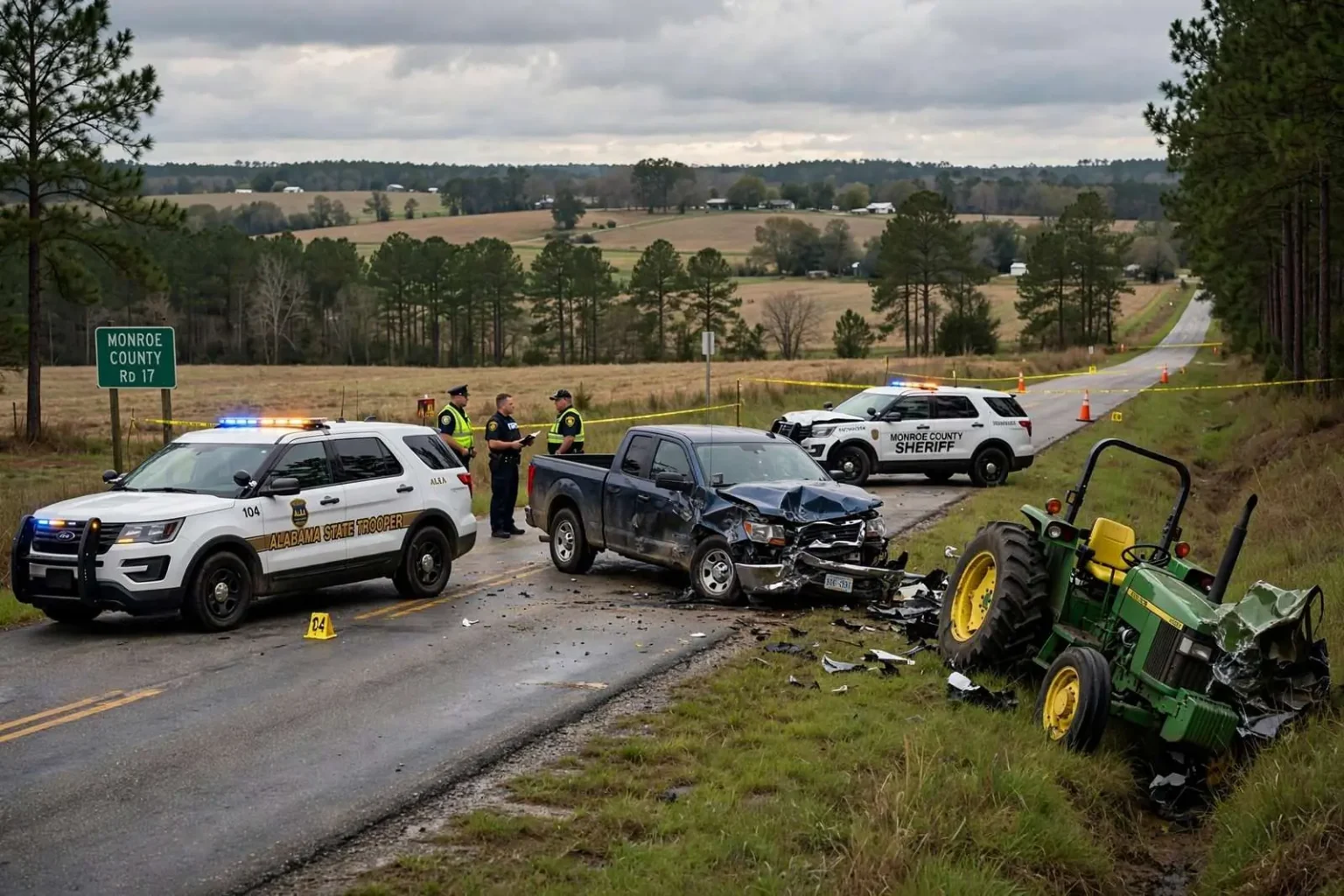
A rural stretch of Monroe County Road 17 was the scene of a fatal crash that claimed the life of a 71-year-old Franklin man, according to Alabama State Troopers who investigated the collision. Authorities say the man was driving a farm tractor along the county road, roughly 15 miles north of Monroeville, when a pickup truck collided with the vehicle. The force of the impact threw him from the tractor, and he was not wearing a seat belt at the time of the crash, troopers said.
Emergency responders arrived at the scene but were unable to save him; he was pronounced dead where the crash occurred. The stretch of County Road 17 where the collision happened runs through rolling farm country far from Monroeville’s town limits, an area of small fields, timber tracts and scattered homesteads where a crash scene can be minutes away from the nearest ambulance station. For neighbors along the road, the arrival of rescue vehicles on a quiet afternoon brought the news before any official word was issued.
Troopers with the Alabama Law Enforcement Agency continued investigating in the days that followed, working to piece together the exact sequence of events that led to the collision. Investigators typically document vehicle positions, roadway conditions and sight lines, interview witnesses and examine both vehicles for mechanical evidence before determining what happened. No further details about potential citations or contributing factors had been released as the investigation continued.
Farm country, shared roads
Farm equipment sharing the road with passenger vehicles is a common sight throughout rural Monroe County, where agriculture remains a central part of the local economy. The county’s landscape outside Monroeville is a patchwork of row crops, cattle pastures and pine plantations, and the movement of tractors, hay balers and grain wagons between fields is a routine part of life for the people who live along the county’s rural roads. During busy seasons, a driver may pass the same piece of equipment moving from one field to another several times in a week.
Tractors and other slow-moving farm machinery often travel on county roads between fields, and safety officials have long urged drivers to use caution when approaching them, particularly on two-lane roads with limited visibility. A loaded tractor moving at low speed can appear suddenly over a rise or around a curve, and closing speeds between farm equipment and highway traffic are deceptive. Safety guidance urges drivers to slow immediately on sight, pass only with a clear line of vision and assume the operator cannot hear approaching traffic over engine noise.
The crash serves as a reminder of the risks associated with mixing slow, heavy equipment and highway-speed traffic on rural roads. Safety advocates note that tractors are far more vulnerable in a collision than the vehicles that share the road with them, and that drivers unfamiliar with farm country should be especially alert during planting and harvest seasons when equipment movement increases. Operators of farm equipment, for their part, are advised to use reflective markings and lights and to avoid road travel at dawn and dusk when visibility is poorest.
Seat belt use, or the lack of it, is a recurring factor in tractor fatalities across the country. A tractor involved in a collision offers no enclosure to protect its operator, and an unbelted driver can be thrown from the machine by an impact that the vehicle itself might survive. Investigators routinely record restraint use in such crashes because it shapes both the outcome and the safety lessons drawn from them.
Investigating a rural crash
The investigation of a fatal crash in a rural county draws on resources spread thin across a wide territory. ALEA’s highway patrol division covers large rural districts, and a collision scene miles from the nearest town requires coordination among troopers, county deputies, volunteer fire departments and ambulance services. The responders who work such scenes are often neighbors of the people involved, a reality of rural emergency service that adds a personal weight to crashes like this one.
Monroe County Road 17 remained open in the aftermath of the crash, with investigators working to determine what led up to the collision between the two vehicles. Unlike crashes on state highways, a county road scene typically clears quickly once the roadway has been documented, allowing regular traffic, much of it itself agricultural, to resume. The pace of the investigative work continues well after the road reopens, as reports are completed and any decisions about charges are weighed.
Monroeville, the county seat roughly 15 miles to the south, serves as the commercial and institutional center for the rural communities that surround it. Residents of the Franklin area drive to Monroeville for groceries, medical care and county government, traveling the same two-lane roads where farm equipment and commuter traffic mix. Those routes carry a volume of slow-moving agricultural traffic that urban commuters rarely encounter, and experience on them teaches the patience that rural driving demands.
A community feels the loss
Community members in the Franklin and Monroeville area were reported to be shaken by the loss, with neighbors describing a tight-knit rural community where such crashes are felt widely, even when they occur on quiet back roads far from busier highways. In communities of this size, a 71-year-old farmer is not a statistic but a familiar face at the feed store, the co-op and the church pew, and word of a fatal crash travels through phone calls long before it reaches the news.
The farming community of rural Monroe County has watched its share of change over the decades, as younger residents have moved away and operations have consolidated, but the seasonal rhythm of planting and harvest still governs the calendar. Equipment moves on the roads most heavily in spring and fall, and drivers who live in farm country learn to expect delays behind a baler or a grain cart. Residents say the shared roads demand a mutual courtesy: farmers pulling over when traffic backs up, and motorists giving the machinery room.
Safety educators in rural Alabama counties regularly emphasize that most collisions involving farm equipment happen in daylight on dry roads, close to home, during routine moves rather than unusual circumstances. The familiarity of the route can breed complacency on both sides, for the tractor operator who has made the trip a hundred times and the driver who has passed equipment without incident for years. Campaigns aimed at both audiences stress that a few seconds of slowing down is the cheapest insurance available on a rural road.
As the investigation moved forward, the family and neighbors of the man who died were left to absorb a loss that came without warning on an ordinary workday. The crash added Monroe County to the annual toll of farm-related roadway deaths that safety officials track across the state and the region, a toll collected one quiet county road at a time. For the people who live and drive along County Road 17, the memory of the wreck will likely shape how carefully they travel that stretch for a long while.
Monroeville carries a national reputation far larger than its size, known across the country as the hometown of writer Harper Lee and the inspiration for the fictional Maycomb of her novels. The town’s literary fame draws visitors to the historic courthouse square, but the daily life of the county remains rooted in the land around it, in the timber, cattle and row-crop operations that have sustained families for generations. The contrast between the town’s literary profile and its agricultural present is a defining feature of the county.
Agriculture across south Alabama has evolved considerably over the decades, with operations growing larger and more mechanized even as the number of farms has contracted. Modern tractors are heavier and faster than the machines they replace, and the equipment moved between fields today can be wider than a traffic lane. That scale increases both the productivity of the work and the stakes of every mile traveled on a narrow county road.
Rural emergency response depends heavily on volunteer departments and a limited number of ambulances covering wide territories. In counties like Monroe, a call in the far northern end of the county can require responders to travel twenty minutes or more to reach a scene, time that matters enormously in traumatic injuries. Volunteers train for exactly the kind of scene troopers described on County Road 17, where the mechanics of a crash involving heavy equipment require specialized knowledge to stabilize and investigate.
Alabama law enforcement organizes highway safety work through ALEA, the state agency formed to consolidate troopers, investigators and support functions under a single cabinet-level department. Troopers assigned to rural districts handle everything from routine collisions to fatalities, and their crash reports become the official record on which insurance claims and any criminal charges rest. The thoroughness of that documentation process is one reason findings and citations often emerge weeks after the crash itself.
State law requires seat belts in passenger vehicles, but farm equipment occupies a different regulatory category, and restraint use on tractors is governed by a combination of equipment design and operator choice. Modern tractors commonly roll off the assembly line with rollover protective structures and seat belts, safety features that only work when they are used. Safety extension agents across Alabama have spent years urging operators to buckle up inside the cab structure, a habit that turns a potentially fatal ejection into a survivable jolt.
The pickup truck driver involved in the collision remained part of the ongoing investigation, with troopers weighing speed, visibility and right of way as they reconstructed the contact. In crashes between passenger vehicles and farm equipment, fault determinations can be complicated by the speed differential and by questions of whether the slow-moving vehicle was properly marked and lit. Those details, once established, determine whether the case ends with a traffic citation or a more serious charge.
Funerals and memorial gatherings in communities like Franklin tend to draw attendees from across the county, and the days after a fatal crash typically bring an outpouring of food, visits and practical help for the family left behind. Rural churches and civic organizations function as the social safety net in the weeks after a loss, organizing meals and covering immediate needs. Neighbors said that response had already begun as word of the crash spread through the community.
The longer-term question for rural counties is how to reduce the underlying risk that produced this crash. County commissions weigh signage, striping and shoulder maintenance against limited road budgets, while extension services and farm bureaus push education aimed at both equipment operators and the motoring public. Each fatal collision adds urgency to that work, and each one is remembered locally as the argument for driving slower on the back roads.