Monroeville Man Killed in Head-On Crash Near Beatrice
A 35-year-old Monroeville man died Sunday morning when his car collided head-on with another vehicle on Alabama 265 near Beatrice, according to the Alabama Law Enforcement Agency.
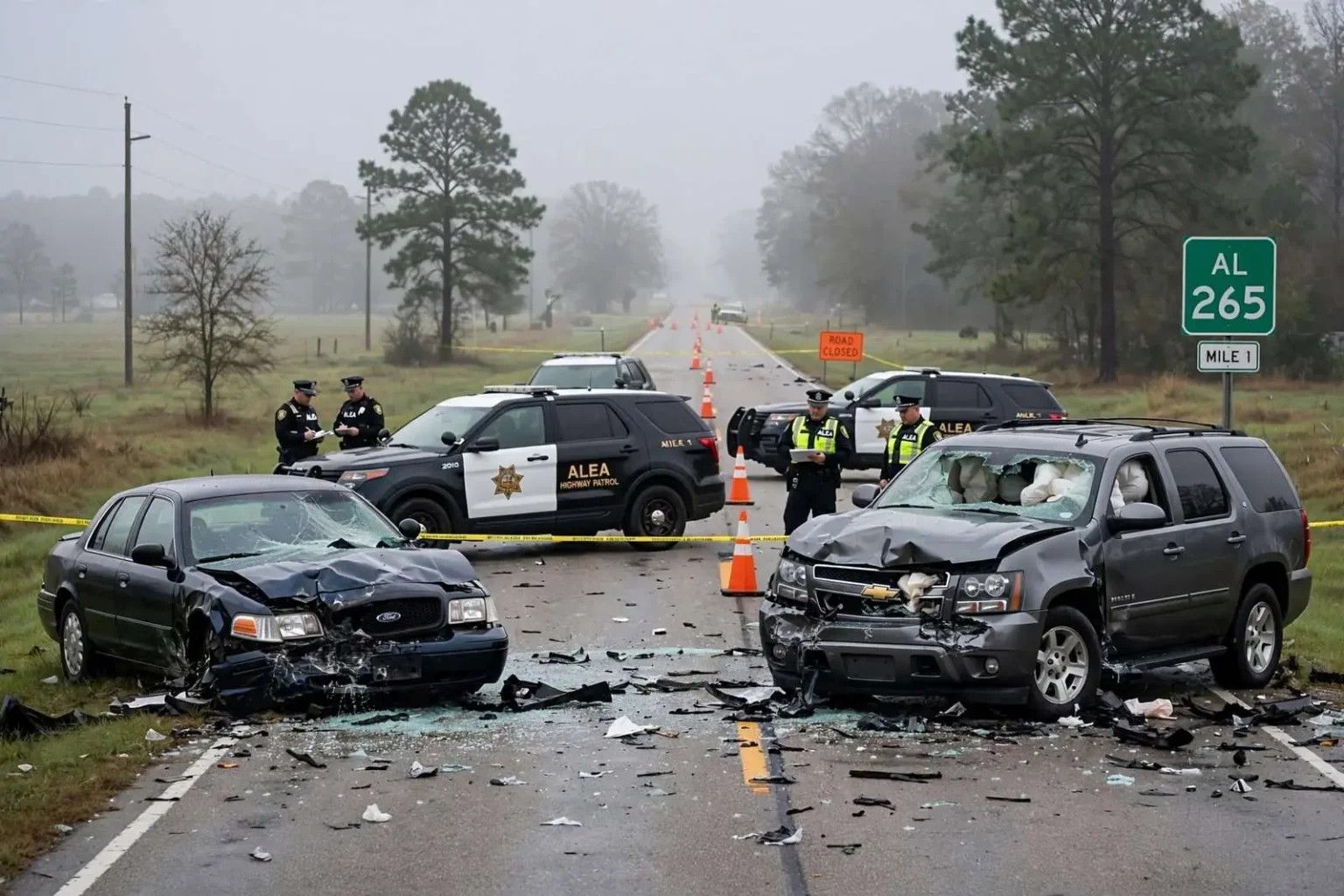
A Monroeville man is dead following a head-on crash Sunday morning in Monroe County, according to the Alabama Law Enforcement Agency. ALEA identified the victim as 35-year-old Christopher O. Hill, who was driving a 2010 Ford Crown Victoria that collided head-on with a 2009 Chevrolet Tahoe driven by 60-year-old Joshua Williams of Camden.
Hill was pronounced dead at the scene. The crash happened around 7:30 a.m. on Alabama Highway 265 near the one-mile marker, about a mile north of Beatrice — a stretch of rural two-lane highway where a Sunday morning collision closed the road for several hours while troopers worked the scene.
The highway remained shut down through the Sunday morning hours as troopers with ALEA’s Highway Patrol Division documented the wreckage and investigated the crash. Authorities have not released additional details on Williams’ condition or on what led to the collision. The Highway Patrol Division’s investigation into the crash remains ongoing, and ALEA said no further information was immediately available.
The crash on Highway 265
Alabama Highway 265 runs north from Beatrice through the rural interior of Monroe County, connecting the small communities of the region to the county seat at Monroeville. Near the one-mile marker — the reference point troopers use to locate crashes within a mile of the highway’s start — the road carries local traffic at highway speeds on a two-lane profile with no median separating opposing directions. A head-on impact on such a road combines the closing speed of both vehicles into a single violent moment, and the consequences for occupants are frequently fatal.
The 7:30 a.m. timing put the crash at the leading edge of a Sunday morning, when traffic on rural Alabama highways is light but not empty — early church runs, shift changes, errands across county lines. Troopers have not said in which direction each vehicle was traveling, whether either driver crossed the centerline, or what circumstances preceded the collision. Those determinations are the work of the crash reconstruction that follows every fatal collision ALEA investigates.
Both vehicles involved were more than a decade old — Hill’s 2010 Crown Victoria and Williams’ 2009 Tahoe — the kind of vehicles that make up a large share of the rural South’s daily fleet. Investigators will examine both vehicles mechanically and download whatever data their onboard systems retained, looking for the answer to the question every fatal crash investigation must resolve: why two vehicles traveling in opposite directions ended up occupying the same space.
The victim
Christopher O. Hill, 35, of Monroeville was pronounced dead at the scene. In Monroe County, where emergency medical response distances are measured in the miles between small towns, the pronouncement came from the responders who arrived to find a crash that had already taken a life. The Monroe County Coroner’s Office handles death certification in fatal crashes of this kind, and formal autopsy procedures accompany any fatal collision investigation.
Hill was 35 — young by the standards of rural highway fatality statistics, which skew older in part because retirees log so many of the miles on roads like Highway 265. His death adds to the toll on Alabama’s rural roads, which consistently account for a disproportionate share of the state’s traffic fatalities even though they carry a minority of its traffic volume.
The other driver
Joshua Williams, 60, of Camden was driving the Chevrolet Tahoe. Camden, the seat of Wilcox County, lies west of Monroe County across the Alabama River, meaning Williams was operating well outside his home county when the crash occurred. Authorities have not released details on his condition, and no information has been made public about the injuries he may have sustained or whether he was transported for treatment.
The silence around Williams’ condition is standard practice in the opening days of a fatal crash investigation. Troopers withhold details while next-of-kin notifications are completed and while the facts of the collision — including any contribution by either driver — are established. Should the investigation conclude that a traffic violation or criminal conduct contributed to the crash, the case would be referred to the District Attorney for the judicial circuit that covers Monroe County.
The response and the closure
The highway closure that followed the crash stretched across the Sunday morning hours — a familiar disruption in rural Alabama, where a fatal collision on a two-lane road leaves no detour but the long way around. Monroe County’s rural road grid means traffic that would normally use Highway 265 near Beatrice must circle through county roads never designed for diverted volume, and local drivers learned within hours to route around the closed segment.
Troopers with ALEA’s Highway Patrol Division spent those hours doing the work that fatal crash investigations demand: photographing and measuring the scene, marking skid marks and debris fields, examining both vehicles, and beginning the interviews that will anchor the final report. Only after the physical evidence was fully documented could the road be reopened, which is why closures in fatal crashes routinely run four hours or more.
Monroe County’s road safety picture
Monroe County, known to the world as the home of Monroeville and the literary legacy of Harper Lee, is in transportation terms a rural county whose residents depend on a network of two-lane highways — U.S. 84, Highway 265, Highway 41 — to reach work, medical care and commerce. Those roads carry the county’s traffic at design standards set decades ago, and head-on collisions on undivided rural highways remain among the deadliest crash types in the state.
State data has long shown that Alabama’s fatal crashes concentrate on rural two-lane roads, where speeding, distraction, fatigue and the absence of any barrier between opposing traffic combine with long response distances to produce outcomes like Sunday’s. Engineering countermeasures — centerline rumble strips, widened shoulders, passing lanes — have been installed on stretches of the state’s rural network and have demonstrated reductions in crossover crashes where they appear, but the mileage of rural highway vastly outpaces the pace of upgrades.
What the investigation will determine
The Highway Patrol Division’s investigation will culminate in a reconstruction report that assigns the physical facts of the collision: vehicle speeds, points of impact, which vehicle crossed the centerline, and the contributing factors — from distraction and impairment to medical emergencies and mechanical failure. Toxicology testing is routine in Alabama fatal crashes, and the results, along with vehicle downloads and witness statements, feed the final determination.
That process takes weeks, and ALEA has said no further information was immediately available — the standard posture while the work proceeds. The findings matter for more than the record: they determine whether any charges are referred to prosecutors, they inform insurance proceedings for the families involved, and they feed the state’s data on why drivers die on rural roads.
For two families in neighboring counties, the investigation’s timeline is secondary to the fact of the crash itself. A 35-year-old Monroeville man is dead, a 60-year-old Camden man’s condition remains unknown, and a Sunday morning on a rural highway ended in the kind of collision that erases a life in the seconds it takes two vehicles to meet head-on.
Anyone who witnessed the crash or has information relevant to the investigation is encouraged to contact ALEA’s Highway Patrol Division as troopers complete their work on the Highway 265 collision.
Beatrice and the communities along the highway
Beatrice, the small town a mile south of the crash site, sits in the southern reaches of Monroe County along Highway 265’s corridor. Communities like it — and the others scattered along the highway between Beatrice and Monroeville — experience these closures and crashes not as statistics but as local events, on roads where nearly every passing car is recognizable and word of a fatal collision travels faster than any official release.
The town’s residents also know the response pattern well. Volunteer fire departments and first responders from the surrounding communities are typically the first on scene for crashes on the county’s rural highways, arriving from fire stations within a few minutes’ drive and providing care until ambulances make the longer trip from larger stations. On a Sunday morning, that system runs with the full cooperation of a community that staffs it by choice.
The wider toll on rural Alabama roads
Each fatal crash on a road like Highway 265 lands within a grim statewide pattern. Alabama records hundreds of traffic deaths annually, and the deaths concentrate on the rural two-lane network that carries the daily life of counties like Monroe. The factors are structural: higher speeds for the road’s design, long distances between emergency facilities, low seat-belt use in some rural populations, and exposure — rural residents drive more miles to reach the same services.
Safety officials respond with a combination of engineering, enforcement and education, from rumble strip programs to targeted patrols to the state’s seat belt and impaired driving campaigns. The work has contributed to a long-term decline in fatality rates, but Sunday’s crash is a reminder of the residual risk that remains on any undivided rural highway — a risk that turns a morning drive into a fatal event in the space between two oncoming vehicles.