
More Than Half of Northwest Florida Voters Cast Ballots Before Election Day
Escambia, Santa Rosa and Okaloosa counties saw record early voting turnout ahead of the 2020 election, with totals projected near 80 percent by Election.
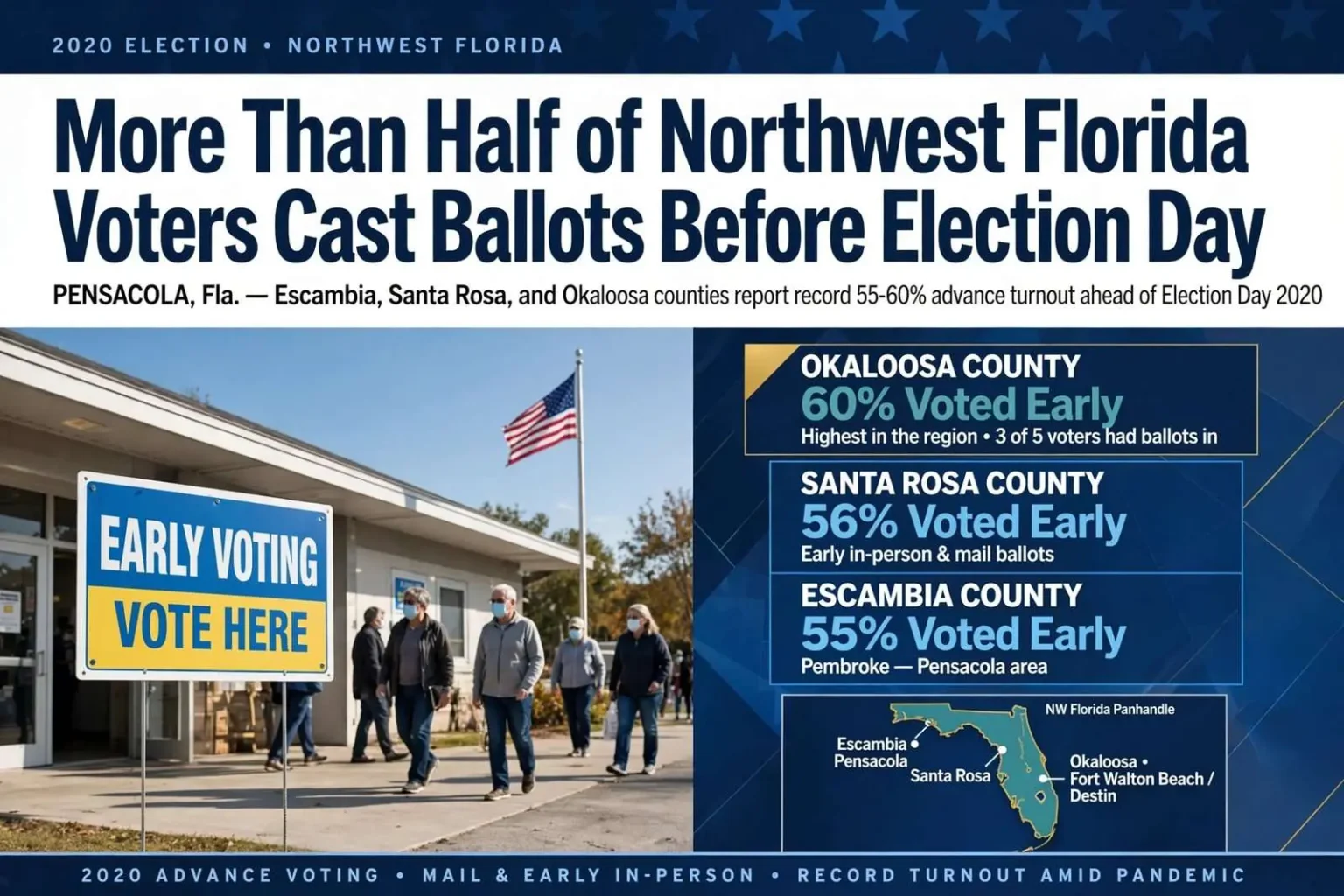
PENSACOLA, Fla. — More than half of registered voters across three northwest Florida counties had already voted — either in person or by mail — heading into Election Day 2020, a level of advance participation that shattered previous turnout records in the Panhandle and reshaped what the final day of voting would look like.
Escambia County reported 55 percent turnout during early voting, while Santa Rosa County reached 56 percent and Okaloosa County led the region at 60 percent, according to Escambia County Elections Supervisor David Stafford. In each county, well over half of all registered voters had made their choices before polls even opened for the general election.
“Early in-person voting and vote by mail ballots have both been up pretty significantly over 2016,” Stafford said. The surge reflected the peculiar circumstances of a presidential election held during a pandemic, when millions of voters rethought how — and when — they wanted to cast ballots.
He noted that Democrats leaned heavily on mail ballots at first, with Republicans surging back once early in-person voting opened — leaving Republican ballots outnumbering Democratic ones in all three counties, consistent with the historically red Panhandle. The partisan split of the advance vote became one of the most watched signals of the 2020 cycle, as analysts tracked which party banked ballots early.
A Region That Votes Early
The Panhandle’s three westernmost counties — Escambia, home to Pensacola; Santa Rosa, its fast-growing eastern neighbor; and Okaloosa, anchored by Fort Walton Beach and Destin — form a reliably Republican corner of a swing state. Military installations including Naval Air Station Pensacola, Eglin Air Force Base, and Hurlburt Field give the region a large veteran and active-duty population, and its voting patterns have leaned right for decades.
But the 2020 advance-vote numbers were remarkable in both parties. Mail ballot requests broke records across Florida, driven by voters who wanted to avoid crowds, and early in-person sites saw lines that in some locations stretched for hours as voters embraced an option many were using for the first time.
Stafford’s office, which administers elections for Florida’s oldest settlement, has been at the center of several historic election moments. Escambia County’s election apparatus handled the doubled workload of early voting and mail processing in stride, officials said, thanks in part to the expansion of early voting sites and days under Florida law.
Pensacola Mayor Grover Robinson estimated that another 60,000 to 65,000 local voters would head to the polls on Election Day itself, pushing total turnout toward 80 percent. A figure in that range would place the region among the highest-turnout areas of the state, continuing a pattern of Panhandle voters participating at rates above national norms.
Why the Numbers Mattered
Turnout of that magnitude carries consequences for how an election runs. Long advance-vote lines meant shorter Election Day crowds, easing pressure on precincts and poll workers in a year when many jurisdictions struggled to staff elections. It also meant that a large share of the region’s ballots were already in hand — waiting to be counted — when Election Day arrived.
Polls were open Tuesday from 7 a.m. to 7 p.m., and Florida expected results earlier than many contested states because mail ballots were already being tallied. Unlike states whose laws prohibited processing mail ballots before Election Day, Florida allowed canvassing boards to begin work in advance, meaning the state’s count could move quickly once polls closed.
That mattered in a presidential year when the nation watched swing states count for days after Election Day. Florida’s experience in 2020 stood in contrast to the delays in some battlegrounds: the state reported results the night of the election, having processed millions of mail ballots in the weeks prior.
For the Panhandle’s elections officials, the record advance turnout validated years of investment in early voting infrastructure. Florida expanded early voting after the troubled 2000 and 2012 elections, and the system’s performance in 2020 — through a pandemic, no less — became a point of pride for the supervisors who run it.
The Voting Methods Split
The partisan dynamics of the advance vote told a story that played out nationally. Democrats embraced mail voting earlier in the cycle, partly on public health concerns and partly at the urging of party leaders, while President Trump’s criticism of mail ballots pushed many Republican voters toward in-person early voting once it opened. The result was a partisan sequencing of the advance vote: Democratic-heavy mail ballots first, Republican-heavy early in-person votes later.
By the time early voting closed, Republican ballots outnumbered Democratic ones in Escambia, Santa Rosa, and Okaloosa — a margin consistent with the region’s registration and its history. Election analysts noted that the pattern gave an early hint of the region’s direction, though final results depended on Election Day and the processing of all ballots.
The 60,000 to 65,000 voters Robinson expected on Election Day represented the remaining share of the electorate — voters who preferred the tradition of voting on the day itself or who had waited to decide. For campaigns, those late deciders and habitual Election Day voters were the final target of sign waves, robocalls, and precinct-level get-out-the-vote pushes.
Local races also benefited from the high turnout. County commission seats, school board races, judicial retainment, and state legislative contests all drew from an electorate that was engaged at record levels, and down-ballot candidates found more voters casting ballots in their races than in a typical year.
How Florida Counts Early
Florida’s election code allows canvassing boards to begin processing mail ballots weeks before Election Day — verifying signatures, opening envelopes, and feeding ballots through scanners. The procedure meant that by election night, the state could release totals that included the vast majority of mail and early votes, producing a relatively complete picture within hours.
Supervisors like Stafford spent the weeks before the election on that processing work, alongside security measures, equipment testing, and the staffing of early voting sites. The logistics of a record election are invisible when they go well, and Florida’s 2020 count was widely noted as among the smoothest of the large swing states.
The Panhandle’s advance turnout also reflected the region’s demographics: a large retirement population, a military community accustomed to absentee voting, and a civic culture with high rates of registration and participation. Okaloosa’s 60 percent advance figure meant three of every five registered voters had finished voting before Election Day — a level that would have been unthinkable a generation ago.
Nationally, 2020 became the highest-turnout presidential election in more than a century, and Northwest Florida’s numbers fit that pattern. Whether the embrace of early and mail voting persists in future cycles — without a pandemic to drive it — remained the open question elections officials were already pondering as they closed the books on the record year.
For the voters of Escambia, Santa Rosa, and Okaloosa, the message of the 2020 cycle was simple: the habit of voting early had taken hold. Election Day still mattered — polls open 7 a.m. to 7 p.m., results on the way that night — but the election, for most of the region, was effectively over before Tuesday arrived.
The advance-vote surge also changed the rhythm of campaigns in the region. Canvassing operations shifted earlier, volunteers chased mail ballot returns rather than just Election Day turnout, and the traditional final-weekend push concentrated on voters who had not yet participated by any method.
Lessons for Future Elections
Election officials across Florida spent the post-election period studying what 2020 taught them. Advance voting’s popularity — driven by a pandemic but enabled by decades of legal and logistical groundwork — suggested that high advance turnout might become the norm rather than the exception. Supervisors weighed questions about early voting sites, mail ballot processing capacity, and staffing for cycles to come.
For voters, the experience normalized choice: mail ballot, early in-person, or Election Day, all counting the same. The options give families flexibility around work schedules, travel, and health concerns, and they spread the administrative burden of an election across weeks instead of concentrating it on a single Tuesday.
The Panhandle’s numbers also fed the state’s political narrative. Florida, once the nation’s most notorious swing state, had trended Republican in recent cycles, and the region’s heavy advance participation — with Republican ballots ahead in all three counties — contributed to the picture of a state moving toward the GOP column even as the presidential race remained contested elsewhere.
Robinson’s estimate of Election Day turnout proved a useful gauge of how the region’s voters divide their participation: even with more than half voting early, tens of thousands still preferred the polls, keeping precincts busy and poll workers employed through a long day.
As results arrived on election night, Northwest Florida’s early totals helped Florida deliver its verdict quickly — a contrast to the states that counted for days. For the supervisors who ran the region’s elections, that speed was the payoff for weeks of preparation: records broken, ballots banked, and a count that moved as fast as the voters did.


