Moss Point Drug Bust Takes More Than 400,000 Lethal Doses of Fentanyl Off the Streets
The FBI's Pascagoula task force seized 833 grams of fentanyl mislabeled as cocaine at a Moss Point home — over 416,000 potentially lethal doses.
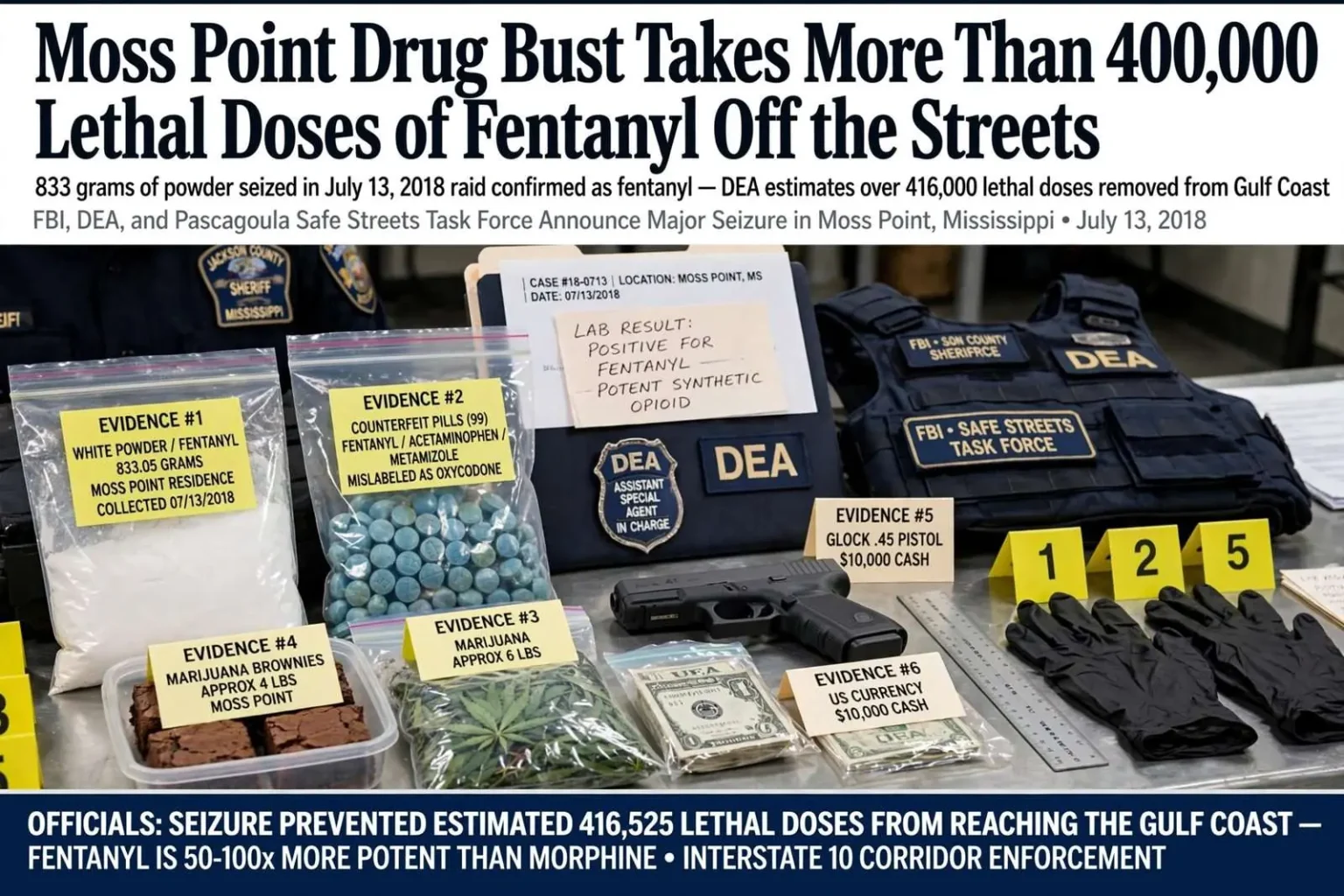
What federal agents first believed to be a cache of cocaine turned out to be something far deadlier: lab tests confirmed that 833 grams of powder seized at a Moss Point residence was fentanyl — enough, by DEA estimates, to deliver more than 416,000 lethal doses. The case illustrates how the synthetic opioid has quietly infiltrated drug supplies across the Gulf Coast, often masquerading as other substances and endangering users who have no idea what they are taking.
The FBI’s Pascagoula Safe Streets Task Force announced that agents, along with the DEA and the Metropolitan Enforcement Team, executed a search warrant on July 13, 2018 at the home of Dale Ricardo Easterling Sr., 43, of Moss Point. The warrant followed Easterling’s arrest by Louisiana State Police, who found seven kilograms (16.48 pounds) of cocaine hidden in a compartment of the vehicle he was driving. His arrest on the highway set in motion the search of the Moss Point residence, where agents uncovered the much larger and far more dangerous cache.
Moss Point sits in Jackson County along the Mississippi Gulf Coast, a community of roughly 13,000 people near the Pascagoula line that has felt the regional impact of the opioid crisis alongside its larger neighbors. Its location along Interstate 10, the principal east-west corridor linking the Deep South’s ports and cities, has made communities like it a focus of federal drug enforcement, since the highway network that carries legitimate commerce also carries narcotics moving between Gulf ports and inland markets. Local police departments in the region have repeatedly pointed to that corridor when explaining why multi-agency task forces operate from Pascagoula.
Mislabeled Pills and a Near-Kilogram of Fentanyl
Inside the residence, agents recovered what they initially logged as 833.05 grams of cocaine and 99 oxycodone dosage units. Laboratory analysis showed the powder was actually fentanyl, while the pills — improperly marked as oxycodone — contained fentanyl, acetaminophen and metamizole. Agents also seized six pounds of marijuana, four pounds of marijuana brownies, a .45 caliber Glock pistol and $10,000 in cash. The misidentification underscores a defining feature of the modern drug trade: even trained officers cannot distinguish fentanyl from cocaine or pressed pills from authentic pharmaceuticals without laboratory testing.
The counterfeit oxycodone pills represent one of the most lethal corners of the fentanyl trade. Users who buy what they believe are prescription painkillers on the street receive tablets pressed with fentanyl in uncontrolled concentrations, with no way to gauge the dose in a single pill. Federal drug laboratories across the country have documented a steady rise in counterfeit pill seizures, and the Moss Point haul shows the pattern reached the Mississippi Gulf Coast in force.
According to the DEA, just two milligrams of fentanyl is a lethal dose for most people, meaning the seized powder represented roughly 416,525 lethal dosage units — enough, officials noted, to kill nearly 14 percent of Mississippi’s population based on 2017 estimates. The arithmetic behind such figures is stark: a quantity of powder that fits in a shoebox carries, in theory, more lethal doses than the population of most Mississippi counties. Fentanyl’s potency, estimated at 50 to 100 times that of morphine, is what transforms a kilogram-scale seizure from a routine drug bust into a mass-casualty averted.
A Warning to the Public
“The FBI and our partners want to warn the public of the dangers of fentanyl and encourage opioid abusers to dispose of opioids purchased illegally,” said Christopher Freeze, the FBI’s Special Agent in Charge in Mississippi. “Fentanyl is the most prevalent and the most significant threat to the United States, including here in Mississippi,” added DEA Assistant Special Agent in Charge J. Derryle Smith. “This seizure, which was almost one kilogram, has saved countless lives.” The paired statements from the two agencies reflected a coordinated federal posture toward fentanyl: enforcement and public health warnings delivered together, on the theory that every seizure is also an opportunity to educate.
Federal officials emphasized that substances purchased on the street cannot be assumed to be what a seller claims. Counterfeit pills and adulterated powder have become so widespread that agents treat nearly every heroin, cocaine and pressed-pill seizure as a potential fentanyl case until laboratory results come back. Public health agencies have urged anyone who uses such substances, and their families, to keep overdose-reversal naloxone on hand and to call 911 immediately when someone shows the slowed breathing and unresponsiveness of an opioid overdose.
Officials also pointed residents to secure drop-box locations across Mississippi for disposing of unused controlled substances, no questions asked. The drop boxes, hosted at police departments and sheriff’s offices, give households a safe way to clear medicine cabinets of leftover opioids before they can be diverted, stolen or misused by family members. Disposal programs have become a standard element of anti-opioid strategy because a large share of misused prescription drugs originates in home medicine cabinets rather than street purchases.
The Task Force Behind the Bust
The Pascagoula Safe Streets Task Force is a Gulf Coast High Intensity Drug Trafficking Area initiative, drawing agents from the FBI alongside officers from the Pascagoula, Moss Point, Gautier and Ocean Springs police departments, the Jackson County Sheriff’s Office and U.S. Border Patrol. The HIDTA program, created by Congress in 1990, designates regions where drug trafficking is judged most serious and funds multi-agency task forces to coordinate intelligence and enforcement across jurisdictional lines.
For the Mississippi Gulf Coast, the task force model matters because drug networks rarely respect municipal boundaries. A distribution operation may source product through one city’s highway corridor, store it in another and sell it across three, which makes single-department investigations slow to build. By embedding local officers alongside federal agents, the task force lets cases move from a local arrest to federal charges with the paperwork, surveillance history and lab coordination already in place — exactly how the Moss Point case developed after the initial Louisiana traffic stop.
The Border Patrol’s participation reflects the coastal dimension of Gulf Coast drug interdiction. The region’s ports, waterways and interstate highways form one of the primary entry and transit zones for narcotics entering the southeastern United States, and task force members share intelligence that connects street-level seizures to larger supply routes. Cooperation of this kind lets a highway stop in Louisiana feed directly into a search warrant in Moss Point, which is precisely the sequence that unfolded in this case.
Fentanyl’s Grip on the Gulf Coast
The Moss Point seizure arrived amid a broader transformation of the American drug supply. Fentanyl, once encountered mainly as an adulterant in heroin, spread through counterfeit pills and mixed into cocaine and methamphetamine supplies, catching users who never considered themselves opioid consumers. Overdose death data compiled by federal health agencies showed the synthetic opioid driving record fatalities nationwide in the years surrounding 2018, and the Gulf Coast states recorded some of the sharpest increases as the drug moved south and east from its early footholds.
For law enforcement along the I-10 corridor, fentanyl also changed the calculus of everyday police work. Agencies issued guidance on protective equipment and exposure protocols, since accidental contact with even small amounts poses risk to officers, and drug interdiction units began field-testing seizures more cautiously. Evidence handling that once required little more than bagging and labeling now involves hazardous-materials precautions for suspected fentanyl.
What Happens Next in the Case
Easterling faced federal charges in connection with the seizure. All suspects are presumed innocent until proven guilty in a court of law.
Federal prosecution of fentanyl distribution cases typically proceeds under statutes covering possession with intent to distribute, and quantities of the size recovered in Moss Point can bring substantial mandatory penalties because of the drug’s classification and the amounts involved. Federal sentencing guidelines treat fentanyl quantities with particular severity precisely because of the lethal-dose math agents cited in announcing this seizure.
The multi-agency nature of the investigation means evidence gathered at the Moss Point residence supports a case that reaches beyond a single city — the Louisiana traffic stop, the interstate transport of cocaine and the stockpile of mislabeled fentanyl together sketch a supply chain connecting Gulf Coast communities to sources outside the region. Prosecutors use cases like this one to map those networks, and each seizure adds to the intelligence picture the task force maintains.
For Moss Point residents, the seizure’s most immediate meaning is the one agents stressed in their public warning: the drugs circulating in the community are more dangerous than their labels suggest. The task force urged anyone holding illegally obtained opioids to use the drop boxes, anyone struggling with addiction to seek treatment resources, and anyone with information about fentanyl distribution in Jackson County to contact investigators. Nearly 416,000 lethal doses never reached the street; the agencies involved said the goal is to make that outcome routine rather than remarkable.