Motorcyclist Critically Hurt After Rear-End Crash Near Brooks Bridge in Fort Walton Beach
A motorcyclist is in critical condition after a three-vehicle rear-end crash near Brooks Bridge in Fort Walton Beach, the Florida Highway Patrol says.
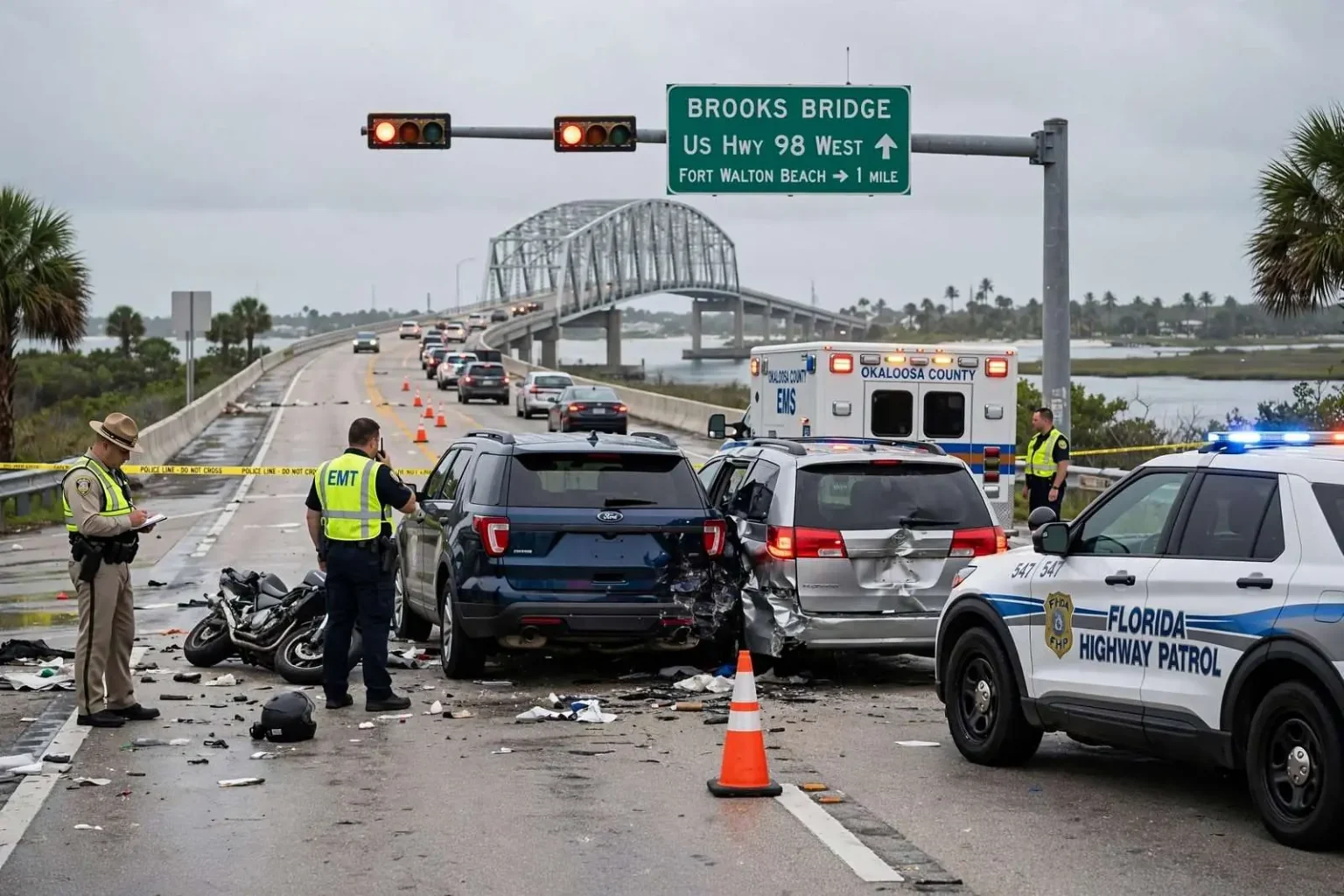
A motorcyclist was left in critical condition after being struck from behind at a Fort Walton Beach intersection early Thursday, according to the Florida Highway Patrol, in a morning crash that shut down traffic on one of the city’s busiest commuter corridors and once again highlighted the danger facing riders at signalized intersections along the Brooks Bridge approach.
Troopers say the rider was stopped at a traffic light near Brooks Bridge when a Ford Explorer hit the motorcycle from behind. The impact pushed the rider and the SUV into a minivan stopped ahead of them, creating a three-vehicle collision at the start of the morning commute. The chain-reaction pattern — a stopped motorcycle struck from behind and propelled into the vehicle ahead — is among the most common and most dangerous crash configurations for motorcyclists, who absorb the full force of the impact with no protective structure around them.
The motorcyclist, identified as Sean Clexton, was taken to Fort Walton Beach Medical Center for treatment of critical injuries. The hospital is the primary trauma receiving facility for Okaloosa County and the surrounding stretch of the Panhandle, meaning the most seriously injured patients from crashes along the Okaloosa Island and Brooks Bridge corridors are routed there for surgical care. No one in either of the vehicles involved was hurt, a contrast investigators routinely note in rear-end collisions: the occupants of the SUV and minivan walked away, while the rider was critically injured in the same seconds.
The Brooks Bridge Corridor
The crash closed in on the busy Brooks Bridge corridor during the morning commute, a stretch where drivers are regularly reminded to watch for motorcycles and leave following distance. The bridge carries U.S. Highway 98 across the Santa Rosa Sound between Okaloosa Island and downtown Fort Walton Beach, and its approaches funnel beach traffic, commuter traffic and commercial vehicles into a handful of signalized intersections where vehicles routinely stack up at red lights. Mornings bring the heaviest volume, as drivers who live on Okaloosa Island and the beach communities cross into Fort Walton Beach for work.
Rear-end crashes at those signalized approaches are a persistent problem along the corridor, and distracted driving is the usual suspect. A driver who looks down at a phone for even two seconds at 40 miles per hour travels the length of a football field blind, and stopped traffic at a light leaves nowhere for that error to go. For motorcyclists, the consequences are disproportionate — a fender-bender between two cars is a hospitalization or worse when one of the vehicles is a motorcycle, which offers nothing between rider and bumper.
What Troopers Investigate
Authorities did not announce any charges as the investigation continued, which is standard procedure in Florida for serious-injury crashes. Florida Highway Patrol troopers work the scene first — documenting vehicle positions, skid marks, debris fields and traffic signal timing — before the vehicles are removed and traffic is allowed to flow again. In rear-end collisions, the striking driver is typically found at fault for following too closely, but investigators will confirm the sequence of impacts, examine the Explorer’s event data recorder for speed and braking inputs in the seconds before impact, and rule out impairment or a medical event behind the wheel before finalizing a report.
The completed crash report determines whether citations or criminal charges follow. In a case involving critical injuries, possible outcomes range from a citation for careless driving — Florida’s workhorse traffic charge — up through felony counts if evidence shows impairment, street racing or willful recklessness. Those decisions generally take days to weeks, pending lab work and the data-recorder downloads, and the Patrol’s findings are shared with the State Attorney’s office if the evidence supports criminal charges.
Motorcycle Safety Along the Panhandle
Northwest Florida draws heavy motorcycle traffic for most of the year. Riders travel U.S. 98 and State Road 30-A along the coast, and the region’s motorcycle rallies and bike weeks bring thousands of additional bikes to the Panhandle roads in spring and fall. Local law enforcement agencies and the Florida Department of Transportation have run periodic safety campaigns urging drivers to look twice at intersections and to give motorcycles a full following distance, since a motorcycle’s smaller profile makes it easy to misjudge both speed and distance at a light or a turn.
Riders’ groups teach a defensive posture for exactly the scenario troopers described Thursday: when stopped at a light, position the bike to the side of the lane rather than dead center, keep a hand on the brake and an eye on the mirror, and leave an escape lane toward the shoulder or the space between queued cars. Those habits can shave the severity of a rear-end hit, but nothing eliminates the physics of a multi-thousand-pound SUV closing on a stopped motorcycle. Riders in gear — helmets, armored jackets, gloves — fare measurably better in crashes, and Florida’s partial helmet law leaves the choice to riders over 21 who carry insurance coverage.
The Morning of the Crash
Thursday’s crash occurred during the peak of the morning commute, when the Brooks Bridge approach and the intersections feeding it are at their most congested. Emergency crews responding to the scene faced the usual complications of a corridor crash — limited room to work between the bridge and the signal, queued traffic backing up in both directions, and the need to route a critical trauma patient quickly. The injured rider’s transport to Fort Walton Beach Medical Center put the hospital’s trauma resources to work within minutes of the first 911 calls, which is the decisive factor in survivability for the most serious crash injuries.
The closure added delays to a route that thousands of drivers use daily. Crashes near the bridge ripple outward quickly, backing up traffic on Okaloosa Island and through downtown Fort Walton Beach at once, and drivers learned of the disruption through the usual mix of navigation apps and local alerts. By the time the vehicles were cleared and the roadway reopened, the morning commute had largely been spent, an all-too-familiar rhythm for a corridor where serious crashes recur.
What Comes Next
For the rider’s family, the hours after a critical-injury crash become a vigil at the hospital, and outcomes at this stage depend on the nature of the injuries — head trauma, pelvic and spinal injuries, and internal bleeding are the typical threats in rear-end motorcycle impacts. The medical center’s trauma team will stabilize the patient first and assess the full injury picture through imaging and surgery as needed. Friends and acquaintances of the rider shared concern across social channels as word of the crash spread through the community.
The investigation will produce a report that assigns fault, and insurance claims between the three vehicle owners will follow from it. For the drivers of the Explorer and the minivan, the crash was over in an instant with no reported injuries; for the rider, the same instant opened an unknown recovery measured in weeks or months, if the critical injuries can be overcome. That asymmetry is the core of every motorcycle-safety message this corridor produces: the car’s driver walks away and the rider pays.
Troopers ask anyone who witnessed the collision or who has dashboard-camera footage from the Brooks Bridge approach Thursday morning to contact the Florida Highway Patrol’s local district office, since witness statements from stopped vehicles often resolve the question of signal timing and impact sequence faster than physical evidence alone. The reminder the crash leaves behind is the one the corridor’s safety campaigns have repeated for years — watch for motorcycles, put the phone down, and leave following distance, because the few seconds it takes to stop behind a rider is the difference between a bad morning and a tragedy.
Local emergency responders train regularly for corridor crashes of this type, and the agencies that cover Fort Walton Beach and Okaloosa Island coordinate on the logistics of bridge-approach incidents — where to stage ambulances, how to hold traffic, and when to request air transport if ground transport to the trauma center would be slower. Those decisions are made in the first minutes by the incident commander on scene, and they are the reason serious-injury patients from this corridor generally reach definitive care quickly.
Statistics compiled by the state over the years consistently rank rear-end collisions among the leading crash types at signalized intersections, and motorcycle-involved crashes carry an injury rate several times higher than the all-vehicle average. Every safety campaign aimed at the Brooks Bridge corridor repeats the same arithmetic: a rider stopped at a red light has done everything right, and the outcome depends entirely on the driver coming up from behind. Troopers will complete their report in the coming days, and the findings will determine what, if anything, the Explorer’s driver answers for in court.