
Murphy High Students Unharmed After Bus Struck Near Greensboro
A bus carrying 27 Murphy High School sophomores was struck near Greensboro while returning from a University of Alabama trip. No injuries were reported.
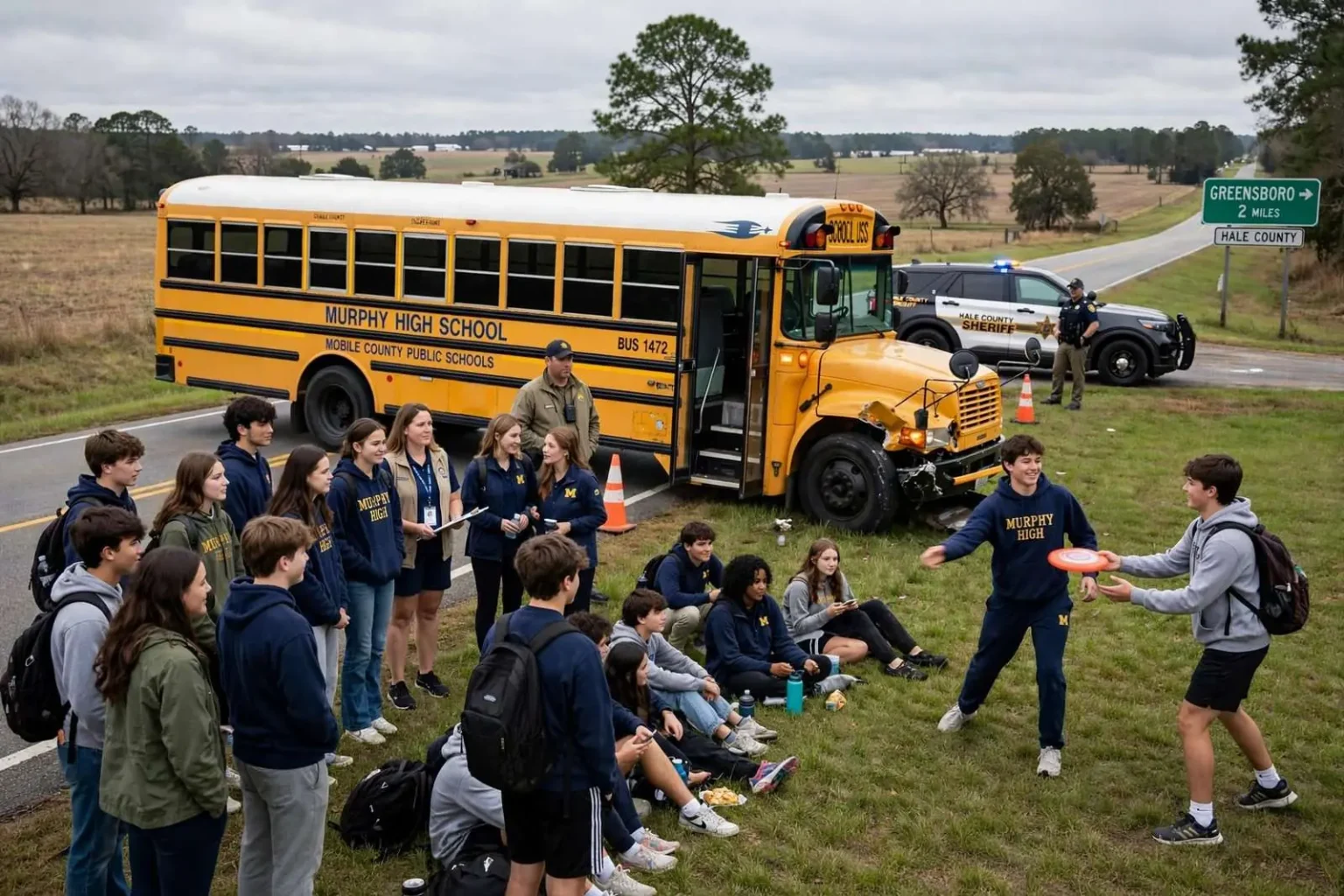
A bus carrying dozens of Murphy High School students back from a college visit was struck near Greensboro, but school officials say no one was hurt. Rean Philips with Mobile County Public Schools said 27 sophomores and 8 chaperones were returning to Mobile from the University of Alabama on Friday when an SUV hit their bus.
The group had traveled to Tuscaloosa to tour campus and receive UA ID cards through the Murphy University Center, a program that lets students take college classes at Murphy while earning up to 30 hours of college credit. The trip is a milestone in the program’s calendar, marking the point at which sophomores in the pipeline are formally connected to the university whose courses they will begin taking back home in Mobile.
The collision happened along the route home near Greensboro, the county seat of Hale County, a small Black Belt city roughly midway between Tuscaloosa and the western approach to Mobile. Details about the impact were limited, but officials confirmed that the students and chaperones aboard the bus escaped without injuries — an outcome that, given the speeds and masses involved in crashes between buses and passenger vehicles, was welcomed with relief on both ends of the route.
Students Wait Safely for Replacement Bus
With their original bus out of service, the group waited for a replacement — passing the time with a game of frisbee, Philips said. The students called their parents to let them know what happened, and word of the crash spread through Murphy families in Mobile while the teenagers themselves, by every account from the school system, took the delay in stride.
The episode offered an accidental lesson in trip planning. School transportation protocols require a disabled bus’s passengers to remain with chaperones while a replacement vehicle is dispatched, and chaperones on long-distance student trips are trained to keep students together, account for everyone by name, and maintain communication with the school system’s transportation office until the swap is complete. A multi-hour wait in a town like Greensboro tests everyone’s patience, but a frisbee and a patch of grass proved sufficient entertainment for a group of sophomores whose day had already included a major university campus tour.
The Murphy University Center
The program at the heart of the trip is one of the most distinctive offerings in Mobile County Public Schools. The Murphy University Center allows high school students to take actual college courses taught at Murphy, with credits that count toward a University of Alabama degree. Students can earn up to 30 hours of college credit before graduating high school — roughly the equivalent of a full year of university coursework — at a fraction of the cost of taking the same classes on campus in Tuscaloosa.
The campus visit served a purpose beyond the ID cards the students picked up. For many sophomores, the trip to Tuscaloosa is their first extended look at the university they may eventually attend full time: the Quad, the academic buildings, the scale of a campus whose fall football Saturdays are known nationwide. Program organizers view the visit as a motivational anchor, showing students early what the destination looks like so that two years of accelerated coursework back at Murphy have a concrete goal attached.
Murphy High School itself is one of Mobile’s oldest and most storied public schools, a campus that has educated generations of the city’s students. Its University Center model has drawn attention as a way to make college more accessible — students who accumulate a year of credit before enrollment save substantially on tuition and housing, and they arrive at their universities with proof that they can handle college-level work.
The Route Home Through Alabama’s Black Belt
The drive between Tuscaloosa and Mobile crosses some of Alabama’s most rural terrain. The route passes through the Black Belt, a swath of west and south-central Alabama named for its dark soil, where counties like Hale have small populations, modest road budgets, and long stretches of two-lane highway between towns. Greensboro, with its historic antebellum homes and courthouse square, sits at the heart of that landscape.
Rural highways carry a disproportionate share of Alabama’s serious crashes. Long sight lines encourage higher speeds, intersections are frequently controlled by stop signs rather than signals, and emergency medical response times run longer than in urban areas. School buses do hold up well in collisions — their size, compartmentalized seating, and structural standards make them among the safest vehicles on the road — which is why an SUV striking a loaded bus so often ends with the bus’s passengers shaken but unhurt, as happened here.
Hale County’s Investigation
The crash remained under investigation by authorities in Hale County. In a rural county, that work typically falls to the Hale County Sheriff’s Office, whose deputies document the scene, interview drivers and witnesses, and reconstruct what happened before any citation or charge is issued. When a school bus is involved, investigators also coordinate with the bus’s operator and the school system, which supplies maintenance records, driver qualification files, and any onboard cameras that may have recorded the moments of impact.
Investigators in these cases look at several standard questions: which vehicle had the right of way, whether speed or distraction played a role, and whether mechanical failure contributed. Findings can take weeks, particularly when no injuries are involved and the case proceeds on paperwork rather than urgency. Until the investigation concludes, neither the school system nor law enforcement can say definitively who bears responsibility for the collision.
For Mobile County Public Schools, the incident becomes part of the data it maintains on its transportation operation — one of the largest school bus fleets in Alabama, running thousands of routes daily across a county that stretches from the Mississippi line to the Eastern Shore. The system logs every reportable collision involving its buses, and patterns in those reports feed into driver training and route planning.
Reassurance for Murphy Families
News of a crash involving a bus full of one’s own children arrives as every parent’s worst notification, and the phone calls home from the students themselves — reporting that they were fine, that a frisbee game had broken out — provided reassurance no official statement could match. School officials emphasized that the response worked as intended: students accounted for, chaperones in control, communication flowing, and a replacement vehicle on the way.
The outcome also reflects well on the adults aboard. Eight chaperones for 27 students is a strong ratio for a field trip of any kind, and the adults’ ability to keep a group of teenagers organized and calm beside a damaged bus on the side of a rural highway is precisely what that staffing is for.
School Bus Safety in Alabama
Alabama’s school transportation record has been a point of state attention for years. School buses nationally transport students billions of miles annually with fatality rates far below those of passenger vehicles, a result of federal construction standards, driver certification requirements, and the simple physics of a large, well-built vehicle. In Alabama, school bus drivers must hold a commercial driver’s license with passenger and school bus endorsements, pass background checks, and complete ongoing training, and the state inspects buses on a regular cycle.
Advocacy around school bus safety in Alabama has focused in recent years on measures such as stop-arm cameras to catch drivers who illegally pass boarding buses, a violation that endangers students at their most vulnerable moments. Rural routes add their own considerations — longer distances, higher speeds, and fewer sidewalks or shoulders for students waiting at stops — which is why districts weigh route timing and road conditions carefully, especially on highway segments like those connecting Mobile to the universities its students visit.
The Trip Ends Where It Was Always Going
Eventually the replacement bus arrived, the frisbee was put away, and the group of 27 sophomores and 8 chaperones completed the final leg back to Mobile, carrying UA ID cards that will open doors in Murphy’s hallways for the next two years. The bus that carried them most of the way home did not finish the trip, but everyone aboard did.
For the Murphy University Center, the episode is likely to become one of those stories programs tell for years — the campus tour, the crash on the way home, the game of frisbee in a Hale County town whose name the students may never have known otherwise. For the students themselves, it was a crash course in a different kind of education: that plans go sideways, that adults follow procedures for a reason, and that a group of people who keep their heads can turn a frightening moment into nothing more than a story worth retelling.
The Hale County investigation will produce its findings in due course, and any lessons for road safety along the Tuscaloosa-Mobile corridor will be noted where they always are — in the data. But the immediate account is the one school officials gave plainly: dozens of Mobile students, struck near Greensboro, unharmed, and already back to work on the college futures that brought them onto the highway in the first place.


