
Murphy Tailgaters to Collect Hurricane Sally Relief Supplies at Friday Night Game
Murphy High tailgaters are collecting water, food, tarps and baby supplies for Hurricane Sally victims at Friday's game against McGill-Toolen in Mobile.
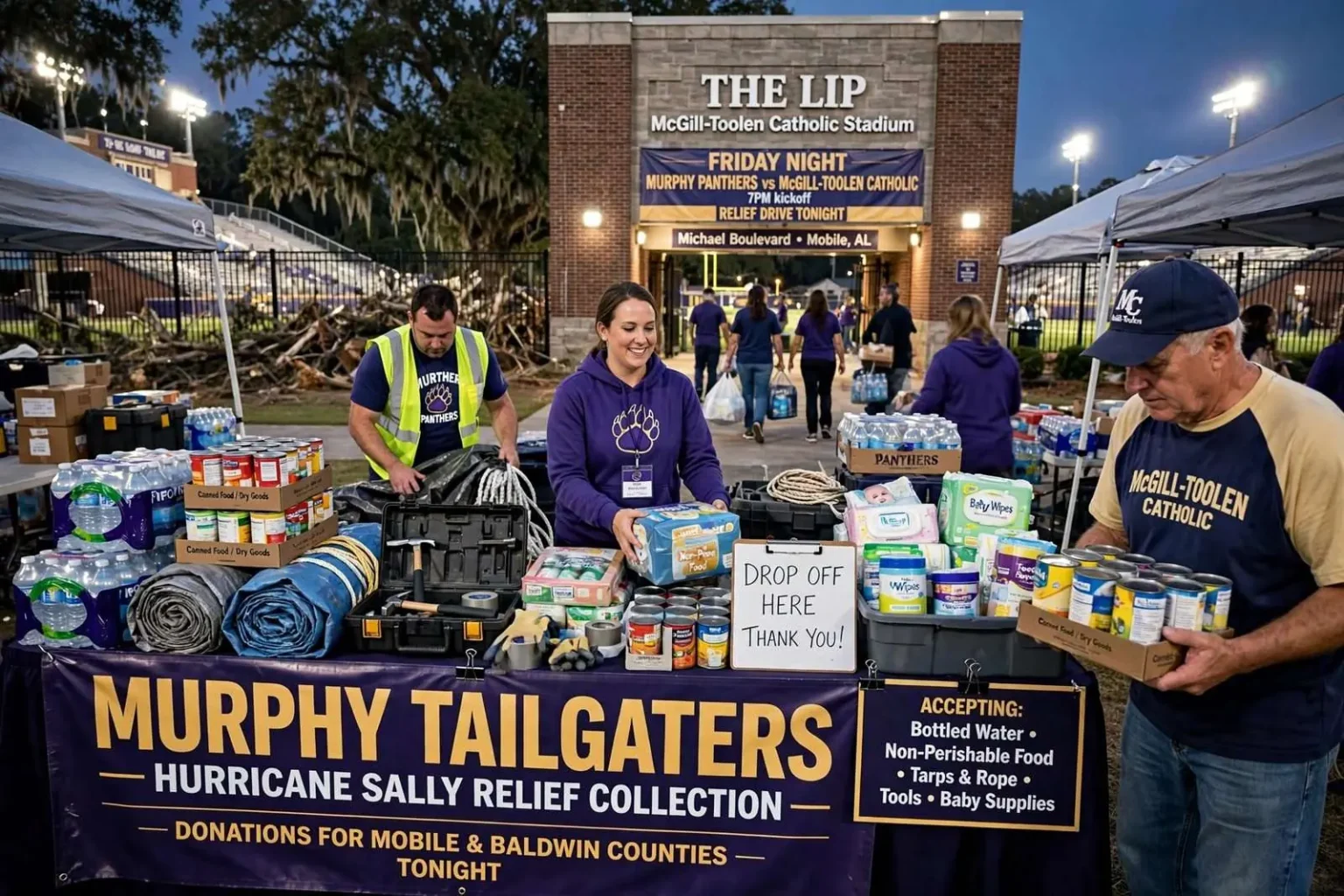
Fans heading to Friday night’s football game between Murphy High School and McGill-Toolen Catholic High School will be able to drop off help for neighbors still digging out from Hurricane Sally. The Murphy Panther tailgaters are gathering relief supplies at the game, giving Mobile residents one convenient place to hand off donations on their way into the stands. The pairing of a storied high school rivalry with a relief drive means that the crowd flowing into the stadium can turn a night of football into a night of practical assistance for families across the area who are still without power, without roofing or without the basics after the storm.
The donations collected at the game go toward supplies that have been in heavy demand since Sally came ashore. Organizers are asking for bottled water, non-perishable food, tarps, rope, tools and baby supplies. Each of those items speaks to a specific problem left behind by the hurricane: water for households whose tap service was disrupted, food for families whose refrigerators lost power, tarps and rope for roofs that lost shingles or entire sections, tools for clearing downed limbs and making temporary repairs, and baby supplies for the youngest residents whose routines the storm upended entirely.
What Sally Left Behind
Hurricane Sally made landfall on the Alabama coast as a slow-moving storm that punished the region with prolonged periods of heavy rain and sustained winds. The storm tore off roofing across Mobile and Baldwin counties, downed trees by the thousands and left homes and businesses without power, some for days and others for longer. Streets in Mobile’s older neighborhoods were blocked by fallen oaks and pine trees, crews worked around the clock to clear arterial roads, and utility companies brought in out-of-state line workers to restore electricity to thousands of customers. In neighborhoods across the two counties, the days after the storm were spent dragging branches to the curb, covering damaged roofs and waiting on insurance adjusters.
The pace of Sally’s approach made the aftermath worse in familiar ways. Because the storm lingered rather than passing quickly, rainfall totals piled up and drainage systems struggled to keep pace, flooding streets in low-lying areas even well inland from the coast. Baldwin County’s communities along Mobile Bay took heavy damage at the shoreline, while in the city of Mobile the dominant damage pattern was trees and wind: whole trees uprooted into houses, limbs through roofs and power lines brought down across neighborhood streets.
The Collection Point: The Lip
Supplies can be dropped off at McGill-Toolen’s stadium, known as The Lip, on Michael Boulevard, in the heart of Mobile’s Midtown area. The stadium sits in a densely populated part of the city that is easy to reach from Spring Hill, Midtown, West Mobile and the downtown neighborhoods, which makes it a practical collection point for a drive aimed at the whole community. Fans attending the game can bring items with them and hand them off before finding their seats, and residents who are not attending the game can still stop by and contribute during the collection window.
The Murphy-McGill-Toolen matchup is one of the classic fixtures on Mobile’s high school football calendar, drawing large crowds from across the city whenever the two schools meet. Murphy, a public high school with one of the longest histories in the Mobile County Public School System, and McGill-Toolen, the Catholic high school whose teams have long been among the strongest in the region, share a fan base that spans generations of Mobile families. Routing a relief drive through a game of that size means the potential volume of donations is substantial.
The collection is one of a growing number of grassroots efforts organized by schools, churches and neighborhood groups across the Mobile area in the days after Sally came ashore. In the aftermath of the storm, the formal relief response, utility restoration, debris pickup and emergency management operations, took time to reach every street, and in that gap neighbors filled the need themselves. Churches opened their parking lots for distribution points, schools with intact campuses became collection sites, and civic groups coordinated chainsaw crews and tarp teams for elderly residents who could not clear their own yards.
That pattern of local response is a long-standing feature of Gulf Coast storms. Large hurricanes overwhelm the capacity of any single agency in their first days, and the recovery that reaches households most quickly usually travels through informal networks: a school club collecting supplies, a church group cooking meals, a neighborhood association matching volunteers with residents who need trees cut off their roofs. The Murphy tailgaters’ drive at the football game fits squarely into that tradition, using an existing community gathering to funnel goods to where they are needed.
Why These Supplies Matter
The items on the organizers’ list track the real needs of a wind-damaged city. Bottled water matters because power outages knock out well pumps and can compromise municipal service in pockets, and because clean water is the first thing a household without electricity needs while it waits. Non-perishable food matters because families without power cannot keep refrigerated goods and cooking options are limited. Tarps and rope matter because a damaged roof cannot wait for a contractor to become available; covering a roof with a tarp is often the difference between a repair and a total loss when the next rain arrives. Tools matter because downed trees and limbs must be cleared before daily life can resume, and baby supplies matter because infants depend on items, formula, diapers, wipes, that disappear from shelves quickly after a storm.
In the weeks after Sally, the demand for exactly those items ran well ahead of what was on store shelves in many parts of Mobile and Baldwin counties. Roofing contractors were booked out for months, hardware stores sold out of tarps and generators repeatedly, and grocery supply chains took days to restock some neighborhoods. Community drives like the one at the Murphy game helped bridge that shortage, moving donated goods directly to the families who needed them without waiting on larger distribution channels.
The Recovery Ahead
For families still digging out, the recovery from Sally stretches well past the first week. Insurance adjusters must inspect damaged properties before claims can be paid, FEMA and state assistance programs require documentation and applications, and debris pickup across Mobile and Baldwin counties proceeded street by street for weeks after the storm. In the meantime, the visible signs of the hurricane, blue tarps on rooftops, curb lines stacked with cut limbs, boarded storefronts, remain part of daily life across the area.
Efforts like the Friday night collection at The Lip give residents a direct way to help with the phase of recovery that comes before the paperwork and the contractors: the phase where a family needs water, food, a covered roof and basic supplies today. The Murphy Panther tailgaters’ organizers have framed the drive simply, one convenient place to hand off donations on the way into the game. For a community in which thousands of homes were damaged and power crews and debris haulers were still working through backlogs, that simplicity is the point, and the response from fans arriving for one of Mobile’s biggest rivalry games is expected to fill more than a few trucks.
High school football has long served as the connective tissue of Mobile’s neighborhoods, and that role becomes most visible after a disaster. Friday night games draw together students, parents, alumni and neighbors who might otherwise never be in one place, which is precisely what makes them effective staging grounds for community drives. The Murphy tailgaters, the group of supporters who gather before games with food and fellowship, took that built-in gathering and gave it a second purpose: everyone coming to the stadium brings something the storm victims need.
The drive also reflects the specific geography of the damage Sally caused in Mobile. Midtown and Spring Hill, the neighborhoods nearest Michael Boulevard and The Lip, lost large numbers of mature oak trees, and tree damage was the story of the storm inside the city limits. A single uprooted oak can destroy a roof, crush a car and block a street simultaneously, and Mobile’s canopy, one of the treasures of its older neighborhoods, became one of its biggest hazards in Sally’s winds. Families in those neighborhoods were among those most in need of tarps, tools and helping hands in the days after the storm.
Coordinating Relief Across the Area
Grassroots collection drives work best when they are simple, and the logistics for this one were straightforward: suggested donations listed in advance, a single drop-off point at the stadium on game night, and volunteers from the tailgaters’ group to receive and organize the items. Once collected, supplies typically move through church networks and neighborhood groups that know exactly which households need them, avoiding the delays that can come with routing goods through distant distribution centers. The school communities involved, Murphy’s public-school base and McGill-Toolen’s Catholic community, reach across nearly every part of the city, giving the drive an unusually wide reach.
The timing matters as well. The days immediately after a hurricane are when demand peaks, before relief agencies have fully mobilized and before stores have restocked. A collection held within the first days or weeks after landfall catches families at the moment their needs are most acute, while the storm is still the central fact of daily life. As the weeks pass, attention shifts to insurance claims and reconstruction, but the supplies gathered early are what carry households through that transitional period.
A Rivalry With a Shared Purpose
There is a long tradition on the Gulf Coast of turning rivalry games into service projects, and the Murphy-McGill-Toolen matchup is a natural fit. The two schools have met on the football field for decades, and their fans include families split between the two camps, often within the same household. When a storm has just hammered the whole city, both sides of a rivalry share the same broken tree lines and the same neighbors waiting on power crews. Channeling that shared experience into a supply drive lets the game do double duty: it returns a piece of normalcy to a battered community while collecting real material help.
For students on both sidelines, the drive is also a lesson in what their schools’ communities look like at their best. Teenagers hauling cases of bottled water and stacks of tarps out of truck beds see directly who in their city is hurting and how quickly a crowd of neighbors can respond. Those are the images that tend to outlast the score of the game, in a season when the scoreboard has competition from the recovery still unfolding across Mobile and Baldwin counties. Residents who cannot attend the game are encouraged to look for other collection points being organized by schools and churches across the area, since the need for water, food, tarps, tools and baby supplies will continue as the region digs out.


