National Walk@Lunch Day Brings Downtown Mobile Out for a Stroll
Hundreds turned out for National Walk@Lunch Day in Downtown Mobile, a Blue Cross and Blue Shield initiative encouraging workers to walk during their lunch.
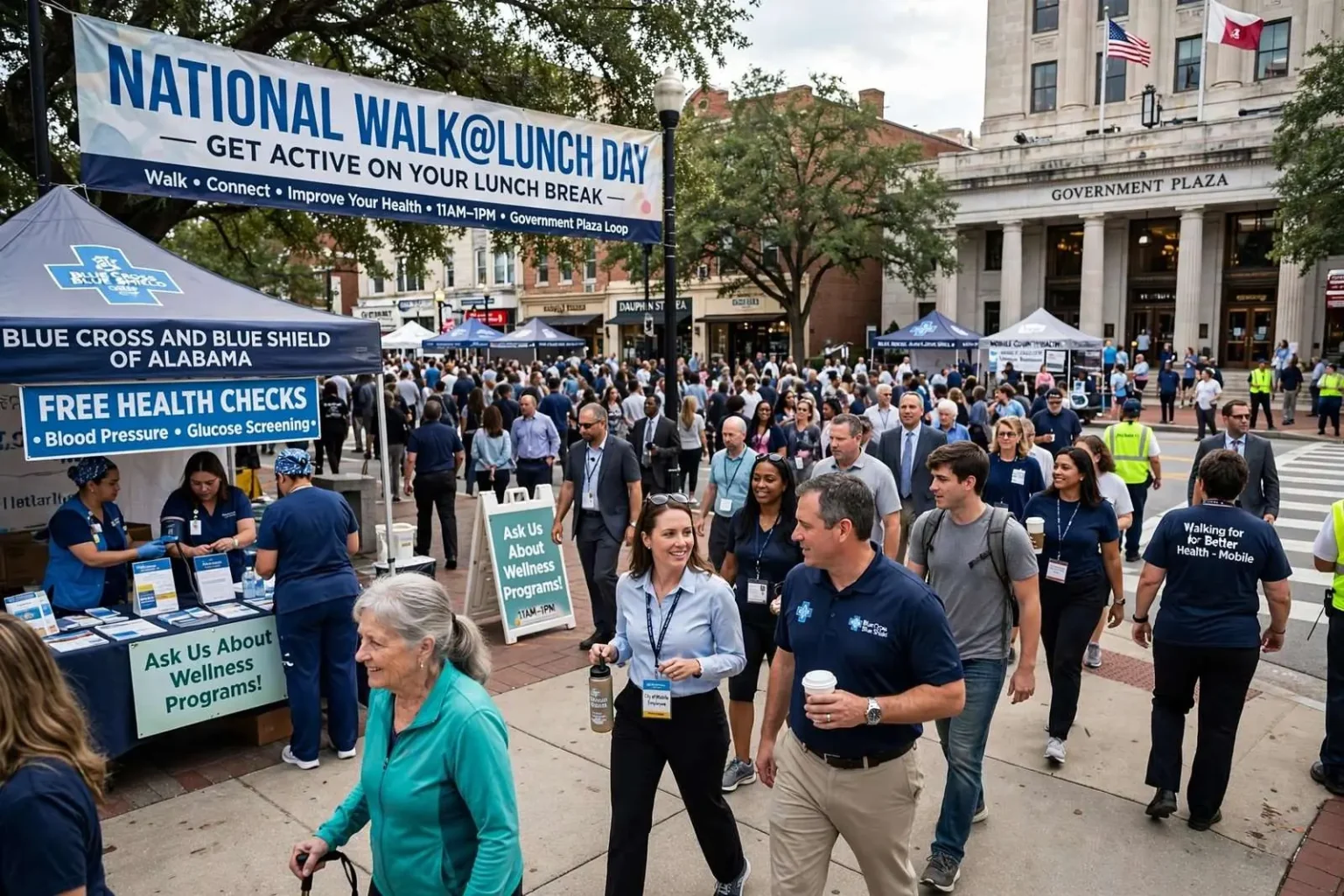
Hundreds of people laced up their shoes Wednesday and took to the streets of downtown Mobile for National Walk@Lunch Day, trading their desks for a one-mile loop around Government Plaza. The event was part of a statewide initiative organized by Blue Cross and Blue Shield that encourages employees to get active during their lunch break instead of spending the midday hour entirely indoors.
The walk ran from 11 a.m. to 1 p.m., giving participants a generous window to complete the mile-long route that circled Government Plaza, the civic heart of downtown Mobile where city and county offices sit within a few blocks of one another. Because the start and end times were spread across two hours, workers could slip out when their schedules allowed rather than all descending on the route at once, and the loop remained busy through the middle of the day.
A statewide push to get Alabama moving
National Walk@Lunch Day is designed to make physical activity fit inside a workday rather than compete with it. Blue Cross and Blue Shield, which organizes the observance across Alabama, has promoted the event for years as a low-barrier entry point to exercise: no gym membership, no special equipment and no need to carve out evening hours. Workers simply need a comfortable pair of shoes and a route that starts at their front door, which in downtown Mobile means the sidewalks around Government Plaza, Dauphin Street and the surrounding blocks.
The idea resonates in a state where public health officials have long flagged low physical activity rates as a contributor to chronic conditions such as diabetes, heart disease and obesity. Alabama routinely ranks near the bottom of national health rankings, and organizations like Blue Cross and Blue Shield have used workplace challenges, walking programs and events like the lunchtime walk to try to shift those numbers one step at a time. The message is deliberately simple: thirty minutes of walking a day is enough to begin improving health, and that half hour can be split into shorter walks during breaks.
Employers have a stake in the outcome as well. Organizers pointed to research showing that walking about 30 minutes a day can improve overall health and may lower long-term health care costs for both employers and employees. Healthier workforces mean fewer sick days, lower insurance claims and, often, better morale, which is why companies and public agencies alike have been willing to let employees step away from their desks for a structured walk.
Mobile brings health checks to the route
For the Mobile event, the City of Mobile and Mobile County went beyond simply allowing the walk to happen. Local health officials and vendors were brought in so residents could get a free health check while they were downtown, turning the lunchtime stroll into a small health fair. Screenings of that kind catch problems that often go unnoticed, from elevated blood pressure to blood sugar issues, and they reach people who might not otherwise schedule a visit to a clinic during working hours.
Government Plaza made a natural staging ground. The building houses offices for both the city and the county, and its position downtown puts it within walking distance of thousands of employees at City Hall, the county complex, courthouses, banks, law firms and the growing cluster of businesses along Dauphin and Government streets. Participants in Wednesday’s event came from all of those groups, along with residents who simply wanted to take part.
The free health checks also reflect a broader strategy that public health workers in Mobile County have pursued for years: meet people where they already are. Rather than asking residents to find a clinic, health officials set up tables along the event route and offered services during a window when downtown workers were already outside and moving. Vendors on hand represented hospitals, fitness providers and community organizations that offer ongoing wellness programs for people who want to keep walking after the event ends.
Why a one-mile walk matters
A single mile may not sound like much, but health researchers say the cumulative effect of regular short walks is substantial. Walking thirty minutes a day is associated with improved cardiovascular health, better weight control, stronger bones and muscles, and reduced risk of depression and anxiety. For people who get no other exercise, a daily lunchtime walk can be the difference between a sedentary lifestyle and an active one.
The lunch-hour timing is part of the design. Studies of workplace wellness programs have found that employees are more likely to stick with activity that happens during the workday, when routines are already fixed, than with evening plans that compete with family obligations and fatigue. Walking with coworkers also adds a social element that keeps people accountable, and many participants in past Walk@Lunch events have formed standing walking groups that outlast the official observance.
Downtown Mobile is well suited to the format. The area’s grid of sidewalks, its relatively flat terrain and its shade trees make for comfortable walking much of the year, and landmarks like Government Plaza, Bienville Square and the Dauphin Street corridor give walkers recognizable reference points. City officials have invested in downtown revitalization for decades, and events that put hundreds of pedestrians on the sidewalks during the workday double as a showcase for those efforts.
Blue Cross and Blue Shield’s broader wellness campaign
The statewide initiative is part of a larger effort by Blue Cross and Blue Shield of Alabama to address the state’s chronic health challenges. The insurer sponsors walking programs in schools, supports community fitness events and publishes guidance for employers who want to build wellness into the workday. National Walk@Lunch Day, observed annually, is one of the most visible pieces of that campaign because it requires so little from participants.
Public health officials in Alabama have long emphasized that the state’s health problems — high rates of diabetes, obesity and heart disease — will not be solved by treatment alone. Prevention, especially inexpensive prevention like walking, remains one of the few interventions available to nearly everyone. A walking program costs nothing, and research cited by organizers suggests the payoff extends to the balance sheet, with employers and employees both standing to save on long-term health care costs when routine activity becomes a habit.
For downtown Mobile, the day also served as a reminder that the lunch hour is a resource. City and county workers who joined the walk took the first step toward a routine that, repeated daily, could meaningfully change their health trajectory. Organizers hope that participants who enjoyed the event will keep walking on their own, whether on the Government Plaza loop, in Bienville Square or around their own neighborhoods after work.
Getting active on the Gulf Coast
The Gulf Coast presents both opportunities and obstacles for would-be walkers. Summers are hot and humid, and afternoon thunderstorms are a regular feature of the forecast from late spring through early fall. That makes the lunch hour, before the day’s peak heat in many months, a practical window for exercise. Winter in Mobile is mild by national standards, which allows year-round walking that residents of colder states cannot manage outdoors.
Communities across Mobile County have responded by expanding sidewalks, marking walking trails and promoting park facilities, from Langan Park in the city to municipal trails in Prichard, Saraland and Tillman’s Corner. Employers have done their part too, with some companies mapping one-mile routes that start and end at their buildings so employees know exactly how far they have gone.
Wednesday’s event put hundreds of those steps on display at once. For the duration of the two-hour window, the loop around Government Plaza belonged to workers in office clothes and walking shoes, health officials offering screenings at their tables and vendors handing out information on everything from nutrition programs to gym memberships. It was, in miniature, what the organizers of National Walk@Lunch Day hope to see across Alabama: a state that usually ranks near the bottom of the health charts taking a simple, free, collective step in the other direction.
How to keep the habit going
Wellness coordinators offer a few practical tips for anyone who joined Wednesday’s walk and wants to continue. Schedule the walk like a meeting so it is not skipped when the day gets busy; recruit a coworker to make the commitment mutual; and start with a route that is short enough to finish comfortably inside a lunch hour, with time left to eat. Comfortable shoes matter more than any gadget, and beginners are advised to build up gradually rather than jumping into long distances.
For workers who cannot leave their desks midday, splitting activity into shorter bouts — ten minutes in the morning, ten at lunch and ten in the afternoon — delivers much of the same benefit, according to the research organizers cited. The goal is a daily total near thirty minutes, not perfection on any single day.
Employees who want structured options after the event can check with their human resources departments, since many employers participating in Blue Cross and Blue Shield wellness programs offer incentives for logged activity. Community members without workplace programs can still take part in free options across the city, including the walking paths at public parks and group walks organized by neighborhood associations throughout Mobile County.
Wednesday’s stroll around Government Plaza was, on its face, a modest affair: a one-mile loop, completed at a casual pace, by people who had to get back to their desks. But the arithmetic behind it is what organizers emphasize. Hundreds of walkers, thirty minutes each, repeated day after day — that is how a community’s health numbers start to move, one lunch break at a time.