
Navy Admiral Praises Mobile Veterans Housing Program During Navy Week Visit
Rear Adm. Ron Fritzmeier toured the Volunteers of America Southeast Eagle's Landing facility in Mobile during Navy Week, praising the program's success helping homeless veterans find jobs and housing.
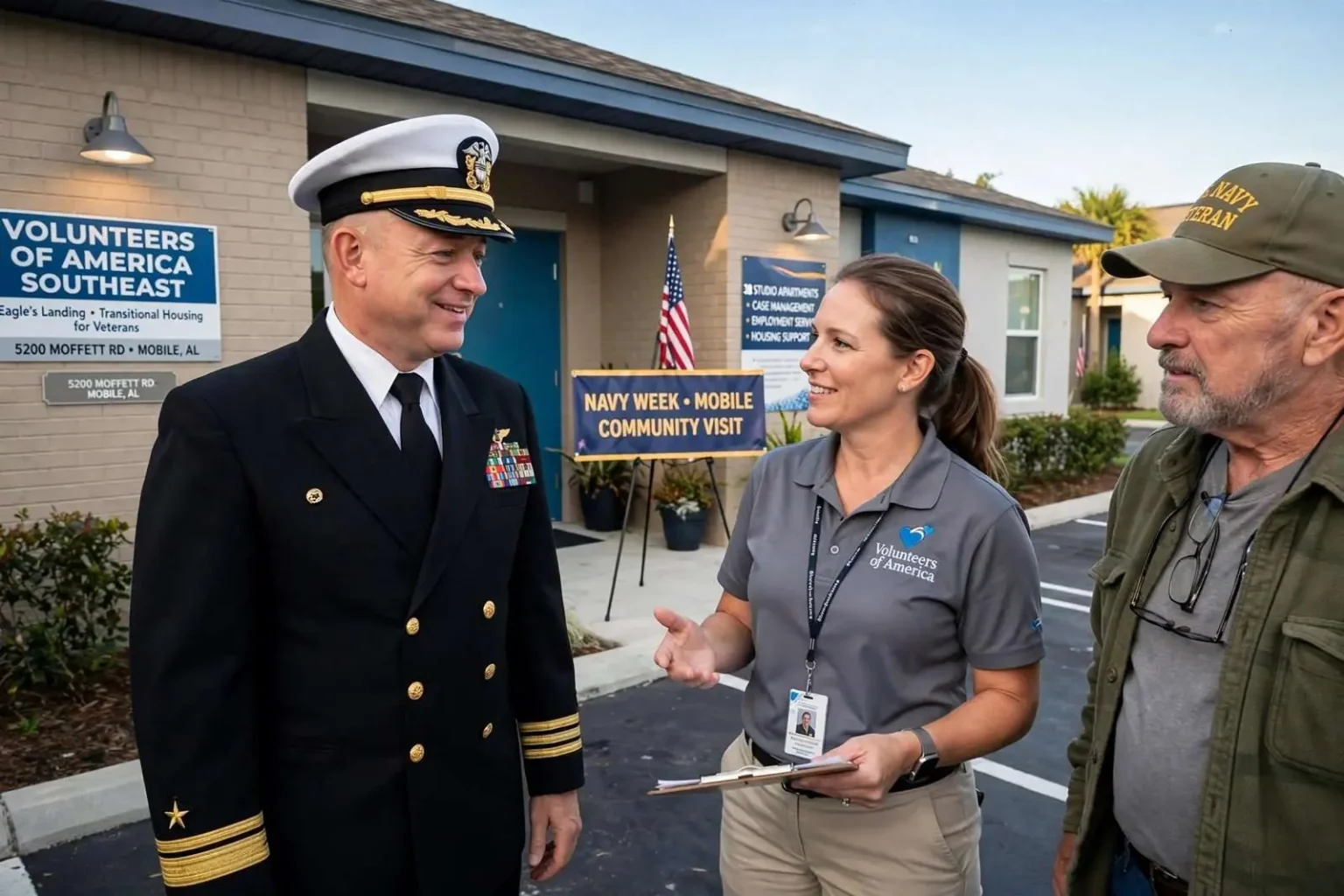
A senior Navy officer visiting Mobile for Navy Week toured a local facility that provides transitional housing for homeless veterans, calling the nonprofit program one of the more impressive efforts he has seen to help former service members rebuild their lives. Rear Adm. Ron Fritzmeier, chief engineer of the Space and Naval Warfare Systems Command, stopped at the Volunteers of America Southeast Eagle’s Landing facility as part of a slate of community visits scheduled during Navy Week in the Port City.
The stop gave the admiral a firsthand look at one of the region’s key resources for veterans without stable housing. Navy Week visits are built around exactly this kind of engagement, sending senior officers beyond the piers and air stations and into the community programs that serve the people who wore the uniform, and Mobile’s strong Navy ties — from the shipbuilding work along the river to the area’s deep veteran population — make the city a recurring stop on the Navy’s calendar.
Fritzmeier commands the engineering side of the Space and Naval Warfare Systems Command, the Navy organization responsible for the networks, communications and information systems on which the modern fleet depends. A chief engineer visiting a transitional housing facility is an unusual pairing, but the admiral framed the connection in personal terms: the sailors and marines the Navy builds systems for do not stop needing care when they take the uniform off.
Inside Eagle’s Landing
Eagle’s Landing, located on Moffett Road, provides furnished studio apartments and support services for up to 38 male veterans at a time. Every unit was full at the time of the admiral’s visit, and the facility maintains a waiting list, though officials did not disclose how many veterans are currently waiting for a spot to open. The waiting list itself tells the story that officials and visitors alike keep returning to: demand for this kind of housing in the Mobile area exceeds what the region currently provides.
The facility’s model is transitional by design rather than permanent in the ordinary sense. Veterans moving into Eagle’s Landing receive a furnished studio apartment of their own, then wrap it with the services that address why the housing was needed in the first place — case management, connection to benefits, employment help, and treatment referrals where needed. The goal is not simply shelter but a bridge back to self-sufficiency, with residents moving through the program toward stable independent housing and steady income.
Volunteers of America Southeast operates the facility as part of a broader regional network of services for veterans and other vulnerable populations. The organization has long specialized in programs that government agencies fund but cannot easily staff, and its track record in the Gulf Coast region is what programs like Eagle’s Landing are built on. The Moffett Road location places the facility along one of Mobile’s major northwest corridors, accessible to services downtown and to the jobs along the Highway 45 and Highway 43 corridors.
That all 38 units were occupied during a senior officer’s visit speaks to the constant pressure on the program. Transitional housing works best when a veteran can enter as soon as the need arises, and every full unit represents either a veteran now progressing toward independence or a veteran still waiting for the chance.
“Wounds on the Inside”
Fritzmeier said the visit underscored a challenge that has persisted even as medical care for service members has advanced. “You know it’s, in a sense, one of those tragedies that we have continued to get the medical technology to be able to take care of the needs of our military and veterans, but taking care of the wounds on the inside has always been harder,” he said following the tour.
The observation lands on a problem the veterans’ services field knows intimately. Combat medicine has advanced to the point that survival rates from injuries that would have been fatal in earlier generations are now dramatically higher, which means more veterans return home carrying injuries that are physical in origin but psychological and social in their consequences. The systems built to heal the body have raced ahead of the systems built to heal the mind, and homelessness among veterans is one of the most visible results of that gap.
He said the Navy’s mission extends beyond protecting geography to defending a broader way of life, which makes it especially difficult to see veterans struggle after their service ends. “That’s what we exist to defend, and then you see the unfortunate consequences for many vets,” he said. “The struggles they have, frankly, sometimes it’s their own poor choices, but oftentimes there is a root and some experience they had — especially recently because of all the sustained conflicts we’ve had — that can be really, really hard to deal with. So, it’s great to see these communities of people who are now going, ‘we need to care for these people.'”
The admiral’s distinction between choices and causes is one the transitional housing field has been making for decades. Homelessness among veterans is rarely explained by a single factor; it typically emerges from a combination of service-related trauma, injuries, family breakdown, economic hardship and gaps in benefits, and programs that address only the housing symptom without those underlying causes see residents cycle back out onto the street.
Why Navy Week Comes to Mobile
Navy Weeks exist to connect the fleet with the inland and coastal communities that rarely see a Navy ship up close, and Mobile’s edition is a natural fit for a city whose identity has been tied to the water for three centuries. The week’s schedule typically mixes flag officer visits, ship tours where available, community service projects, band performances and school engagements, all aimed at showing residents what their Navy does and letting service members see the communities they serve.
For Mobile, the ties run deeper than ceremony. The Port City has one of the most active shipbuilding and repair yards on the Gulf, a large veteran population spread across Mobile and Baldwin counties, and a long tradition of military service that shows up in everything from the area’s veteran service organizations to the turnout at veterans’ events along the coast. A Navy Week that ignored the region’s veteran services would miss the point, which is what made the Eagle’s Landing tour part of the schedule rather than an afterthought.
Senior officer visits like Fritzmeier’s also carry practical weight for the organizations involved. A tour by a flag officer draws attention to a program’s work, connects its staff to Navy leaders who can point veterans toward resources, and signals to donors and partners that the program is worth backing. Nonprofit facilities that serve veterans often operate on funding that arrives grant by grant, and visibility is a currency they cannot buy.
The National Picture Behind One Facility
Eagle’s Landing exists against a national backdrop that federal agencies have been working to change for years. Veteran homelessness is one of the few categories of homelessness where the country has seen sustained, measurable progress, driven by coordinated federal programs that pair housing vouchers with the dedicated services Eagle’s Landing provides — but progress nationally has never eliminated the need locally, and the full units and waiting list at the Mobile facility show the demand is not theoretical.
The transition from military service is the hinge point where most veteran housing problems begin. Service members spend years in a system that provides housing, employment, medical care and structure, and the move back to civilian life requires rebuilding all of those supports at once. For veterans who leave with untreated trauma, physical injuries, or skills that do not translate easily to civilian hiring, the transition can fail quietly over months or years, and the result is frequently the kind of housing instability that Eagle’s Landing exists to interrupt.
Programs like this one target the male veteran population that federal counts have consistently found at high risk. Transitional programs fill the gap between emergency shelter and permanent housing, a stretch of months where a veteran has a stable address while he works through benefits claims, employment searches and treatment, and where the alternative to a program slot is too often a car, a friend’s couch, or the street.
What Comes Next for the Program
The admiral’s visit ended without any new funding announcement, and that was not the purpose of the stop. What the visit produced was what such visits produce: a senior Navy leader with a clearer picture of what veteran services look like on the ground in Mobile, a nonprofit facility with a high-profile endorsement of its work, and a public reminder that the 38 furnished studios on Moffett Road — all of them occupied, with more names on the waiting list — represent only a fraction of the region’s need.
Volunteers of America Southeast continues to operate Eagle’s Landing and its companion programs across the Gulf Coast region, with veterans moving through the facility on the program’s timeline rather than a fixed calendar. Referrals into the program come through the regional continuum of care for homeless services, VA connections and direct outreach, and the facility’s staff continue the daily work the admiral came to see: taking veterans off the street, giving them a key of their own, and walking with them toward whatever comes next.
For the veterans who pass through its doors, the program’s value is measured in outcomes that never make headlines — a benefits claim approved, a job interview attended, a lease signed on an apartment of one’s own. Fritzmeier’s visit put a Navy admiral’s voice behind those quiet results, and it gave Mobile a moment of recognition that the care of its veterans does not end at the gate of any base or the edge of any shipyard.


