
Navy Taps Austal USA for $235 Million EPF 15 Shipbuilding Contract
Austal USA lands a $235 million Navy contract for its 15th Expeditionary Fast Transport, adding medical capability to the versatile Mobile-built vessel.
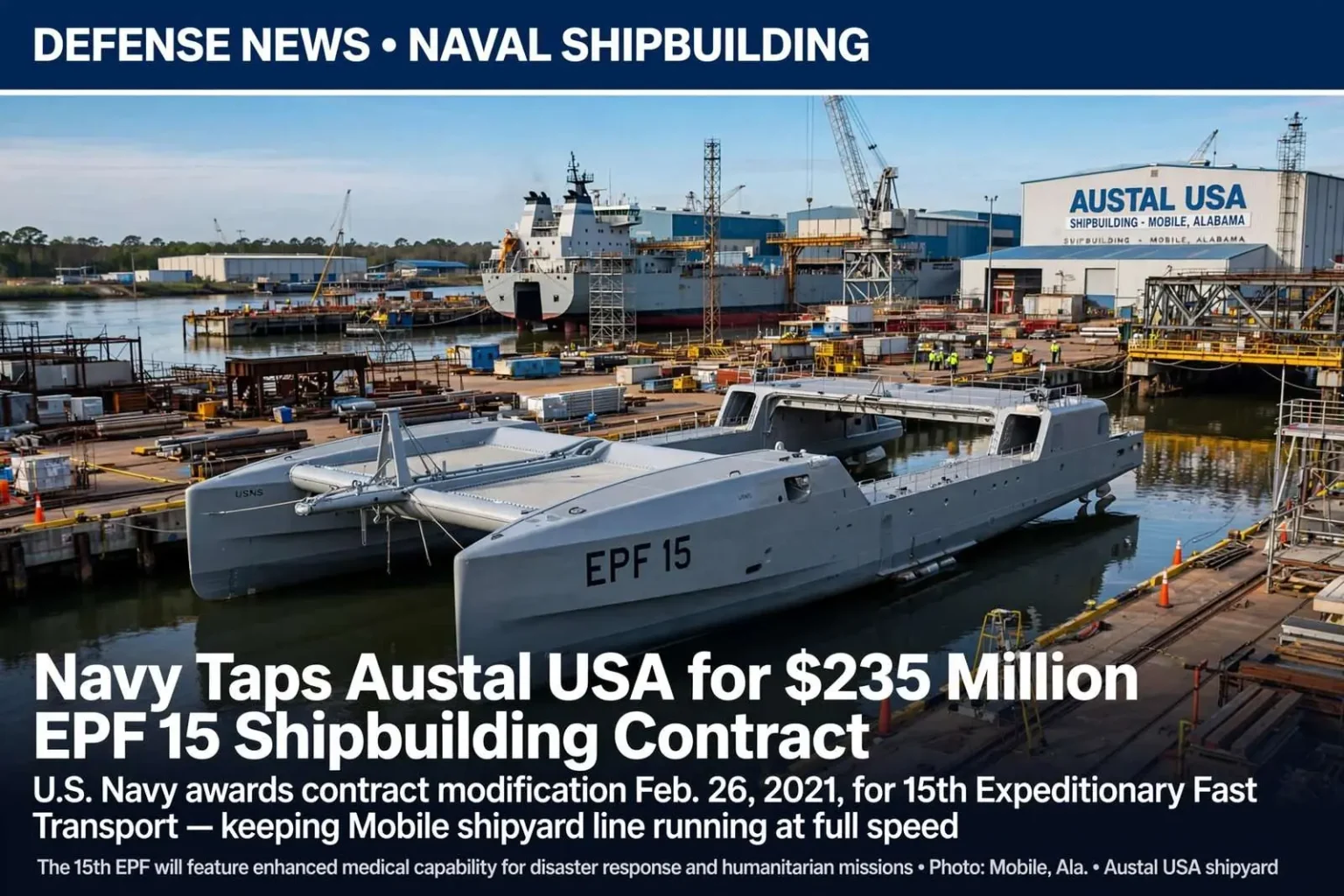
The U.S. Navy has awarded Austal USA a $235 million contract modification for the detailed design and construction of the fleet’s 15th Expeditionary Fast Transport, keeping the Mobile shipyard’s aluminum ship line running at full speed. The un-definitized contract action was signed Feb. 26, 2021, and signals continued Navy confidence in a program that has delivered a dozen ships to the fleet while staying on schedule and under budget.
The award is the latest chapter in a program that has become one of the success stories of American military shipbuilding. Austal USA, located along the Mobile River on the site of the former Buddy’s shipyard operations, grew out of the Australian shipbuilder Austal’s expansion into the American market in the late 1990s and has since become one of Mobile’s largest industrial employers, with a workforce of thousands building aluminum vessels for the Navy and, more recently, steel ships for programs like the T-ATS towing and salvage ships and the Navy’s next-generation frigate competition era facilities.
An un-definitized contract action — common in defense shipbuilding — lets the shipyard begin long-lead work and detail design while the government and contractor finalize the precise terms and pricing of the modification. For the Navy, it preserves schedule; for the yard, it keeps design teams and production trades busy without the gap that a lengthy negotiation could otherwise impose. Signing it in late February kept EPF 15 on the same production rhythm that has carried the class from EPF 1 through a dozen delivered hulls.
A Workhorse With Growing Missions
Originally conceived as a high-speed transport for moving troops and equipment inside a theater of operations, the EPF has earned a reputation among military planners as something like the pickup truck of the fleet. The vessels have carried out humanitarian assistance, disaster relief, maritime security, surveillance, command-and-control and counter-narcotics missions in nearly every corner of the world. The class proved its worth early — EPF hulls delivered relief supplies after hurricanes in the Caribbean and the Gulf, served as afloat staging bases for special operations forces and supported disaster response across the Pacific and Central America.
The design behind that versatility is distinctive. Each EPF is an aluminum catamaran, a twin-hull configuration that delivers stability and an enormous usable deck area at high speed, and the ships are built to commercial standards adapted for military service, which keeps their cost well below that of purpose-built combatants. Crewed by a relatively small contingent of civilian mariners and military specialists, an EPF can carry hundreds of tons of cargo and troops at speeds most vessels in the fleet cannot approach.
EPF 15 will add enhanced medical capability, expanding what future hulls can do. The medical configuration — developed with input from Navy medicine — is intended to let the class serve as a floating medical facility for disaster response, humanitarian missions and battlefield casualty care, filling a gap between small shipboard sick bays and the Navy’s full hospital ships. That evolution reflects lessons learned during two decades of contingency operations, when fleet commanders repeatedly reached for EPFs to perform missions their designers never imagined.
Design Built for Austere Places
The design’s shallow 13-foot draft, waterjet propulsion, large open mission bay and top speeds exceeding 35 knots let the ships reach austere or damaged ports with little outside help — flexibility that has opened doors to special operations and medical support missions as well. Where a conventional warship or transport needs a deep-draft pier and shore support to unload, an EPF can nose up to a ruined quay, lower its bow ramp and put vehicles and supplies directly onto a beach or damaged dock, which is precisely the capability that matters in the hours after a hurricane or earthquake.
The waterjets give the ships their signature performance, pushing the catamaran hulls at speeds conventional ships cannot sustain while letting them operate in shallow water where propeller-driven vessels risk fouling or grounding. The aluminum construction keeps weight down, and the vast mission bay — essentially a flat, flexible warehouse the length of the ship — accepts helicopters on its flight deck, vehicles through the bow ramp and mission modules tailored to whatever the deployment requires, from command-and-control suites to medical treatment spaces.
That combination has made the EPF a favorite of combatant commanders who need to move quickly without relying on infrastructure that may not exist. Special operations forces have used the class as an afloat staging platform, humanitarian missions have used it as a delivery vehicle for relief supplies, and Navy medicine’s interest in the hull — reflected in the enhanced medical capability planned for EPF 15 and future ships — grew directly out of those operational experiences.
Leadership Perspective on the Award
“At its core, the EPF is designed to be highly capable, flexible and affordable,” said Rusty Murdaugh, then Austal USA’s chief financial officer and interim president. He noted that awarding EPF 15 lets the Navy “leverage a hot production line and highly trained workforce” to keep delivering ships for today’s warfighters and beyond.
The emphasis on the production line reflects the economics of shipbuilding. A shipyard loses efficiency when orders arrive in bursts; a steady, unbroken line of hulls keeps designers, welders and outfitters working at the pace where they are most productive, and it holds down the cost of every ship in the class. The Navy’s decision to keep the EPF line moving — rather than letting it wind down and restart — protected both the schedule and the per-ship price, and preserved a workforce that would be difficult and expensive to rebuild.
For Mobile, the modification meant continued work on the riverfront through the life of the program. The EPF line has anchored Austal USA’s operations for more than a decade, drawing a supply chain of regional subcontractors and supporting thousands of jobs across the Gulf Coast. Each additional hull extends that economic footprint, and the medical variant planned for future ships offered the prospect of work that differs enough from the baseline design to keep the yard’s engineering teams growing along with the fleet’s needs.
The EPF Program’s Record
The program’s track record underpinned the Navy’s confidence in awarding the 15th hull. A dozen EPFs had already been delivered to the fleet on schedule and under budget — a rarity in modern shipbuilding, where cost growth and schedule slips have plagued many larger programs. The class entered service in 2012, and its production run in Mobile represented one of the fastest deliveries of a new ship class to the Navy in decades, driven by the simplified commercial-based design and the stability of the production line.
That consistency has made the Expeditionary Fast Transport program a case study in how the Navy acquires non-combatant ships. Rather than gold-plated specifications, the EPF sticks to proven commercial technologies adapted for military missions, and the fleet has rewarded that approach by finding ever more uses for the hull. What began as an intra-theater troop transport has become an operational Swiss army knife, and each successive contract has expanded the concept rather than merely repeating it.
The Navy’s future plans for the class point in the same direction. Beyond the medical configuration arriving with EPF 15, service leaders have explored EPF variants for missions including submarine support, command-and-control and mine countermeasures — a measure of how central the hull has become to the Navy’s distributed plans for the Pacific and elsewhere. Every additional hull delivered to the fleet extends those possibilities, and the Mobile yard’s experience with the design makes it the natural home for that growth.
What the Award Means for Mobile
For the Gulf Coast, the $235 million modification was more than a contract headline. Shipbuilding ranks among the largest industrial employers in the Mobile region, and Austal USA’s yard on the Mobile River draws workers from across southern Alabama and northwest Florida while supporting a network of suppliers whose businesses depend on steady naval work. A continuing production line stabilizes hiring, sustains apprenticeship pipelines that train the next generation of shipbuilders, and keeps capital flowing into facilities that benefit every future program the yard pursues.
The award also reinforced Mobile’s standing in the American shipbuilding industry. The city’s riverfront now hosts one of the nation’s most productive aluminum shipbuilding operations, and Austal USA’s expansion into steel construction has broadened the yard’s portfolio beyond the fast transport line. Local leaders have pointed to the steady rhythm of Navy awards as evidence that Mobile’s shipbuilding workforce can compete for any program the fleet needs built. For a program built on speed — both the ships’ 35-knot sprint and the yard’s rapid delivery record — the February 2021 signing of EPF 15 kept the momentum going, ensuring that the fleet’s pickup truck would keep rolling out of Mobile well into the future, ready for whatever mission commanders assign next.


