Navy to Name Future Destroyer USS Thad Cochran for Late Mississippi Senator
The Navy will name an Arleigh Burke-class destroyer for the late Sen. Thad Cochran, with possible construction at the Pascagoula shipyard.
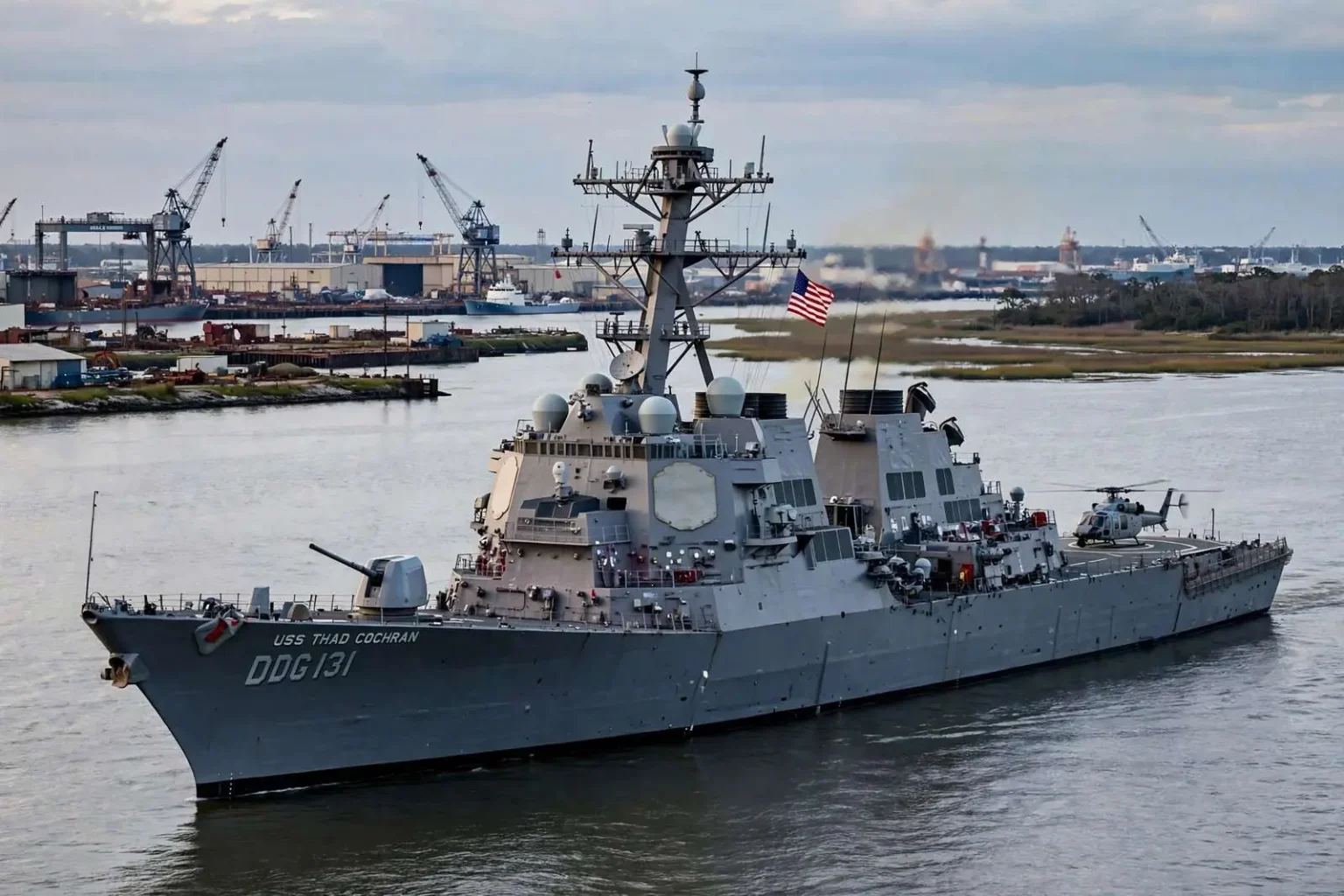
The United States Navy will name a future Arleigh Burke-class guided-missile destroyer in honor of the late Sen. Thad Cochran, the Mississippi Republican who served more than four decades in Congress and was himself a Navy veteran. The decision ties the Navy’s next generation of surface warships to one of the most consequential legislative careers in modern Mississippi history.
Sen. Cindy Hyde-Smith, who succeeded Cochran, announced that Navy Secretary Richard V. Spencer made the decision. Spencer called Cochran a strong advocate for national defense and “a courtly voice for cooperation and civility in American politics” — a tribute that captured both the substance of Cochran’s defense work and the personal style that made him effective across party lines.
A Statesman’s Legacy
Cochran served six years in the House before winning his Senate seat in 1978, beginning a Senate tenure that would span more than three decades of national security policy. As longtime chairman of the Senate Appropriations Committee, he steered federal spending and channeled major investments to the Gulf Coast, including defense and shipbuilding priorities that shaped the industrial economy of Mississippi and the entire Gulf region.
He was the 10th longest-serving senator in history when he resigned in April 2018 amid health concerns, and died that May at age 81. His departure ended a career defined by an understated, meticulous approach to the appropriations process — the kind of influence built through decades of committee work rather than headlines, and felt most keenly in the shipyards, bases and research institutions that federal spending sustains.
“Thad Cochran was a statesman who dedicated his life to serving his nation and his state,” Hyde-Smith said. “A future USS Thad Cochran destroyer is a fitting tribute to a leader whose service in the Navy was a touchstone for how he conducted himself as a public servant.”
Mississippi’s other senator, Roger Wicker, added: “When future Mississippians see the USS Thad Cochran, they can be proud of this statesman and the work he did for our state and nation.”
The Navy’s practice of naming destroyers for distinguished leaders places Cochran in the company of secretaries of the Navy, admirals, members of Congress and other public servants whose names sail on the fleet’s most numerous surface combatants. For Mississippi, the honor continues a tradition of naval namesakes with deep roots in the state.
The Ship: An Arleigh Burke-Class Destroyer
Arleigh Burke-class destroyers — able to fight air, surface and subsurface battles simultaneously — are built at only two shipyards: Bath, Maine, and Pascagoula, Mississippi, home of Ingalls Shipbuilding on the Gulf Coast. It is not yet clear where the future USS Thad Cochran will be constructed.
The Burke class forms the backbone of the Navy’s surface fleet, with dozens of ships in service and more under contract. Each destroyer carries the Aegis combat system, a phased-array radar suite and a loadout of missiles that allows a single hull to defend a carrier strike group against aircraft and missiles while prosecuting submarines and surface targets of its own. Their versatility has made them the most-produced major surface combatant in the world, and the class continues to evolve with each flight of new construction.
For the Gulf Coast, the question of where USS Thad Cochran is built is more than symbolic. Ingalls Shipbuilding in Pascagoula is one of the largest employers on the Mississippi coast and the sole builder of the Navy’s large-deck amphibious ships, and its destroyer assembly lines depend on the steady rhythm of new construction contracts. A Burke built at Ingalls means years of work for thousands of shipbuilders, electricians, pipefitters and tradespeople along the coast.
The Appropriations Connection
Hyde-Smith noted in September that the Senate Appropriations Committee approved a defense spending bill recommending a $390 million increase in materials funding for three destroyers, work that could flow to the Pascagoula yard. The advance procurement of long-lead materials — steel, propulsion components, electrical systems — is how Congress keeps shipyard production lines full between fully funded ships, and it is precisely the kind of spending decision that Cochran himself shaped for decades from the same committee.
The symbolism is difficult to miss: the committee Cochran chaired continuing to fund the shipyard his appropriations sustained, while a ship bearing his name moves toward the fleet. Mississippi’s congressional delegation has long treated shipbuilding as a core responsibility, and the Burke-class production lines at Ingalls are the visible result of that continuity across administrations and Congresses.
Cochran’s own Navy service gave the naming a personal dimension as well. Many of the country’s greatest legislative champions of the fleet served in uniform, and the Navy’s naming decisions often honor those who understood the service from the inside. Hyde-Smith’s tribute pointed to that connection — Cochran’s Navy years as the touchstone for the way he conducted himself in public office.
A Burke-class destroyer also represents years of sustained industrial work from contract award to launch, and its production schedule must be sequenced alongside the amphibious ships and cutters moving through the same yards. That choreography of docks, cranes and skilled trades is another reason advance funding decisions matter: shipyards plan hiring and supply orders around contracts Congress has actually approved, and uncertainty at the appropriations stage translates directly into pauses along the production line. The steady hand at the committee — the role Cochran played for decades — is what keeps the rhythm intact.
Mississippi’s Naval Namesakes and Gulf Coast Shipbuilding
The future USS Thad Cochran joins a fleet with strong Gulf Coast threads. Ingalls Shipbuilding has delivered destroyers, cruisers, amphibious assault ships, landing docks and National Security Cutters for the Coast Guard from its Pascagoula yards for generations, and the ships built there carry namesakes from across the nation’s history. A destroyer named for the state’s late senior senator will be commissioned into a fleet that already counts dozens of Gulf-built hulls among its most capable ships.
The economic reach of that shipyard extends across the region, including into Alabama. Workers from Mobile and the surrounding counties cross the state line daily to work in Pascagoula’s yards, and the supplier networks for naval construction — machining, coatings, electronics, fabrication — spread along the Gulf Coast in both states. A new Burke-class contract sustains that industrial web far beyond the shipyard’s gates.
The naming also lands at a time of expanding naval investment. Successive national defense strategies have emphasized the size and capability of the fleet, with Congress steadily adding destroyers to the Navy’s force structure, and the appropriations committees — where Cochran made his mark — remain the decisive arena for those decisions.
The Career Behind the Name
Understanding why Cochran earned this tribute requires recalling the mechanics of his influence. The Senate Appropriations Committee controls the yearly spending that keeps the government running, and its chairman sits among the most powerful positions in Washington. Cochran’s ascent to that post reflected seniority, trust on both sides of the aisle and a reputation for careful, unglamorous mastery of the budget — the kind of stewardship that steadily builds shipyards, funds ship construction and keeps installations open.
For Mississippi and the Gulf Coast, that stewardship meant defense contracts, shipbuilding work, research programs and federal facilities woven into the regional economy. Allies and successors, including Hyde-Smith and Wicker, inherited both the committee assignments and the expectation that Mississippi’s shipyard interests would be defended — an expectation the materials funding for three destroyers illustrates in concrete dollars.
Cochran’s reputation for civility, which Navy Secretary Spencer invoked in announcing the naming, was itself part of his effectiveness. In an institution that runs on relationships, his courtly manner and word-keeping style allowed him to negotiate across party lines during eras of divided government, securing outcomes for his state that a more combative approach might not have.
From Announcement to Commissioning
The journey from a naming announcement to a warship in commission takes years: contract award, construction milestones, launch, sea trials and delivery, with commissioning ceremonies often held in ports with meaning for the namesake’s family and home state. Should the future USS Thad Cochran be built at Pascagoula, Mississippi would later have the chance to host that moment — a commissioning on the Gulf Coast for a ship named for the senator whose appropriations work did so much to build the region’s shipbuilding industry.
Until then, the announcement stands as the Navy’s judgment on a career: a statesman honored the way the service honors its own, with a hull that will carry his name into the fleet for decades. The future USS Thad Cochran will fight air, surface and subsurface battles simultaneously, as every Burke-class destroyer is built to do — and every time it makes port or passes in review, it will carry the story of a Navy veteran from Mississippi who steered the nation’s spending and remembered the Gulf Coast while doing it.