Nearly 5,000 Signatures Back Food Pak’s Move. Its Neighbors Say the Fight Is About the Zoning, Not the Store.
Food Pak International wants to move two blocks to a lot the Hejazi family owns near Lavretta Park, which requires rezoning from R-1 residential to B-2 business. The Mobile Planning Commission takes up the request Sept. 17.
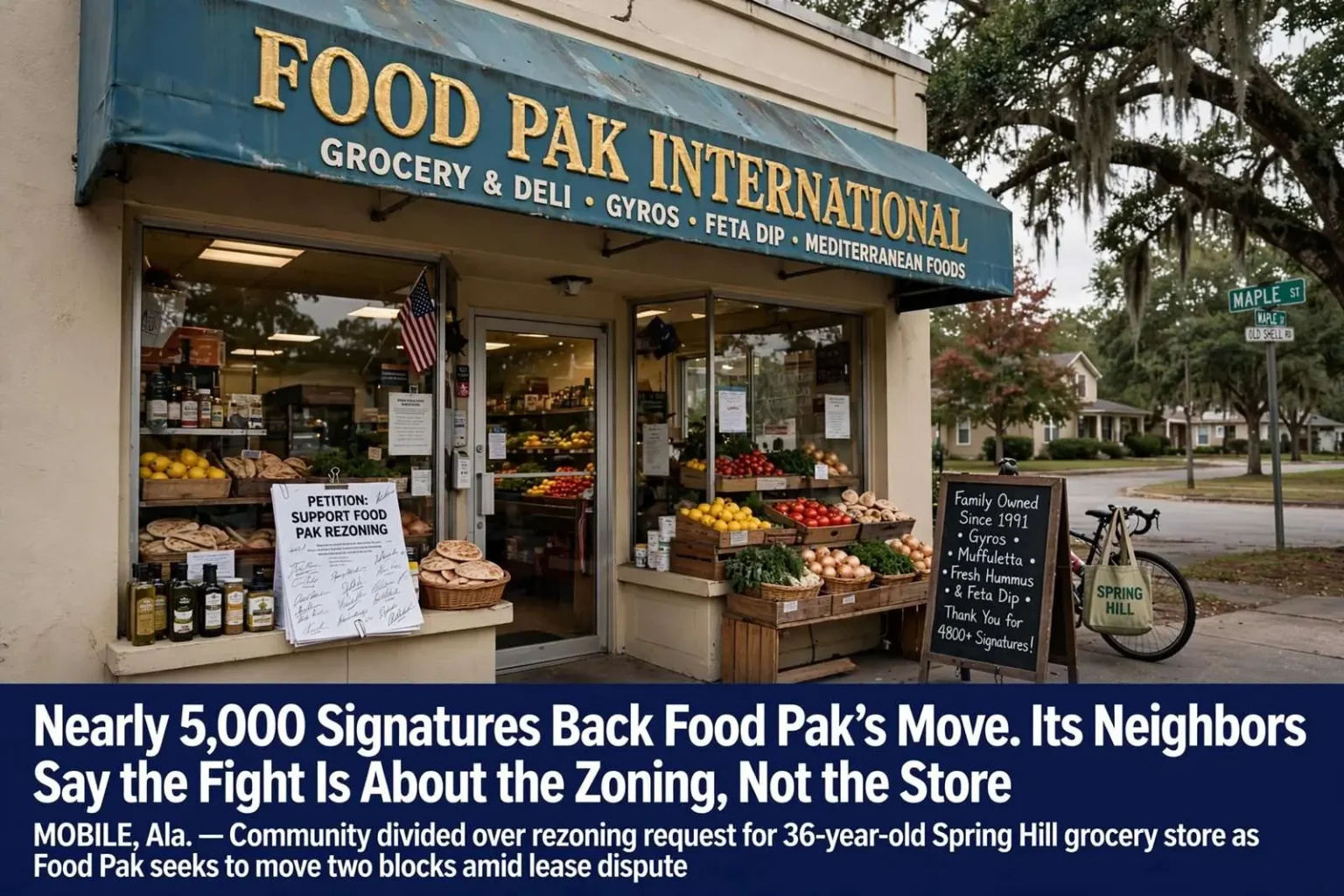
MOBILE, Ala. — Nearly 5,000 people have signed a petition to help a Spring Hill grocery store move two blocks. The store’s neighbors, many of whom signed nothing and shop there regularly, say the question before the city is not whether they like Food Pak. It is what happens to a residential parcel once its zoning is gone.
Food Pak International, a 36-year-old international grocery and deli on Old Shell Road, is seeking to relocate to an undeveloped half-acre lot across from Lavretta Park and near Maple Street Biscuit Company. The property is zoned R-1 residential. The Hejazi family, which owns both the business and the lot, has applied to rezone it B-2 business so they can build there.
The application was submitted to the city on Aug. 18. A hearing before the Mobile Planning Commission is scheduled for Sept. 17 at 2 p.m., and will be livestreamed for the public. A separate filing made Tuesday, Sept. 9, additionally seeks a variance for on-site parking and landscaping changes.
Why They Are Moving
The relocation is not an expansion play. It is a response to a lease that is ending.
Owner Mahin Hejazi said the move is necessary because the business has not reached an agreement to extend its lease, which is set to end in February 2027 unless new terms can be negotiated. Reza Hejazi, who signed the original lease in 1991 and has run the store since, said the landlord decided roughly four or five months ago not to renew.
Food Pak’s current location is leased from Blue Bird Properties, Inc., according to Mobile County property records. The business was founded by Deborah Beverly. The Hejazi family also owns a small lot just north of the current storefront, which previously served as a Masonic Lodge.
Mahin Hejazi said the proposed half-acre site two blocks east makes sense for the family. They already own the property, and the move would let them continue serving the same Spring Hill customers who have supported the store for more than three decades.
“It’s our mission to keep our store open, and continue to give our customers good quality food and quality service,” Hejazi said.
The Petition
Support materialized quickly. In roughly a week, nearly 4,800 signatures were collected backing the rezoning application; by another count the petition approached 5,000.
“Let’s all rally behind them to show Gina Gregory and the City Council that we support this rezoning and the Food Pak,” wrote petition starter Ricki Klyce.
Reza Hejazi said the support was hard-earned.
“At the beginning, it was not easy, but as time goes on, they saw from different lens who I am. And they realize who I am. That’s why I have so many that are supporting me and this move,” he said.
Customers describe a relationship that extends past groceries. Summer Hancock, a longtime resident and customer, said Reza Hejazi still asks after her family every time she comes in.
“He’s the sweetest person. I go in there to this day and he asks me about my life, asks me about my dad and like, ‘how are things going?’” she said. “I hope I can always go there just to feel a taste of home, because that’s what it is to me.”
Ivey Welch said the store has served multiple generations of her family.
“They are wonderful human beings. Family-oriented, love children, love the community, hardworking, make great food, just very dependable… You just trust them, they’re just part of our community. They’re like family neighbors,” she said. “Not only do they have a neighborhood business, but they live in our neighborhood, they raised their kids in our neighborhood.”
Former resident Tatiana Morris said the prospect of losing it affects her from out of town.
“It just makes me so emotional thinking about losing it. They’re amazing,” she said. “I just hope that whatever happens with anything, that they do well because I still want to be able to get feta dip and have an amazing gyro because their food is just fantastic.”
Mahin Hejazi said many regulars walk, bike or drive golf carts to the store, and that longtime customers frequently return years later with families of their own.
“They will grow up and have left, but when they come back they want to come and get our gyro and muffuletta,” she said.
The Objection Is Not About the Store
Kellie Myers, a Spring Hill community organizer who lives across the street from the site, has been circulating information opposing the rezoning through a Facebook group renamed “Oppose Residential Rezoning and Support Food Pak.” The name is the argument.
“No one opposing the rezoning is against or not supporting Food Pak and the Hejazis. That’s not what this is about,” Myers said.
Myers is herself a longtime customer. Her concern is that zoning attaches to land rather than to the business occupying it. Once the parcel changes from R-1 residential to B-2 business, the commercial designation stays with the property — even if Food Pak’s plans change, the project stalls, or the land is later sold to someone else.
“Once you lose that R-1 zoning, it’s gone. It’s not coming back,” she said.
She has a specific reason to make that argument. Earlier this year, Myers said, she assisted the Hejazis on the same property in securing permitting for a small multi-residential project there — a proposal she supported precisely because it would have kept the parcel residential. That project appears to have been abandoned after the city approved it. Her position changed when the family began pursuing a commercial use on the same site.
Residents in Country Club Village and nearby neighborhoods have opposed efforts to rezone the parcel for decades, according to Myers. The most recent proposal she recalled reaching the Planning Commission came around 2007, when a cable billing company sought to build an office there.
The Practical Concerns
Beyond the land-use principle, Myers raised operational objections: traffic, delivery access, waste disposal and drainage.
The same small road that serves Maple Street Biscuit Company would also handle traffic for the proposed Food Pak site, including delivery trucks and garbage trucks. The street has no traffic light and functions as a main entrance for Country Club Village and Spring Hill Woods. Myers said the effects could extend to nearby areas including Horloesther Court and the Kingswood subdivision.
She also questioned whether a half-acre parcel can physically accommodate the Hejazis’ site plans.
“I want their business to thrive. I just don’t want it to be right there with rezoning another residential space to commercial,” she said.
Mahin Hejazi said traffic impacts would be minimal because many customers already arrive from the surrounding area without vehicles.
A Middle Position
Former Mobile Councilwoman Bess Rich raised concerns about future stability in a community Facebook group, framing the question around compatibility rather than opposition.
“Compatibility with surrounding properties is important. Like traffic patterns, lighting requirements on the property, signage, noise levels and hours of usage,” Rich wrote. “Maybe there’s a way to make this change work that adds value for everyone. That’s the best part of the community coming together to ensure whatever the change is, it is positive and not negative.”
That comment points toward the tools a planning commission actually has. Rezoning is not always a binary approve-or-deny decision. Conditions can be attached governing hours of operation, delivery windows, lighting, signage, buffering and landscaping, and site plan requirements can address drainage and parking. Whether such conditions adequately answer the permanence objection — that the B-2 designation survives any particular occupant — is a separate question, and it is the one Myers is pressing.
Some supporters view the practical concerns as manageable given the parcel’s location at the edge of the neighborhood.
“Even if it’s an issue — the runoff, the building too big — it’s all on the outskirts of the neighborhood. There’s no reason why it couldn’t be there. It’s not like we’re tearing down residential — it’s a lot,” Ivey Welch said.
A Business in Public View
Mahin Hejazi said the family has tried to keep its business matters private, and that the public nature of a rezoning request has necessarily pushed them into the open. She said the customer response has been exceptional, though it has also created room for what she described as “negative energy.” Specifics about the lease negotiations remain private, she said; finding a way to stay open is the priority.
What Happens Sept. 17
The Mobile Planning Commission will take up the rezoning request at its Sept. 17 meeting at 2 p.m. Reza Hejazi said he expects to attend in person. The meeting will be livestreamed.
The commission’s role is advisory in this context; rezoning decisions in Mobile ultimately rest with the City Council, which acts on the commission’s recommendation. A separate variance request covering on-site parking and landscaping is also pending.
South Alabama News will report the outcome of the hearing.
Update: What the Planning Commission Staff Report Says
The rezoning request appeared as the fifth item on the Mobile Planning Commission’s Sept. 17 agenda.
Documents included with the agenda state the new building would be 8,600 square feet and would come with an outdoor dining area and eight parking spaces. Before that plan can be realized, planning commissioners would have to rezone the property from single-family residential to neighborhood business suburban district zoning.
The staff analysis included with the agenda frames the central objection in zoning terms rather than in terms of the business itself.
“The requested rezoning would introduce a B2 zoning classification into an area otherwise surrounded by R- zoning,” the documents state. “Although the Spring Hill Overlay contemplates limited retail uses within the neighborhood general subdistrict, its stated intent is to maintain a primarily residential urban fabric.”
That language matters because it identifies the precise tension commissioners are being asked to resolve. The Spring Hill Overlay does allow for some retail within the neighborhood general subdistrict — meaning a store on that block is not categorically inconsistent with the plan. But the overlay’s stated purpose is to keep the area predominantly residential, and a B-2 designation is not limited to the applicant or to a grocery store. Once the parcel carries business zoning, the range of uses permitted under that classification attaches to the land.
That is the distinction neighbors opposing the request have drawn throughout: support for Food Pak, opposition to placing a commercial zoning designation into a block otherwise zoned residential. Community organizer Kellie Myers has previously said she supports Food Pak but opposes the rezoning effort because a commercial zoning designation would welcome other businesses the neighborhood likely would not support.
Thousands of Food Pak supporters have signed a petition backing the rezoning request.