New Bivalent COVID-19 Booster Now Available at Every Mississippi County Health Department
The bivalent COVID-19 booster is now available free at every Mississippi county health department. Here's how to book an appointment.
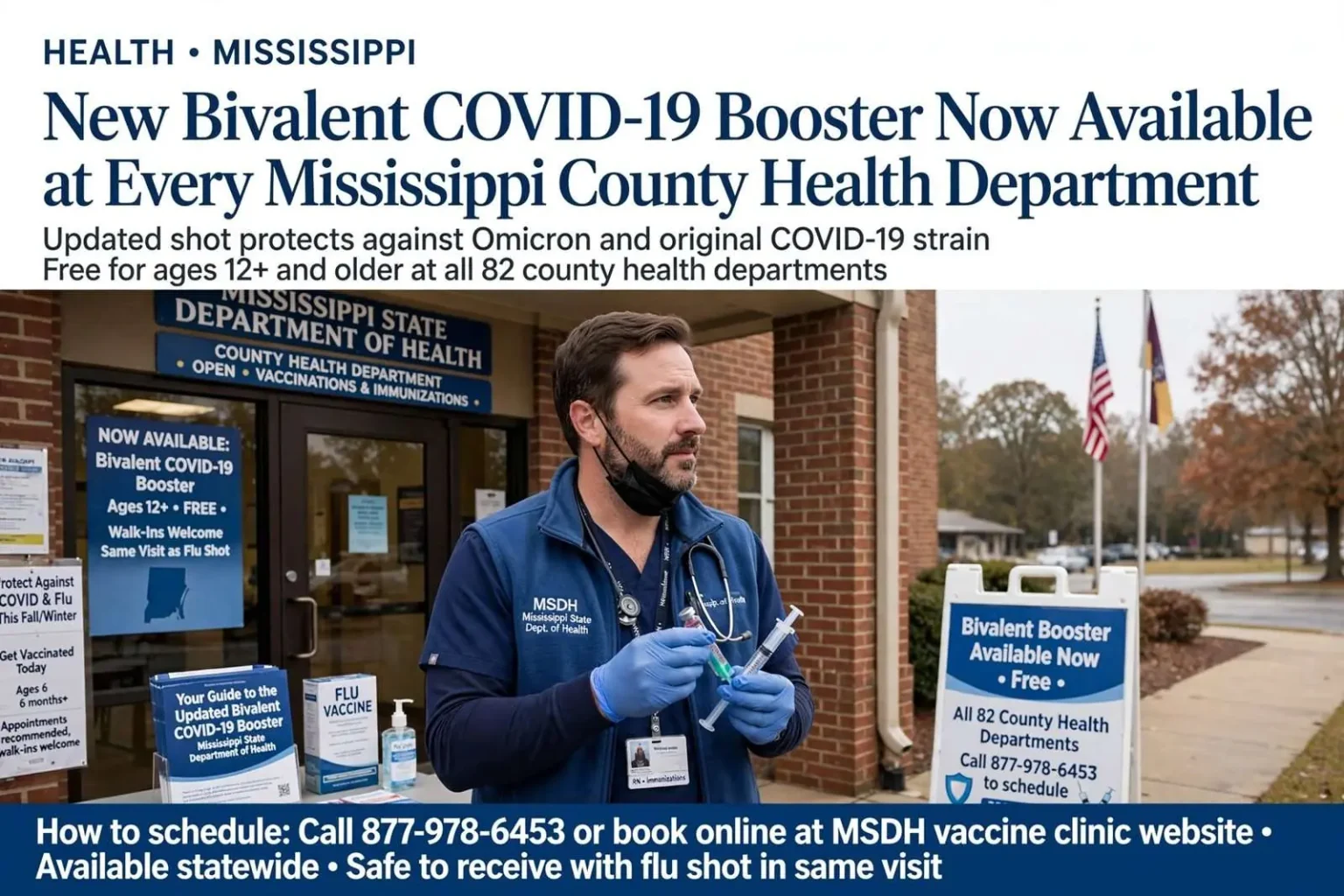
Mississippians can now get the updated bivalent COVID-19 booster shot at any county health department in the state, the Mississippi State Department of Health announced. The booster, endorsed by the FDA, targets both the original strain of the coronavirus and the Omicron variants driving most current infections. It is recommended for anyone 12 and older at least two months after finishing their primary vaccination series or their most recent booster.
The arrival of the bivalent formulation marked a shift in how the country’s vaccination campaign was built. Earlier boosters matched the original virus that emerged in 2020, while the bivalent shots were updated to address Omicron subvariants that had become dominant nationwide. Health officials in Mississippi and across the country described the two-strain approach as a way to restore protection that had faded as the virus evolved, particularly against infection, while the vaccines’ protection against severe illness and hospitalization had held up better.
How to book an appointment
Appointments can be made through the MSDH vaccine clinic website or by calling the COVID-19 hotline at 877-978-6453. Vaccinations are free at county health departments and are also offered at many pharmacies and private providers across the state. Patients should bring their COVID-19 vaccination card to their appointment if they have it, so providers can document the dose and confirm eligibility timing.
Mississippi’s county health department network means residents in every county — from the Gulf Coast counties of Hancock, Harrison and Jackson to the Delta and northeast hills — have a public vaccination point within reach. For residents without a regular physician, the county health department has long been the most accessible route to routine immunizations, and folding COVID-19 boosters into that network follows the same model the state uses for flu clinics and childhood vaccines.
With flu season approaching, health officials say the booster is safe to receive at the same visit as a flu shot. Co-administration has become standard practice: a single trip to the health department or pharmacy covers both vaccines, with each given in a separate arm. Officials have encouraged the combined visit as a way to lift both vaccination rates at once, since respiratory viruses tend to surge in Mississippi from late fall through winter.
“We strongly recommend that anyone eligible should go ahead and receive the updated booster now to provide the best protection against COVID-19 infection and severe complications from COVID-19,” said State Epidemiologist Dr. Paul Byers. “There is always the possibility of increased cases as we move into the fall and winter months. Don’t wait to protect yourself.”
Who should get the booster
MSDH recommends COVID-19 vaccination for everyone 6 months and older, and stresses it is especially important for adults 65 and older, children, people with weakened immune systems, and anyone with underlying health conditions. Those groups face the highest risk of severe outcomes from infection, and hospital data throughout the pandemic showed older Mississippians and those with chronic conditions accounting for the overwhelming majority of severe cases.
The eligibility window — at least two months since the last dose — was designed to give recipients enough time after a previous shot for the booster to do its work, while not waiting so long that protection had fallen away. Residents who recently had a COVID-19 infection were advised by health officials in many states to consider waiting a few weeks after recovery before getting the updated dose, a question the hotline staff can address for individual circumstances.
For the 12-and-older group the bivalent authorization covered, the shot represents the first booster reformulated since the original vaccines rolled out. Health officials framed the update as part of an expected rhythm — much like the annual flu vaccine, which is adjusted each year to match circulating strains — as the coronavirus settled into a pattern of variants that succeed one another rather than disappearing.
Mississippi’s pandemic context
Mississippi has ranked near the bottom of national vaccination statistics throughout the pandemic, a gap that state health officials have worked to close through county-level clinics, partnerships with churches and community organizations, and repeated public appeals from the state’s medical leadership. The decision to make the bivalent booster available at all 82 county health departments at once was aimed at removing distance as a barrier — in a largely rural state, a centralized vaccination site would leave many residents an hour or more from a dose.
The state’s free vaccination policy at county health departments has been a consistent feature of the response, since federal programs covered the cost of the vaccines themselves. Pharmacies across Mississippi, from national chains to independent drugstores, signed on as providers as well, giving residents multiple channels depending on where they normally get care.
What the bivalent booster is designed to do
The bivalent formulation contains components targeting two things at once: the original strain of the coronavirus, and an Omicron lineage. That combination reflects how the virus had changed by the time the booster was authorized. The Omicron family, first detected in late 2021, spread faster than earlier variants and produced waves of infection even among people who had been vaccinated or previously infected, because changes in the virus’s spike protein allowed it to partially evade existing antibodies.
Immunity from any vaccine or infection fades over months, which is why health officials have treated boosters as a scheduled part of staying protected rather than a one-time event. The updated dose was intended to renew that protection against the variants actually circulating, and early evidence from health systems that tracked the rollout showed boosted recipients faring better against infection during Omicron waves than those whose last dose was the original formulation.
Officials have been careful to distinguish between protection against infection and protection against severe disease. No vaccine prevents infection entirely, and breakthrough cases were expected and reported throughout the state. What the shots demonstrably do — and what Byers emphasized in urging Mississippians not to wait — is reduce the risk of the outcomes that strain hospitals: severe complications, intensive care admissions and deaths, which concentrate among the unvaccinated and the long-since-boosted.
Flu season and the combined visit
The timing of the announcement, heading into fall, was deliberate. Mississippi’s flu season has historically produced significant hospitalization, and public health officials in the state have long run fall flu vaccination campaigns through the same county health departments now offering the COVID-19 booster. Allowing — and encouraging — both shots at one visit reduces the number of trips a resident must make and removes a common reason for postponement.
For households with members in different age groups, the county health department model also simplifies logistics: parents, older relatives and eligible teenagers can all be vaccinated in one stop, with the state’s immunization registry keeping the records. Residents who have lost their vaccination cards can still be vaccinated — providers can verify doses through the registry — but bringing the card speeds up the check-in process.
Looking toward fall and winter
Byers’ warning about increased cases in the fall and winter months reflected the pattern the coronavirus had established: surges arriving as weather pushed people indoors, overlaid on top of flu and other respiratory illness. Health officials in Mississippi have urged the same layered precautions each season — vaccination, staying home when sick, and testing when symptoms appear — as the practical tools that keep schools open and hospitals from being overwhelmed.
The hotline, 877-978-6453, remains the single phone number for residents with questions about eligibility, scheduling or side effects, and the MSDH website lists county clinic locations and hours. For Mississippians who have let months pass since their last dose, the state health department’s message is straightforward: the updated booster is available now, free, close to home, and can be paired with a flu shot in the same visit.
Appointments are recommended to reduce wait times, though county health departments have continued to accommodate walk-ins for vaccines as capacity allows, keeping the barrier to protection as low as the state can make it.
Access across the state
The county health department rollout carried particular weight in Mississippi’s rural counties, where the nearest pharmacy may be in the next town and a hospital may be half an hour away. Locating the booster at all 82 departments meant that a resident in any county — from DeSoto in the north to Harrison on the coast — had the same access as someone in Jackson, an equity consideration health officials have emphasized since the first vaccines arrived.
The department’s clinic staff have also fielded the practical questions that come with any updated vaccine: whether it is safe with other routine immunizations, what to do about a dose received recently, and how timing works for people who switched between the two-dose and single-dose primary series. The hotline exists for exactly those questions, and operators can book appointments during the same call, collapsing what might otherwise be several phone calls into one.
Pharmacies and private providers add a second layer of access. Many residents have an established relationship with a local pharmacist or physician, and those providers receive the same free vaccine supply under the federal program, so cost does not differ from site to site. For most Mississippians, the deciding factors are distance and convenience — and with three channels available, the state’s message has been that at least one of them should be close by.
As the fall progressed, health officials planned to track uptake county by county and adjust outreach accordingly, leaning on the community partnerships that have anchored Mississippi’s vaccination campaigns throughout the pandemic. The booster’s availability, in the end, is only half the equation; the other half is the state’s standing advice, repeated by its top epidemiologist: don’t wait to protect yourself.