No Masks Required: Baldwin County Students Head Back to Class Under Personal-Choice Policy
Superintendent Eddie Tyler says masks stay optional as Baldwin County students return Jan. 18, even as ADPH reports record pediatric COVID hospitalizations.
A Family-by-Family Decision
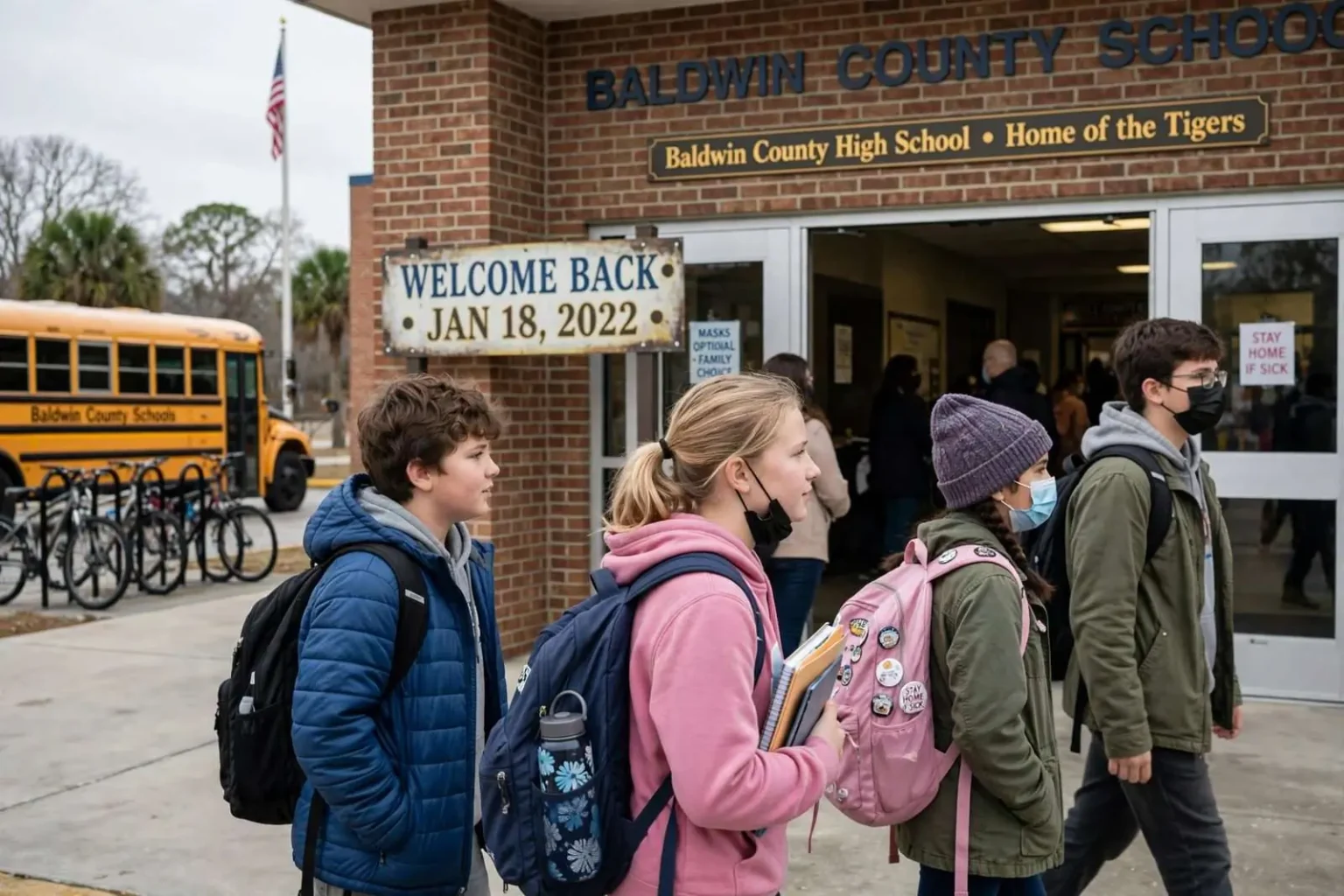
Baldwin County students went back to school Tuesday, January 18, without a mask requirement waiting for them. Superintendent Eddie Tyler told parents in a letter that the district would not reinstate its mask mandate, keeping face coverings a family-by-family choice for now — a decision that put Alabama’s third-largest school system on a different footing than districts around the country still requiring masks in classrooms.
“As a result of the vaccines being widely available, and this particular strain of the virus being much less impactful, I believe we are not facing the dire threats we were before and therefore our response should be measured similarly,” Tyler wrote.
The letter framed the change as a matter of proportion: the tools available to families and doctors at the start of 2022, Tyler argued, bore little resemblance to the uncertainty districts faced when campuses first closed. For a sprawling district that stretches from the Gulf beaches to the farms north of Bay Minette, a single blanket rule had always covered communities living through very different versions of the pandemic.
Health Officials Urge a Different Course
The decision landed amid warning signs from the state’s health apparatus. The Alabama Department of Public Health reported that pediatric hospitalizations stood at their highest level of the entire pandemic, and state figures showed Alabama with the second-lowest vaccination rate in the country, with only about 48 percent of residents fully vaccinated and coverage among children even lower.
Dr. Wes Stubblefield, a district medical officer with ADPH, called the Omicron surge a serious situation that could drive further hospitalizations among children. “In the crisis of higher virus transmission with the Omicron variant, immediate measures are critical,” he said. “School-wide masking is at the top of the list of preventive steps that need to be implemented. Masks can still make a difference in school settings and allow students to remain in class, if properly used.”
The gap between those two positions captured the tension playing out in school board rooms across the South in January 2022. Public health officials, watching hospital capacity tighten as the fast-moving variant tore through the state, pressed for layered precautions in classrooms. District leaders, weighing exhausted parents, staff shortages and a widespread desire for normalcy, were choosing to leave the final call with families.
Tyler said employees he had spoken with supported keeping schools open, and that staff absences were shrinking as workers returned to duty more quickly under updated federal guidance. The district adopted the CDC’s shortened timeline — five days of quarantine followed by five days of masking — which he said should help schools keep pace through the surge.
The shortened isolation period mattered as much as any mask decision for a district the size of Baldwin County’s. Under the earlier guidance, a single positive case could sideline classmates and coworkers for ten days or more, draining classrooms of students and campuses of bus drivers, cafeteria workers and substitutes all at once. The revised timeline was designed to get adults back to work and children back to their desks sooner, with masking as the bridge through the days when a person might still be contagious.
The superintendent stopped short of discouraging masks entirely: he said he strongly encouraged them for students with pre-existing conditions and those with high-risk family members — a carve-out that acknowledged the households where a child’s runny nose could mean a grandparent in the hospital. For those families, the choice the district celebrated as freedom carried a heavier weight, and many would continue masking regardless of what classmates did.
The Context Behind the Call
Baldwin County’s decision arrived against a statewide backdrop in which Alabama’s political leadership had already moved decisions about pandemic precautions down to local school boards. The state had lifted its general mask order months earlier, and state officials had been clear that they did not intend to return to broad mandates, leaving superintendents to absorb the pressure from both public health guidance and their own communities.
Alabama law also guaranteed that even where a district kept a mask requirement, parents could opt their children out — a framework that had already softened the practical effect of mandates in districts that retained them. In that environment, Tyler’s letter read less like a dramatic break and more like a formal acknowledgment of where the district’s day-to-day practice had been heading.
The Omicron variant that drove the January surge behaved differently from the strains that preceded it. It spread faster than any previous version of the virus, ripped through households in days rather than weeks, and filled pediatric wards at a rate earlier waves had not — even as many individual cases proved milder. That combination, high transmission with lower individual severity, was precisely the tension the Baldwin County letter tried to resolve.
For parents, the practical questions were immediate. Should a child with a sniffle go to school? What happens when a classmate tests positive? How long does a sibling stay home? Districts across the state spent the month rewriting answer sheets as guidance changed, and Baldwin County’s adoption of the shortened timeline was its effort to give families and teachers a set of rules simple enough to follow in real time.
The stakes extended beyond classrooms. School attendance ties into household economics — parents who cannot work when children are home — and into the rhythms of a county where the school system is among the largest employers. Keeping campuses open five days a week was, for many families, less a political statement than a financial necessity, and Tyler’s emphasis on staff support reflected that reality.
What Comes Next
Superintendents across Alabama framed decisions like this one as reviewable rather than permanent. A policy adopted in mid-January could be revisited within weeks if hospitalizations worsened or if campuses found themselves unable to staff classrooms, and Baldwin County officials signaled that they would keep watching conditions rather than locking in a course for the spring.
Health officials, for their part, continued to recommend the layered precautions they had pressed all along: vaccination for everyone eligible, masking in crowded indoor settings during high transmission, and keeping sick children home. The recommendation to mask students with vulnerable family members remained the clearest point of agreement between the district’s letter and the department’s advice.
What the episode illustrated most clearly was how the pandemic’s third school year had changed the nature of the debate. The argument in January 2022 was no longer over whether buildings would open — that question had largely been settled — but over which precautions, if any, would travel with students through the door. In Baldwin County, the answer was: few, voluntary, and left to the families who had carried the burden of the decision all along.
The patchwork of district decisions across the region gave the same January a very different texture from one county line to the next. Neighboring Mobile County, with its own sprawling student population, faced the same surge and the same staff absences, and districts throughout the state were effectively running their own policy laboratories at once. Families who lived close enough to a county line to see both systems sometimes found that the rules changed with the school zone — a complication no one had anticipated when the pandemic began.
Teachers’ experiences during the surge illustrated why the staffing question loomed so large. A single exposed teacher could pull a substitute from a pool already stretched thin, and campuses that had operated all fall without enough permanent staff found the Omicron wave compounding shortages that predated the virus. The updated guidance easing staff back after five days was designed in part for exactly this bottleneck, and Baldwin County leaders pointed to shrinking absence numbers as early evidence that it was working.
Sports and extracurricular schedules added another layer of complexity. Athletic teams that traveled across the region for January games faced whichever precautions each host school had adopted, and a quarantine that once would have benched a roster for two weeks now kept players out for five days under the shortened timeline. Coaches and activities directors, like classroom teachers, had learned to build contingency plans around rules that could shift from week to week.
Through all of it, the district’s communications with parents became the primary tool of governance. Letters like Tyler’s did the work that press conferences and state orders had done in earlier phases of the pandemic, setting expectations and explaining the reasoning in the same breath. Baldwin County’s message in mid-January was consistent: schools would stay open, precautions would be proportionate to the threat as the district judged it, and the final decisions in each household belonged to the people who knew their own risks best.