

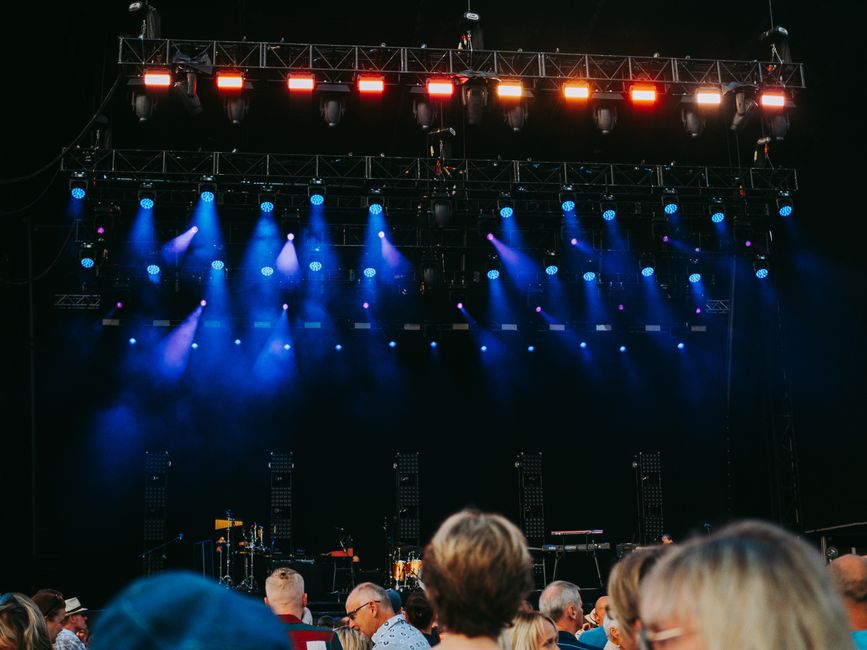
Before the Black Jacket Symphony takes the stage, the house lights fall and something unusual happens: nothing. No opening act, no hype, no warm-up. The lights come up on an orchestra pit full of musicians, and the first notes of a famous album begin exactly the way they do on the record. From that moment until the final chord, the band plays one iconic album, front to back, note for note — a concert built like a symphony performance, with the reverence to match.
That concept belongs to J. Willoughby, the Birmingham-based musician and self-described music history nerd who founded the Black Jacket Symphony in 2009. Fourteen years and 43 albums later, the ensemble has become one of the most reliable touring acts on the Gulf Coast circuit, playing Mobile’s Saenger Theater, Pensacola’s venues and rooms across the Southeast for audiences that keep coming back to hear their favorite records performed the way orchestras perform Beethoven.
The idea started with Abbey Road turning 40
Willoughby’s origin story begins in 2009, the fortieth anniversary of The Beatles’ Abbey Road. He was reading everything he could find about the album’s creation when a radio ad for a classical concert — Mozart in the Park — sparked the connection: the classic albums of the rock era were the classical music of their generation, and future generations would treat them that way.
Tribute bands already existed, but they operated on costumes and impressions. Nobody was treating the source material like a sacred text — no wigs, no gimmicks, just a large ensemble playing the record in sequence with obsessive attention to its arrangements. That gap became the Black Jacket Symphony. The first show, Abbey Road, was performed on May 28, 2009.
The catalog since then covers most of the classic-rock canon: The Beatles, Pink Floyd, Prince, Tom Petty, Fleetwood Mac, The Eagles, AC/DC, Nirvana, Pearl Jam, Led Zeppelin and The Allman Brothers among the 43 albums the group has staged across the United States.
A different band for every record
The Black Jacket Symphony is less a fixed band than a repertory company. Willoughby hand-picks the lineup for each album, because the voice that carries Freddie Mercury is not the voice that carries Brian Johnson, and the guitarist suited to Dark Side of the Moon may be wrong for Hotel California. Some members recur constantly: Peyton Grant handles piano and much of the lead vocal work on the Allman Brothers material; Jess Meuse, who finished fourth on American Idol in 2014, sings the Stevie Nicks parts when Fleetwood Mac is on the docket.
The crew behind them matters as much. On recent tours, the production team has included Randall Hughes on audio and Forrest G. Larramore on lighting — a light show that fans regularly single out as a performance in its own right.
Saenger Theater, Full Moon Fever
The group’s recent stop at Mobile’s historic Saenger Theater showed the format at full strength: Tom Petty’s Full Moon Fever in the first set, then a second set of Petty’s greatest hits. The 1927 theater — with its ornate proscenium and famously intimate sightlines — turned out to be the ideal container for the act, which performs as comfortably in mid-size halls on the coast as it does in larger Southeast markets.
The Petty material suited the band’s philosophy. Full Moon Fever, produced by Jeff Lynne and released in 1989, is an album whose arrangements live in small details — the acoustic strum that opens “Free Fallin’,” the layered harmonies of “I Won’t Back Down,” the jangle of “Runnin’ Down a Dream.” A band that tried to reimagine those details would lose the audience; a band that reproduces them faithfully gives the audience the record they’ve carried in their heads for thirty-five years, at concert volume, surrounded by other people who know every word.
The man behind the jackets
Willoughby’s own story runs through Alabama’s bar-band circuit. After college he fronted The Newboys, a regional act strong enough to land him in Nashville and a Capitol Records signing — an album that never came out, as he tells it, having been “signed and dropped from some of the best labels in the country.” He later led The Willbillies, a three-piece that leaned hard on Tom Petty covers, which in retrospect was practice for the main event.
Music is in the blood: his father, John Ed Willoughby, was a well-known Birmingham radio personality for more than thirty years. The younger Willoughby’s journey from dive bars in Pelham to founding a symphonic rock institution is the kind of career arc that only makes sense in retrospect — the reluctant performer who found that audiences wanted precision more than they wanted celebrity.
Why it works
The Black Jacket Symphony’s staying power comes from a simple exchange: audiences surrender surprise and get mastery. There are no medleys, no jams that wander, no moments where the singer decides to reinterpret. Every song arrives in its original arrangement, often with string and horn parts that the original studio versions buried in the mix now rendered live by additional players.
For the coastal Alabama audiences who have made the group a repeat visitor to Mobile and Pensacola stages, the draw is the chance to hear an album the way it was sequenced — the deep cuts and the hits in order, the way the artist intended — performed by a rotating cast of the region’s best musicians wearing black jackets and absolute focus. If the ensemble comes to a stage near you, the advice from longtime fans is uniform: go. You will be glad you did.
The Players Behind the Petty Night
The lineup for the Tom Petty program at Mobile’s Saenger Theater on April 28 featured Ben Owens on guitar, Heath Price on bass, J. Willoughby on vocals, Jess Meuse on vocals, Mark Lanter on drums, Peyton Grant on piano and vocals, and Will Cash on guitar. Behind the board, Randall Hughes handled audio, while Forrest G. Larramore ran a lighting design that was a show unto itself.
From a Pelham Dive Bar to the Concert Hall
Long before the symphony concept took shape, Willoughby was a regular performer at The Mug Shot Saloon, a small Pelham bar known for customers dancing on the bar and for its motorcycle-enthusiast crowd. He was quiet and somewhat reluctant at first but opened up once the music started, fronting a three-piece Tom Petty-heavy band that was a crowd favorite. His father, John Ed Willoughby, was a well-known Birmingham radio personality for more than 30 years and occasionally came out to watch his son play.