‘Nudes in November’ Brings the Human Form to Blue Velvet Studio
Sixteen Mobile artists explore the human form in sketches, painting, photography, body paint and sculpture for Nudes in November at Blue Velvet Studio.
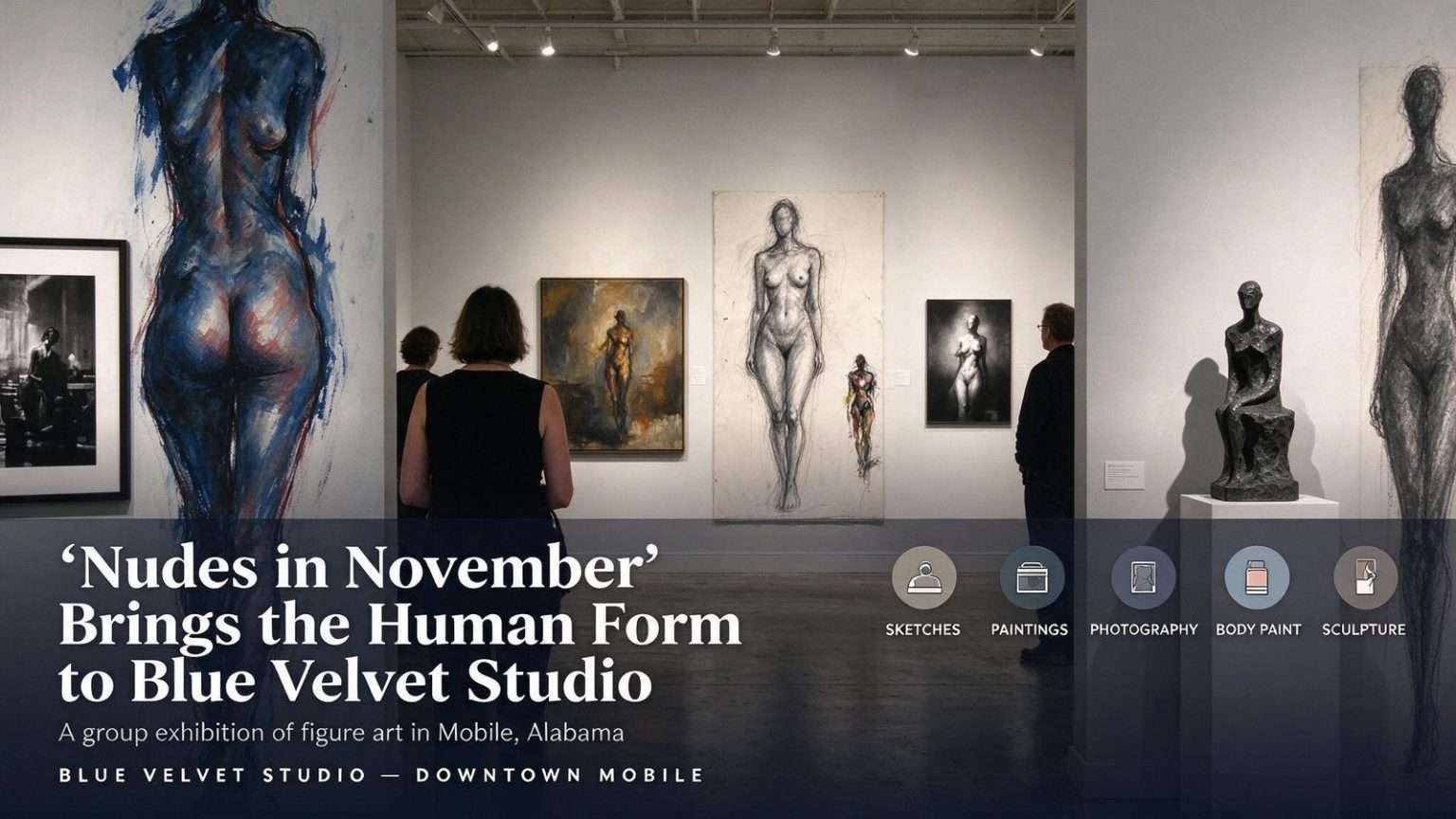
Blue Velvet Studio’s Nudes in November exhibition gathers interpretations of the human form across nearly every medium — sketches, paintings, photography, body paint, and sculpture — from a wide slate of Mobile-area artists. The featured roster includes Fred Marchman, Lynda Smithy Touart, Jamie Smith, Karen Cassidy, Ann Pearce, Amanda Youngblood, Jami Buck, David Trimmier, Amanda Solley, Jamie Clark, Satomi Kamei, Geri Nettles, Pat Hayes, Susan Peele, Jeff Byrd, and Conroy Hudlow. The group show puts the studio’s downtown gallery space to work as a snapshot of the local figure-art scene, with each artist taking a distinct approach to the same enduring subject. A video tour of the exhibit accompanied the original announcement.
Group shows built around a single theme occupy a particular place in a city’s art calendar. Rather than asking visitors to compare a painter with a photographer on neutral ground, a themed exhibition gives every artist the same starting point and lets the differences in medium, technique and temperament carry the interest. Nudes in November applies that structure to the oldest subject in figurative art: the human body itself, rendered here in graphite and charcoal, in oil and acrylic, through the camera lens, in painted-on-skin work, and in three-dimensional form.
The breadth of the roster is the show’s most distinctive feature. Sixteen Mobile-area artists are listed, a lineup that spans working professionals, longtime local exhibitors and emerging names. Shows of this scale require substantial coordination — each artist delivers finished work, the gallery hangs and lights it, and the pieces must cohere as a single viewing experience rather than a row of separate statements. For a downtown studio space, mounting an exhibition of this size is one of the more demanding projects of a season.
The Figure in Local Art
Figure drawing has never left the training canon of American art. Long before artists develop a personal style, they learn anatomy, proportion and gesture by drawing from a live model, and the discipline remains the backbone of most formal art education. What changes from artist to artist is what happens after the training: some carry the classical approach forward, while others push the figure toward abstraction, expressionism, or documentary realism. A themed show like this one makes those differences visible in a way a general group exhibition cannot.
Mobile’s art community supports that practice through the studios, galleries and collectives concentrated downtown, particularly along and around Dauphin Street in the LoDa district. Regular artwalk evenings draw crowds through the galleries, and figure-drawing sessions — open studios where artists pay a small fee to sketch from a live model — run on a recurring basis at various venues in the area. Those sessions feed directly into shows like Nudes in November: the quick gestures and long poses practiced on weeknights become finished drawings and paintings on gallery walls.
The range of media represented is wider than many visitors expect from a figure show. Sketches and paintings are the traditional core, but photography brings a different set of decisions about light and composition, sculpture translates the body into physical mass, and body paint treats the human form as both canvas and subject at once. Presenting all of them side by side gives audiences a rare side-by-side comparison of how each medium handles the same challenge — capturing a living, moving, three-dimensional person on a flat surface or in fixed form.
Why Group Shows Matter
For the artists, the value of a group exhibition is partly economic and partly communal. Selling work through a gallery show puts original art in front of buyers who might never visit a private studio, and the shared cost of mounting the exhibition keeps the burden manageable for everyone involved. Just as important is the professional network: artists who hang together end up sketching together, referring each other for commissions, and pulling each other into the next show.
For the viewing public, a figure exhibition is also a low-pressure entry point into serious art. The subject is universally legible — everyone knows a human body when they see one — so the interest shifts to execution, and visitors find themselves noticing things like the economy of a five-minute gesture sketch versus the density of a fully rendered canvas. Shows organized around a single subject tend to generate those comparisons naturally, which is part of why themed exhibitions have remained a fixture of gallery programming.
The Downtown Gallery Setting
Blue Velvet Studio operates in downtown Mobile, where the concentration of galleries, studios and performance spaces has grown steadily as the district revitalized. Downtown studio galleries typically serve multiple roles at once: working art spaces where pieces are made or finished, exhibition venues for scheduled shows, and gathering places during artwalk nights and opening receptions. A video tour of the exhibit, released with the original announcement, extended that access to audiences who could not attend in person — a practice that became common among galleries after the pandemic years and has persisted as a standard part of showing work.
Video walkthroughs serve artists as well as audiences. They document the hang of the show, preserve a record of how the pieces looked together, and give participating artists a shareable artifact for their own portfolios and social channels. For collectors deciding whether to attend before the show closes, a tour provides a sense of scale and presentation that a list of names cannot.
The Artists on the Roster
The sixteen names in the exhibition represent a cross-section of the Mobile-area figure art community. Rosters this long usually form through a mix of invitation and open call, with the organizer balancing media so that the show does not tilt entirely toward one medium or approach. A lineup that includes painters, photographers, sculptors and body paint artists signals deliberate curation — the goal being a representative snapshot of who is working with the figure locally right now.
Exhibitions like this also function as a record. Years later, a roster of who showed what, in which medium, during a particular season becomes part of the documented history of a city’s art scene. Mobile’s visual arts community has deep roots in the region, and the artists carrying the figure tradition forward are part of a lineage that runs back through decades of local exhibitions, college art programs and informal drawing groups.
Nudes in November, as a title, also nods to a seasonal rhythm that galleries know well. The late-autumn stretch — after the summer slowdown and before the December holidays — has become a favored slot for themed shows, catching residents back in town and visitors beginning their holiday rounds. An exhibition opening in that window benefits from steady foot traffic downtown and from the social calendar that builds toward year’s end.
For anyone following the Mobile art scene, the show offers a practical answer to a simple question: who is drawing, painting, photographing and sculpting the figure in this city, and how do their approaches differ? Sixteen artists, five media, one subject. The video tour accompanying the announcement makes the answer available even to those who never make it to the gallery, and the exhibition itself puts the studio’s downtown space to its fullest use — walls, floors and all — as a single survey of the local figure-art scene at work.
What Visitors See at a Figure Show
Attending a figure exhibition rewards a slow walk. The pieces nearest the door might be quick gesture drawings — worked in a few minutes during a live session, all motion and line — while a wall across the room holds a canvas built up over weeks. Photography asks for different attention again: what the camera freezes, the painter must interpret, and the sculptor must resolve in space. Body paint work, often documented photographically, blurs the line between the medium and the model. Visitors who move through the room in the order the hang presents tend to leave with a sense of the full spectrum of approaches rather than a favorite single piece.
Galleries in Mobile’s downtown district generally rotate exhibitions on a monthly cycle, which means a themed show like this one has a limited run. Residents interested in seeing it are best served by checking the studio’s posted hours and any scheduled reception, since opening nights typically draw the largest and most social crowds, while weekday afternoons offer the quiet needed to actually look.
The exhibition stands as a reminder that a city the size of Mobile sustains a genuinely active figurative art community. Sixteen artists working across sketches, paintings, photography, body paint and sculpture, gathered in one downtown gallery around the oldest subject in art, is a measure of that activity — and the video tour that accompanied the announcement ensures the snapshot reaches beyond the gallery’s walls.