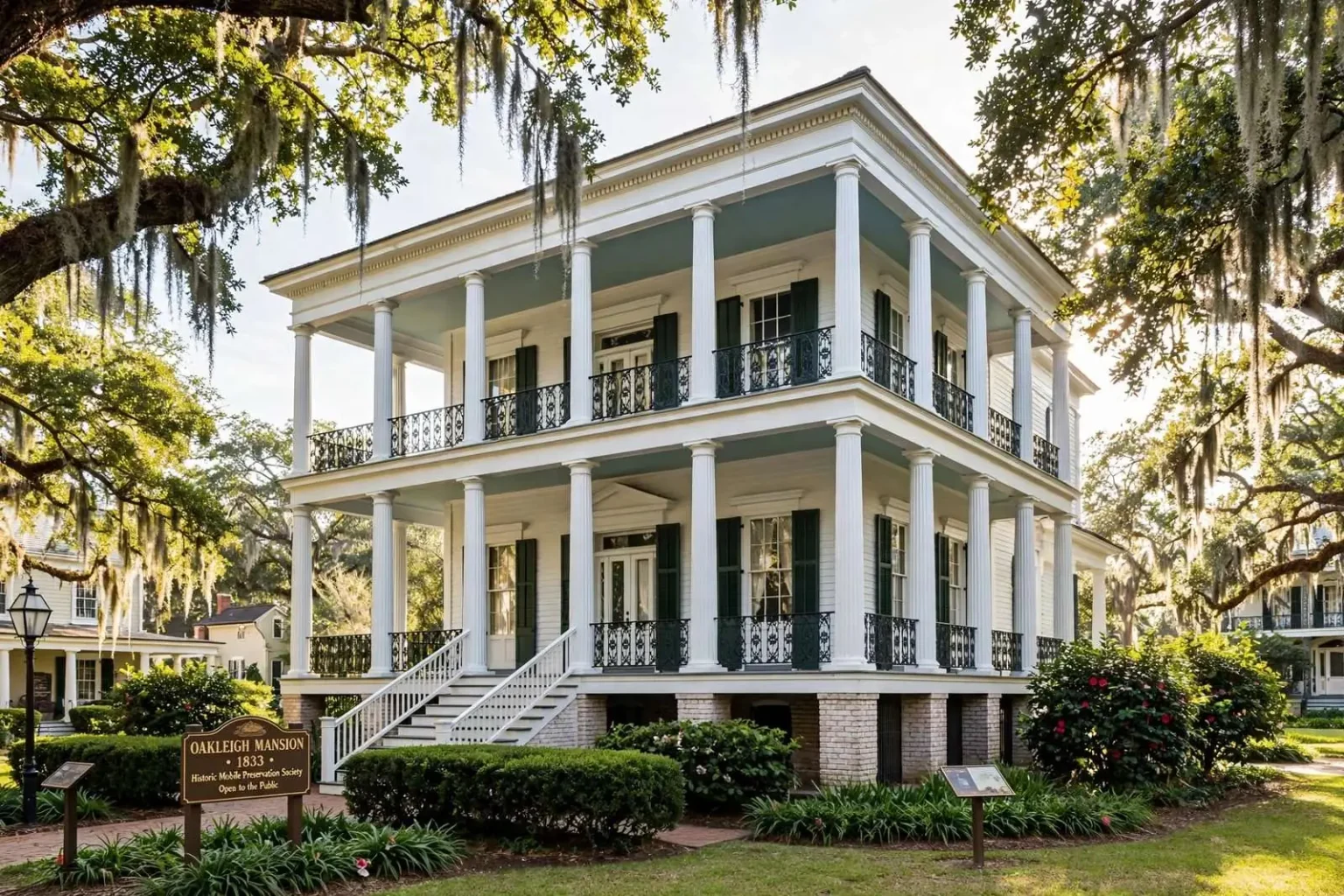
The Oakleigh mansion will remain open to the public, the Historic Mobile Preservation Society confirmed in an announcement made Friday, closing out weeks of uncertainty over the fate of one of Mobile’s most recognizable historic landmarks.
Under the plan, the antebellum-era museum and its attached gift shop will operate four days a week going forward. Visiting hours will run from 10 a.m. to 4 p.m. on Fridays, Saturdays and Mondays, with shorter Sunday hours from 1 to 4 p.m.
The society said in a statement that support from the Mobile City Council, city officials and the broader community had brought the organization nearly to its funding goal, though it is continuing to seek additional pledges to secure the museum’s future.
The funding scare that started it all
The push for donations began after the Historic Mobile Preservation Society warned earlier this fall that it would be forced to close the historic house without an infusion of roughly $40,000, an amount organizers said would allow the museum to operate on a bare-bones budget. The society pointed to a combination of funding cuts throughout 2018 and rising maintenance costs at the aging property as the source of the shortfall.
The warning prompted a wave of renewed attention to Oakleigh’s finances. During an October Mobile City Council meeting, the city’s executive director of finance and Mayor Sandy Stimpson’s acting chief of staff, Paul Wesch, told council members that Oakleigh House was in no immediate danger of closing. Wesch added, however, that the city would be prepared to take over the property if the preservation society could not close the funding gap on its own.
That combination of reassurance and warning framed the weeks that followed, as preservation advocates, neighborhood associations and history organizations across Mobile rallied to keep the museum’s doors open. The society launched its fundraising appeal publicly, and donations and pledges began arriving from residents with personal ties to the house — former volunteers, school groups who had toured it, and descendants of families connected to its past.
What Oakleigh means to Mobile
Oakleigh, built in the early 1830s, stands as one of the oldest and most photographed houses in Mobile, a Greek Revival mansion whose raised basement and double galleries were designed for the Gulf Coast climate. The house takes its name from the oak trees that shaded its grounds, and it has served for decades as the anchor of the Oakleigh Garden Historic District, the neighborhood of historic homes that stretches around it just south of downtown.
The Historic Mobile Preservation Society has operated Oakleigh for decades as one of the centerpieces of Mobile’s historic preservation efforts, offering tours that walk visitors through the city’s antebellum era, its cotton-port economy and the families, enslaved workers and later residents who shaped the property. School groups from across Mobile County cycle through its rooms each year, and the house serves as a frequent stop on regional heritage tours that bring visitors to the city.
For the surrounding neighborhood, the mansion’s grounds and the society’s activities are woven into the district’s identity, and residents mobilized quickly when the closure threat emerged. The preservation society’s mission extends beyond the house itself, encompassing archives, educational programming and advocacy for historic structures across the city.
The four-day operating schedule that emerges from the fundraising push represents a reduction from prior operations, but organizers framed it as a sustainable baseline rather than a retreat. Museums of Oakleigh’s size across the country have increasingly adjusted hours to match staffing and revenue, and the society said the reduced schedule preserves weekend access, when visitation is heaviest, along with Monday tours for school groups and scheduled parties.
What comes next, according to the society: with the reduced four-day schedule now in place, the organization will continue to lean on community pledges to keep the museum sustainable long-term. The society’s leadership has been explicit that the $40,000 figure was a bare-bones number — enough to keep operating, not enough to address the deferred maintenance that comes with a nearly 200-year-old structure.
Maintenance of a house like Oakleigh is a constant expense. Paint, roofing, shutters and structural timbers all require periodic attention, and preservation standards require that repairs be done with appropriate materials and methods, which cost more than conventional work. The 2018 funding cuts that contributed to the crisis compounded years of incremental cost increases, and the society has said long-term sustainability will require a stable funding base rather than year-to-year rescue appeals.
The city’s role
The city’s posture through the episode drew scrutiny from both preservation advocates and council members. Paul Wesch’s statement to the council — that the house was in no immediate danger but that the city stood ready to take over the property if the society could not close its gap — positioned the city as a backstop while leaving the society to raise the funds itself. City officials have historically described Oakleigh as a cultural asset that repays public support through tourism and the city’s image, and the council’s willingness to entertain intervention reflected the property’s stature.
The episode also reignited a familiar conversation about how Mobile funds its cultural institutions. The city supports a range of museums and heritage organizations, and advocates have argued for predictable annual appropriations rather than emergency appeals, pointing out that organizations like the preservation society operate on budgets where a few tens of thousands of dollars determine survival.
For council members, the resolution offered a model: a community fundraising push, matched by the city’s expressed readiness to help, that kept a landmark open without a major new expenditure. Whether that structure becomes a template for other institutions facing shortfalls remains to be seen, but preservation leaders said the Oakleigh outcome demonstrated the depth of public attachment to the city’s historic resources.
Tourism officials count Oakleigh among the stops that anchor Mobile’s heritage travel offerings, alongside the city’s historic churches, forts, cemeteries and the neighborhoods listed on the National Register. Heritage visitors tend to stay longer and spend more than other travelers, and the society has argued that every dollar of public support for the mansion returns value through the visitors it draws to the Oakleigh Garden Historic District and downtown.
The announcement on Friday was met with relief across the preservation community, where the prospect of a closed Oakleigh had been described in stark terms: a shuttered landmark damages not only the organization that runs it but the city’s credibility as a steward of its own history. Peer organizations offered support during the appeal, and volunteers who had stepped back during the uncertain weeks committed to returning under the new schedule.
The society’s gift shop, which will operate alongside the museum under the four-day schedule, contributes a modest but steady revenue stream, and the organization has discussed expanding programming — lectures, tours and membership events — as a way to broaden its base of support. Membership drives and annual fundraisers have long supplemented tour revenue, and the recent crisis prompted a surge in new memberships that organizers hope to retain.
Looking ahead, the society’s leadership has pledged transparency about the museum’s finances, hoping to rebuild confidence after the public scare. Regular updates on fundraising totals and operating costs are expected to accompany the new schedule, and the organization has invited the public to hold it accountable as it works toward a budget that no longer depends on emergency appeals.
For now, the mansion that has watched over its oak-shaded corner of Mobile for nearly two centuries will keep its doors open — four days a week, on a budget held together by the community that rallied when it was needed, and with the city watching to ensure that one of its oldest landmarks remains what it has always been: the front porch of Mobile’s history.
Oakleigh’s history stretches back to the cotton-boom years of the 1830s, when Mobile’s port economy made it one of the South’s busiest cities and merchants built grand homes on the rising ground above the district. The mansion’s design — with its main living floor raised above the ground level to catch breezes and escape dampness — remains a textbook example of Gulf Coast architecture, and architectural historians frequently cite it among the finest surviving houses of its era in the region.
Over the decades the house passed through successive owners before its preservation era began, and its grounds today include additional historic structures relocated to the complex, making the property a compact campus of Gulf Coast history rather than a single-house museum. Docents lead visitors through furnished rooms that interpret different periods of the house’s use, and the society’s collection includes artifacts, documents and photographs that trace Mobile’s development from a colonial town to a modern port city.
The society’s educational reach extends beyond the mansion gates. Its programs bring local history into classrooms, its archives serve researchers and genealogists from across the region, and its advocacy work has influenced how Mobile handles historic properties during the city’s recent growth. Losing the museum operation, organizers warned during the fundraising campaign, would have meant losing far more than one attraction — it would have cut off the programming and preservation infrastructure that Oakleigh supports.
The community response to the crisis, volunteers and donors among them, gave the society a clearer picture of its support than it had in years: hundreds of individual contributors, businesses that sponsored fundraising events, and neighborhood associations that promoted the appeal through their networks. That demonstrated base, organizers said, will be the foundation of the long-term sustainability plan the society intends to build under the new operating schedule.