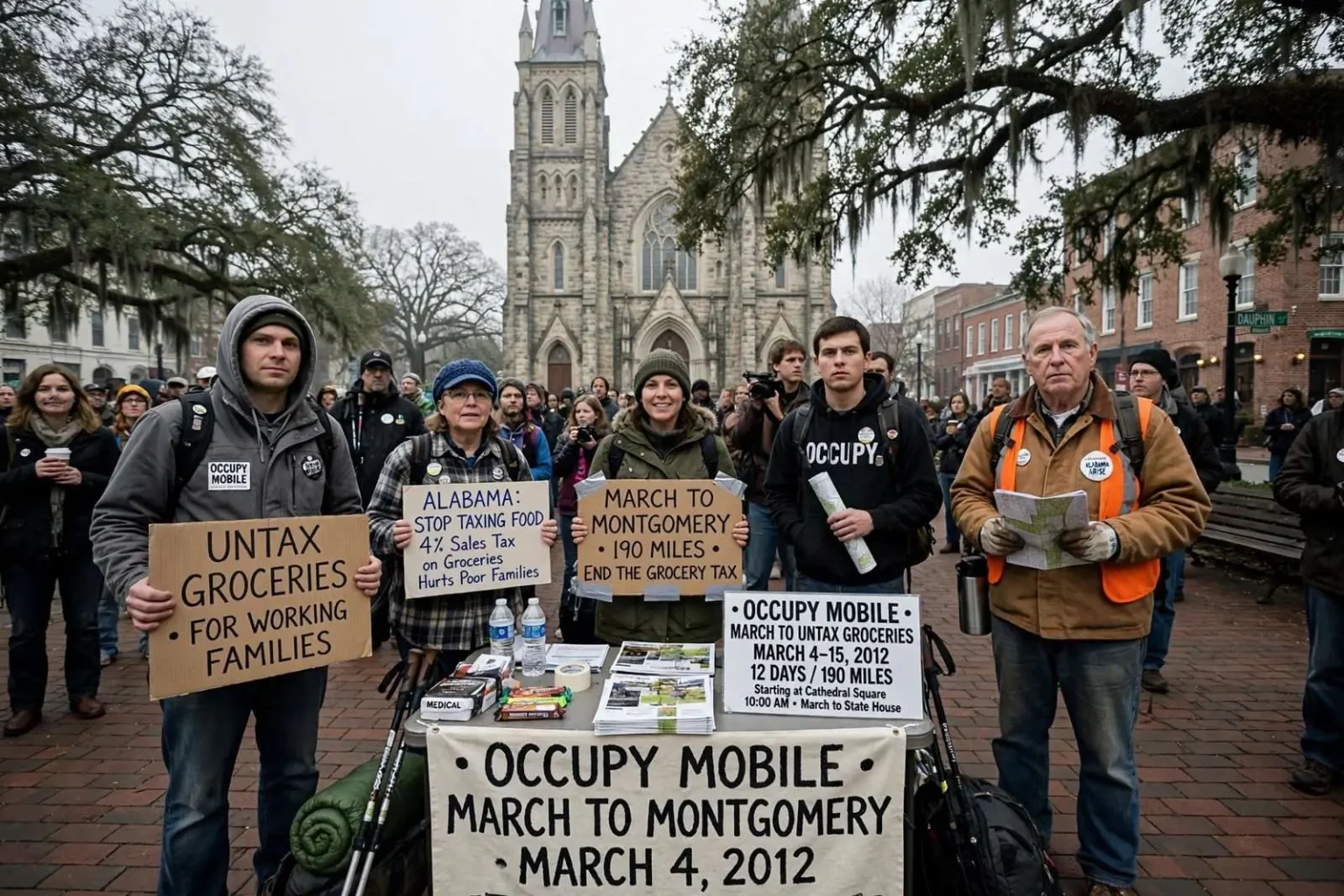
Occupy Mobile activists will set out from Cathedral Square on Sunday, March 4, 2012, on a roughly 190-mile walk to Montgomery protesting Alabama’s tax on groceries, which they say places a disproportionate burden on low-income families. The march ranks among the longest protest walks the state has seen in recent years, and its route connects Mobile’s downtown squares to the steps of the State House.
Marchers plan to gather with supporters at 10 a.m. in downtown Mobile’s Cathedral Square before departing on a 12-day journey along U.S. Highway 31 and other rural routes. The march will take them through the small towns and crossroads communities that line the old federal highway north, through Monroeville-area countryside toward the River Region, before the final approach to the capital.
The group says it expects to reach the state capitol on March 15, in time for a rally at the State House organized by Alabama Arise, a Montgomery-based advocacy group that has also opposed the grocery tax. The arrival date ties the walkers’ effort to an established campaign at the state level, joining the march’s momentum to years of legislative work on the issue.
Cathedral Square, in the heart of downtown Mobile, has served as a staging ground for gatherings of many kinds, and the morning send-off is expected to draw supporters who cannot make the full walk but want to see the marchers off. Organizers have framed the departure as both a beginning and a statement: the issue deserves the effort of the walk itself.
Why marchers say the tax matters
The march aims to push lawmakers to represent working families rather than corporate interests, one organizer said, arguing that corporations enjoy large tax incentives in exchange for jobs while working people are left to pick up the tab and struggle to put food on the table. That contrast — generous recruitment incentives on one side, a full sales tax on bread and milk on the other — is the grievance the march is built around.
Alabama is among the few states that apply its full sales tax rate to groceries, a policy critics say hits poor residents hardest. Because lower-income households spend a larger share of their income on food, a flat tax on groceries functions like a surcharge on poverty, and state-level studies have repeatedly documented how regressive the combined state and local rates are for families at the bottom of the income scale.
Supporters of the tax argue it keeps overall state revenue stable. Groceries are a reliable tax base that does not collapse in recessions the way income and business taxes do, and lawmakers over the years have been reluctant to surrender a revenue stream that funds schools and general government without an identified replacement.
Alabama Arise and allied groups have proposed remedies that would offset the loss — including closing loopholes and ending deductions that primarily benefit higher earners — in an effort to answer the stability argument directly. The march’s arrival at the State House is timed to put those proposals back in front of legislators during the session.
The grocery tax has a long political history in Alabama. Repeal bills have been introduced in successive legislative sessions, and the issue has surfaced in gubernatorial campaigns for decades, but the statehouse arithmetic has never quite come together: fiscal conservatives worry about revenue, and the replacement proposals have struggled to attract a majority in both chambers.
Meanwhile, the state’s image has carried the burden. Alabama and Mississippi stand nearly alone in taxing groceries at the full state rate, and national coverage of tax policy routinely cites Alabama as the emblem of the regressive approach. For activists, that notoriety is part of the point: changing the tax would change how the state is seen.
Occupy Mobile emerged in the fall of 2011 in sympathy with the national Occupy Wall Street movement, holding gatherings in downtown Mobile that focused on economic inequality, foreclosure practices and the influence of corporate money in politics. The grocery tax march translates those national themes into a specifically Alabama grievance with a specific target in Montgomery.
The choice of a walking route along U.S. Highway 31 is itself a statement. The old highway predates the interstate system and threads directly through the communities the tax affects most — towns where a family’s weekly grocery bill is a significant share of the household budget and where many residents commute long distances to work.
A 12-day test of endurance and attention
A 190-mile walk over 12 days works out to roughly 15 miles a day, a pace that demands advance logistics: nightly lodging or camping arrangements, support vehicles for food and water, and contingencies for weather. Late winter along the Gulf Coast corridor is unpredictable, with cold snaps and heavy rain both possible, and organizers have built rest days into the schedule to absorb the worst.
The marchers expect the towns along the way to become part of the story. Occupy Mobile said it would post updates, photos and details of the towns along the walking route on its March to Untax Groceries website as the journey unfolds, turning the walk into a rolling chronicle of the communities between Mobile and Montgomery.
Supporters who cannot walk the full distance will have opportunities to join for single legs, and organizers have encouraged church groups, labor supporters and student volunteers to meet the march as it passes through their areas. The rolling participation model has been a feature of comparable marches, building crowds as the route progresses.
The destination rally on March 15, organized with Alabama Arise at the State House, is designed to convert two weeks of walking into a day of legislative pressure. Marchers will carry the stories of the road into meetings and speeches, and the organizers’ measure of success will be whether the grocery tax repeal finds renewed traction before the session ends.
The arithmetic of the grocery tax makes the stakes concrete. Under Alabama’s 4 percent state rate, plus local sales taxes that frequently add several more points, a family spending $150 a week at the grocery store can pay hundreds of dollars a year in taxes on food alone. For a household living on a minimum wage or a fixed income, that amount is the difference in a utility bill or a prescription refill.
Opponents also point to the compounding effect across the tax structure. Because Alabama’s property taxes are among the lowest in the nation, the state leans heavily on sales taxes for general revenue, and the grocery tax sits at the center of that regressive mix. Every exemption granted to a recruited industry narrows the base further and increases the pressure on the taxes working families pay daily.
Reform advocates sketch the trade-off in detail: repealing the state’s grocery tax would cost hundreds of millions of dollars annually, and proposals to fill the gap have included eliminating the deduction for federal income taxes paid, trimming business tax breaks and reviewing incentives granted to corporations. None of those pieces has yet assembled into a bill that survives the session.
For the marchers, the walk is also about reframing the debate in human terms. Budget tables and revenue projections rarely move legislatures on their own; testimony from families who stand in the checkout line every week and watch the total climb has historically carried more weight. The marchers intend to arrive in Montgomery carrying exactly that kind of testimony.
Walking in a tradition of protest marches
The Mobile-to-Montgomery route echoes earlier Alabama walks, most famously the 1965 Selma to Montgomery marches that helped force the Voting Rights Act through Congress. Organizers have invoked that lineage carefully, noting that their cause is economic rather than a civil rights milestone, but the physical logic is the same: a road between two Alabama cities can concentrate attention in a way no petition drive can.
March logistics mirror those historic efforts in miniature. Support vehicles will carry supplies and shuttle tired walkers, route volunteers will manage road crossings on the stretches where Highway 31 carries heavier traffic, and nightly stops will follow the population centers along the way so that walkers can rest, eat and meet residents.
Safety planning has been a significant part of the preparation. Walking a federal highway means shoulders, visibility and weather all demand attention, and organizers have urged participants to wear bright clothing and to walk in groups. Local law enforcement agencies along the route have been notified of the march’s schedule.
The March to Untax Groceries website will serve as the campaign’s running record, posting daily position updates, photographs and descriptions of each town the march passes through. Supporters at home will be able to track the walkers’ progress mile by mile and find the meeting points for the evening gatherings.
By the time the marchers reach the State House steps on March 15, the organizers hope the walk will have done more than cover 190 miles. The goal is a rolling conversation in a dozen towns about a tax every one of them pays — and a legislature that can no longer describe the grocery tax as a settled question.