Ocean Springs ‘Litter for Lattes’ rewards trash pickup with free coffee
Ocean Springs, Mississippi's 'Litter for Lattes' program rewards volunteers who pick up trash around town with a free cup of coffee from The District.
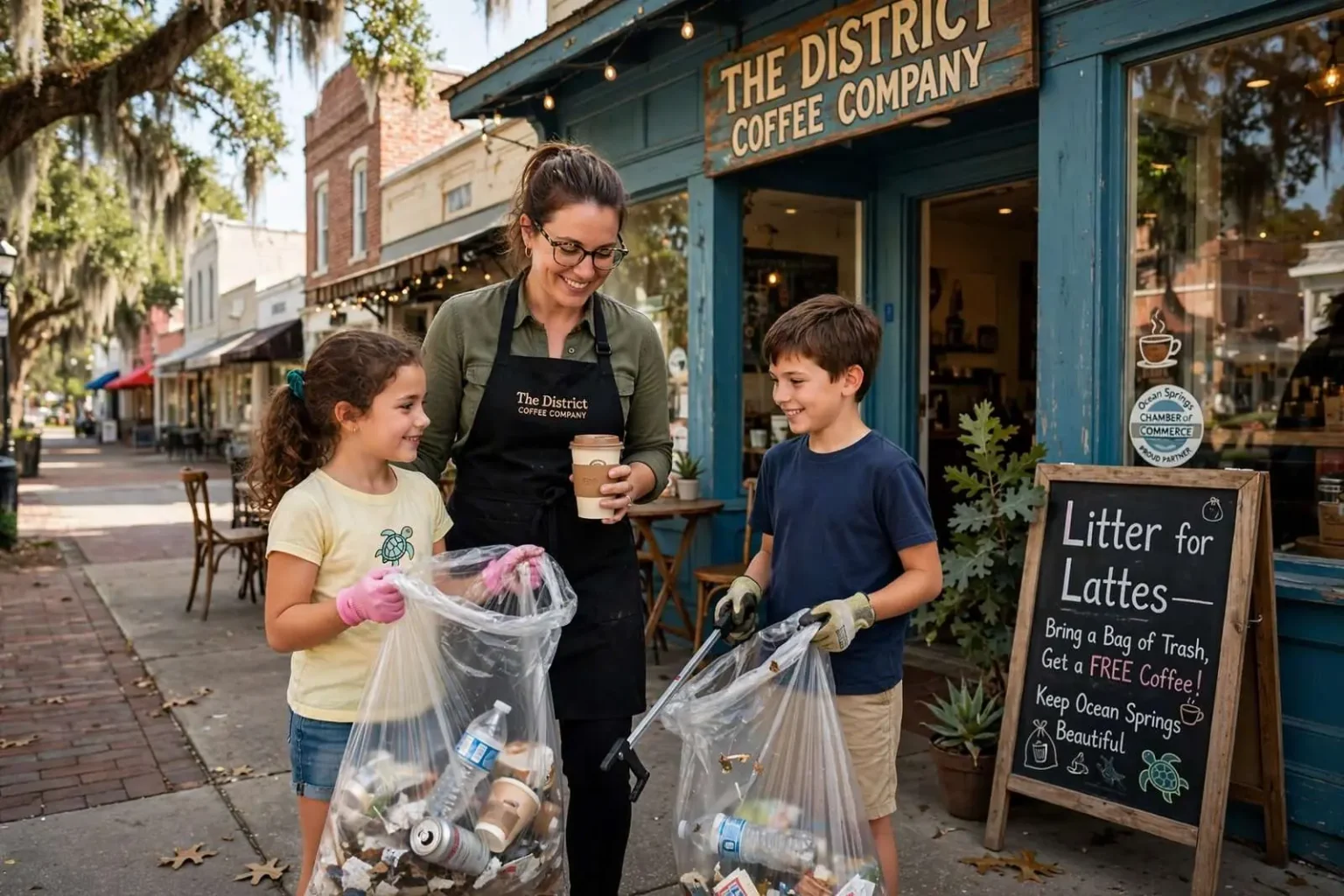
OCEAN SPRINGS, Miss. — A new Gulf Coast initiative is pairing litter cleanup with a caffeine reward. The Ocean Springs Chamber of Commerce pledged its support Wednesday as a local business launched “Litter for Lattes,” a program that trades a free cup of coffee for a bag of trash gathered from the city’s streets and sidewalks. The effort began at The District Coffee Company, where owner Meagan Miller said the idea is as simple as it sounds: residents who pitch in to keep Ocean Springs clean can stop by for a coffee on the house.
“Ocean Springs is a beautiful place, so why not keep our environment as clean as we possibly can,” Miller said. “Litter for Lattes is a way to bring people out on the town, show our children how to be proactive and take care of the place we call home. Now, anytime the kids see litter, they get excited because they know they are doing their part in helping our sea life and overall environment.”
The idea started when Miller and her children were walking downtown and noticed litter in the streets. They grabbed a garbage bag and gloves and made an easy difference. What began as a family errand has grown into a community program after Miller partnered with the Ocean Springs Chamber of Commerce to reward people who help keep the city clean with a free cup of coffee.
“We want to get the community involved. After all, we are all in this together,” Miller said.
A program built for a walkable coastal town
Ocean Springs is well suited to an initiative like this one. The city sits on the Mississippi Sound just across Biloxi Bay, and its historic downtown — a compact grid of locally owned shops, galleries, restaurants and coffeehouses — is built for walking. Visitors come to browse the art community that grew up around the late painter Walter Anderson, to eat along the main commercial streets, and to stroll beneath the massive live oaks that line the older neighborhoods. Because so much of the city’s appeal depends on clean, attractive public spaces, residents have a direct stake in how the streets look.
The reward structure also fits the rhythm of a small downtown. A cleanup walk can start and end within a few blocks, which makes it easy to finish with a stop at a local counter for a latte. That loop — gather a bag of litter, then enjoy a free drink — turns a chore into a short outing, and it gives families a reason to look closely at the condition of the sidewalks and curbs they pass every day.
Why litter matters on the Mississippi Gulf Coast
Along the Gulf Coast, litter is more than an eyesore. Anything dropped on an Ocean Springs street can wash into storm drains during a rainstorm and flow toward the bayous and tidal creeks that drain into the Mississippi Sound. From there, wind and currents can carry lightweight debris — plastic bottles, foam cups, shopping bags, cigarette butts — far from where it started. Marine debris poses a well-documented threat to sea turtles, fish, birds and dolphins, either through entanglement or through ingestion, and it can smother marsh grass and spoil nesting habitat along the shoreline.
That connection between curbside trash and sea life is precisely what Miller says she wants her children and their friends to understand. On the Mississippi Coast, where fishing, boating and beach outings are woven into everyday life, the link between a discarded cup and a polluted waterway is a short one. Cleanup programs that remove litter before a storm washes it into the Sound intercept the problem at the cheapest and easiest point in its life cycle.
Chambers and Main Street groups as cleanup partners
The Chamber’s role matters as well. The Ocean Springs Chamber of Commerce-Main Street-Tourism Bureau wears several hats at once, promoting the city’s businesses, coordinating downtown events and marketing the area to visitors. Because the chamber staff hear from shopkeepers and restaurant owners every day, the organization is well positioned to know where litter problems show up and to spread word of a reward program to the people most likely to use it. Chamber backing also lends credibility, signaling to visitors that keeping the town clean is an organized civic effort rather than a one-off gesture.
Coffee-shop cleanup rewards have appeared in other communities across the country, usually structured the same way: a business offers a small perk to anyone who brings in a filled bag of litter gathered nearby. The model costs little, requires no permits or equipment beyond bags and gloves, and scales naturally — the more people who participate, the cleaner the town gets. What such programs trade in is not money but visibility, reminding residents that a clean public realm is the product of many small individual choices.
What participants can expect
For Ocean Springs residents, taking part requires no sign-up or formal arrangement. The program’s appeal lies in its informality: pick up litter, bring the evidence of the effort to the participating coffeehouse and claim the reward. Families can turn a Saturday morning stroll into a cleanup walk, and downtown workers can spend a lunch hour improving the blocks they walk every day. Parents get a practical lesson to hand their children — that caring for a place is something anyone can do, with tools as ordinary as a garbage bag and a pair of gloves.
The environmental payoff compounds over time. Every bag of litter collected on a downtown street is a bag that cannot clog a storm drain, snag on a marsh plant or drift into the Sound during the next heavy rain. In a coastal city that markets itself on natural beauty — from its bayous and birding spots to its harbor views — that steady, unglamorous work protects the very thing that draws people to town in the first place.
A small gesture with a broad reach
Initiatives like Litter for Lattes rarely make headlines, but civic leaders along the Gulf Coast have long recognized that modest, repeatable efforts often outperform large one-time cleanups. A reward that repeats every time someone fills a bag builds a habit; a habit among families builds a culture. If children grow up seeing litter pickup as a normal part of a walk downtown, the reasoning goes, they carry that expectation into adulthood.
For now, the program’s early days belong to Miller and her neighbors, with the chamber cheering them on. The formula is deliberately simple — a little effort, a little coffee and a cleaner hometown — and its organizers hope that simplicity is exactly what makes it stick. For more information, contact the Ocean Springs Chamber of Commerce-Main Street-Tourism Bureau at 228-875-4424 or The District Coffee Company at 228-215-1846.
The broader push against coastal litter
Litter for Lattes arrives as communities across the Mississippi and Alabama coasts continue to grapple with the steady pressure that litter places on the coastal environment. Local governments spend public money sweeping streets, emptying receptacles and clearing debris from drainage systems, and volunteer groups organize seasonal cleanups along beaches, bayous and boat launches. What those efforts often lack is a daily, street-level presence — people who notice a discarded cup on an ordinary Tuesday and pick it up before the next rain does the moving. Reward programs aim to fill exactly that gap by giving the everyday walker a small, immediate reason to act.
Education plays a quiet supporting role. When children learn that a foam cup tossed on a downtown curb can end up floating in the Sound within days, the abstract idea of “pollution” becomes a concrete chain of cause and effect they can see from their own front door. Teachers and parents along the Gulf Coast have used that chain to make environmental stewardship tangible: the sea life children read about in school — speckled trout, flounder, sea turtles, dolphins — depends on clean water, and clean water starts with clean streets. A free latte is a small thing, but as a teaching aid it ties the lesson directly to an afternoon’s hands-on work.
The chamber’s involvement also connects the program to the city’s tourism economy, which depends on visitors leaving with a good impression. Clean sidewalks and litter-free greenspaces are among the first things a visitor notices, long before they sample a restaurant or browse a gallery. By tying a local business’s reward offer to the appearance of the public streets, Litter for Lattes aligns the interests of shopkeepers, residents and tourists in a single, low-cost habit. If the early enthusiasm around the program holds, organizers hope it will simply become part of how people move through downtown — a walk, a bag, a coffee and a slightly cleaner city at the end of it.