Of Montreal Delivers a Dazzling Night of Psychedelic Rock at Alabama Music Box
Of Montreal brought their psychedelic indie rock spectacle to the Alabama Music Box in Mobile, performing a 17-song set of fan favorites.
Of Montreal brought their trademark blend of theatrical spectacle and genre-defying indie rock to the Alabama Music Box on Dauphin Street in Mobile in December 2012, treating a packed crowd to an electrifying 17-song set that rivaled their acclaimed Soul Kitchen appearance the previous year. The Athens, Georgia band has spent decades building a reputation as one of indie rock’s most visually ambitious live acts, and the Mobile crowd got the full treatment on a night the venue’s walls — literally, by the end — would wear the evidence.
A stage full of color and character
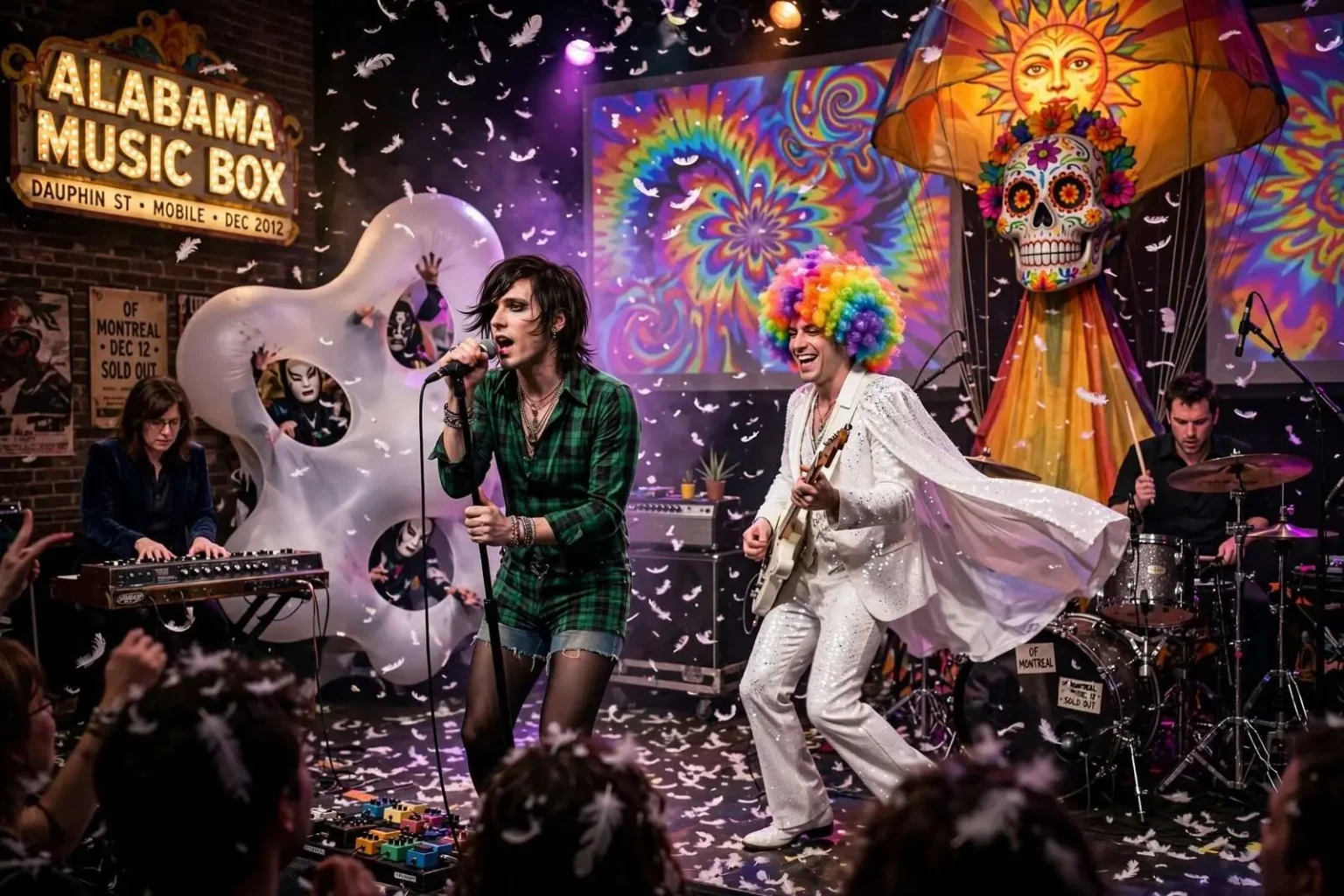
Frontman Kevin Barnes took the stage in a plaid dress paired with cutoff jean shorts, his shoulder-length hair swept dramatically to one side in what seemed a deliberate expression of the gender fluidity that has long informed Of Montreal’s art. Barnes, the band’s founder, songwriter and constant, has made the stage a place where identity is performed rather than fixed, and the costume was part of a visual language the band has been refining since its earliest records.
Guitarist Bryan Poole, also known by his solo moniker B.P. Helium, matched the energy in an all-white sequined outfit complete with a shimmering cape and rainbow afro wig, bouncing exuberantly in front of drummer Clayton Rychlik throughout the evening. Keyboardist Dottie Alexander took a more understated approach to her wardrobe but more than compensated with her playing, layering psychedelic organ textures drenched in chorus and delay effects that gave the band’s sound an otherworldly depth.
The costuming is not incidental to an Of Montreal show — it is the show. The band emerged from Athens’ fertile independent scene, where performance art and rock music have always shared a stage, and its live productions borrow as much from cabaret and theater as from the garage-band tradition. Mobile audiences, who had filled the Soul Kitchen the year before, came expecting theater, and the Alabama Music Box delivered a room built for it.
Deep cuts and fan favorites
The setlist drew generously from across Of Montreal’s extensive discography. The evening opened with “Requiem for O.M.M.2” from the fan-favorite album The Sunlandic Twins, setting the tone for a night that would span nearly the band’s entire catalog. The seminal 2007 album Hissing Fauna, Are You the Destroyer? dominated the set with six selections, including “Cato as Pun,” “Gronlandic Edit,” and “A Sentence of Sorts in Kongsvinger.”
The encore consisted entirely of tracks from that record: “Suffer for Fashion,” “Heimdalsgate Like a Promethean Curse,” and “She’s a Rejector.” Burying the encore inside a single album is the kind of programming choice that tells a crowd what the band considers its core — and for Of Montreal, Hissing Fauna remains the record that converted a cult following into an international one.
False Priest was also well represented with extended renditions of “Hydra Fancies,” “You Do Mutilate?,” “Godly Intersex,” and “Enemy Gene.” From the then-current release Daughter of Cloud, the band performed “Georgie’s Lament” and a crowd-pleasing take on “Sails, Hermaphroditic,” which drew an enthusiastic response with its memorable, irreverent chorus. Skeletal Lamping contributed “Plastis Wafers,” “Women’s Studies Victims,” and “St. Exquisite’s Confessions” to round out the deep-catalog selections.
A 17-song set drawing from five separate releases is a survey course, not a greatest-hits show, and the Mobile crowd rewarded the deep cuts as loudly as the singles. The Daughter of Cloud material was fresh — a 2012 release gathering material from the band’s prolific recent years — and hearing its songs woven between established favorites gave longtime fans the sense of a catalog in motion rather than a band on autopilot.
Art meets performance
True to form, Of Montreal’s visual production was as ambitious as their music. Rainbow patterns projected across the stage bathed the musicians in shifting kaleidoscopic color, while screens displayed psychedelic shapes that dissolved into candy-colored patterns reminiscent of 1970s wallpaper. The projections move with the songs — colors and shapes keyed to tempo and mood — turning the stage into a moving canvas that no static light rig can match.
Midway through the show, masked cabaret performers emerged within a large amoeba-like fabric structure, their hands stretching and distorting the white material from inside to create the unsettling impression of creatures struggling to break free. The interplay of costumed performers and projection is Of Montreal’s signature: the band treats its stage as an art installation that happens to have a rock concert inside it.
Later, a towering figure topped with a cheerful sugar skull appeared on stage, its billowing parachute-like body serving as a screen for a projected sun image that shifted colors as the character circled among the band members. The imagery draws from the same well as the band’s album art — folklore, surrealism and pop illustration blended into something festive and faintly disturbing at once.
The finale saw air cannons blast feathers into the dancing crowd, coating the walls and floor of the venue in fuzzy white plumage. Concertgoers who spilled out onto Dauphin Street afterward wore the feathers as badges of honor, marking themselves to fellow bargoers as survivors of another unforgettable Of Montreal experience.
The feather storm has become the band’s calling card — a finale that turns the audience into part of the production and leaves the venue physically marked by the night. Clean-up at the Alabama Music Box would take days, but the trade is the kind a venue on a thriving entertainment street makes happily: a show people describe to their friends for years.
Dauphin Street on a show night
The Alabama Music Box sits on Dauphin Street, the spine of Mobile’s downtown nightlife, where blocks of bars, music rooms and restaurants fill on weekends with a crowd that moves between venues on foot. A touring act of Of Montreal’s caliber on a December weekend draws fans from across the Gulf Coast — New Orleans, Pensacola and Baldwin County all sit within easy driving distance — and the overflow spreads into the street’s other businesses through the night.
The show also confirmed what the previous year’s Soul Kitchen appearance had suggested: Mobile supports acts that arrive with something to see, not just something to hear. The Port City’s downtown entertainment district has built its reputation on exactly this kind of booking — national touring bands in rooms small enough that the stage feels an arm’s length away, with production values that would be swallowed by an arena.
For the packed house, the night delivered the full Of Montreal experience: a 17-song tour of one of indie rock’s strangest catalogs, costumes and projections and giant skulls, and a feather-filled finale that followed everyone out the door. The band left town with a sold-out memory behind it; the venue left with feathers in every corner and a claim to having hosted one of the year’s most theatrical shows anywhere on the Gulf Coast.
By the time the last feathers settled, the comparison to the previous year’s Soul Kitchen show had its answer. Of Montreal returned to Mobile and was, if anything, bigger — louder, stranger, more covered in color — and Dauphin Street spent the rest of the night wearing the proof.
The band behind the spectacle
Understanding why an Of Montreal show looks the way it does requires a look at where the band came from. Formed in Athens, Georgia, in the late 1990s as a project of Kevin Barnes, the band grew out of the Elephant 6 collective’s loosely affiliated scene — a circle of bands that treated pop music as a handmade art form, layered with instrumentation and imagination. Over the following decade, Barnes steered the project from lo-fi pop toward the glam-psychedelic theatrical production that filled the Alabama Music Box in December 2012.
The discography the setlist drew from tells that story in sequence. The Sunlandic Twins marked the band’s break into wider indie popularity; Hissing Fauna, Are You the Destroyer? turned Barnes’s personal unraveling into the band’s most celebrated record; Skeletal Lamping pushed the theatrical ambition further; False Priest brought funk and soul collaborators into the mix; and Daughter of Cloud, released in 2012, gathered the era’s outpouring of material into one release. A set touching all five albums is a career retrospective compressed into a single night.
Barnes’s willingness to change — sonically and visually, record by record — is what keeps the live show unpredictable. The audience at a 2012 Of Montreal concert was not watching a band perform its hits; it was watching a project mid-evolution, complete with the costumes, projections and performance-art interludes that evolution has produced.
Mobile’s appetite for touring acts
The December show fit a stretch of growing ambition in Mobile’s live-music calendar. Downtown venues had spent several years proving that national indie and alternative acts could draw profitable crowds in the Port City, close enough to New Orleans and Pensacola to pull from a multi-state fan base without the costs of a larger market. An act like Of Montreal — a band with two decades of catalog, a devoted following and a production heavy enough to worry smaller venues — choosing Mobile for a Gulf Coast date said something about how the market had matured.
The Alabama Music Box’s role in that maturation is structural. Rooms like it give touring bands a mid-sized stop between New Orleans and the Florida panhandle, and they give Mobile audiences access to shows that once required a road trip. When a packed crowd fills such a room for a theatrical act, the night doubles as an argument for more bookings of the same caliber.
The 17-song set, the five-album spread, the cabaret performers and the sugar-skull figure were, in that sense, more than a single show’s spectacle. They were evidence of a scene capable of supporting it — a downtown street that fills on weekends, a venue that can handle a production-heavy tour, and an audience that turned out twice in consecutive years for one of indie rock’s most demanding live acts.
When the air cannons fired and the feathers came down, the night’s meaning was simple enough: Of Montreal had given Mobile its full production, and Mobile had given the band a crowd worthy of it. The feathers on Dauphin Street were the receipt.