Old Lock 1 Park in Jackson Shut Until Nov. 5 as Corps Dredging Gets Underway
The U.S. Army Corps of Engineers has closed Old Lock 1 Park in Jackson to the public from Sept. 8 through Nov. 5, 2026, to keep visitors clear of scheduled dredging work nearby. The brief notice sets a firm reopening date but leaves the scope of the operation undescribed.
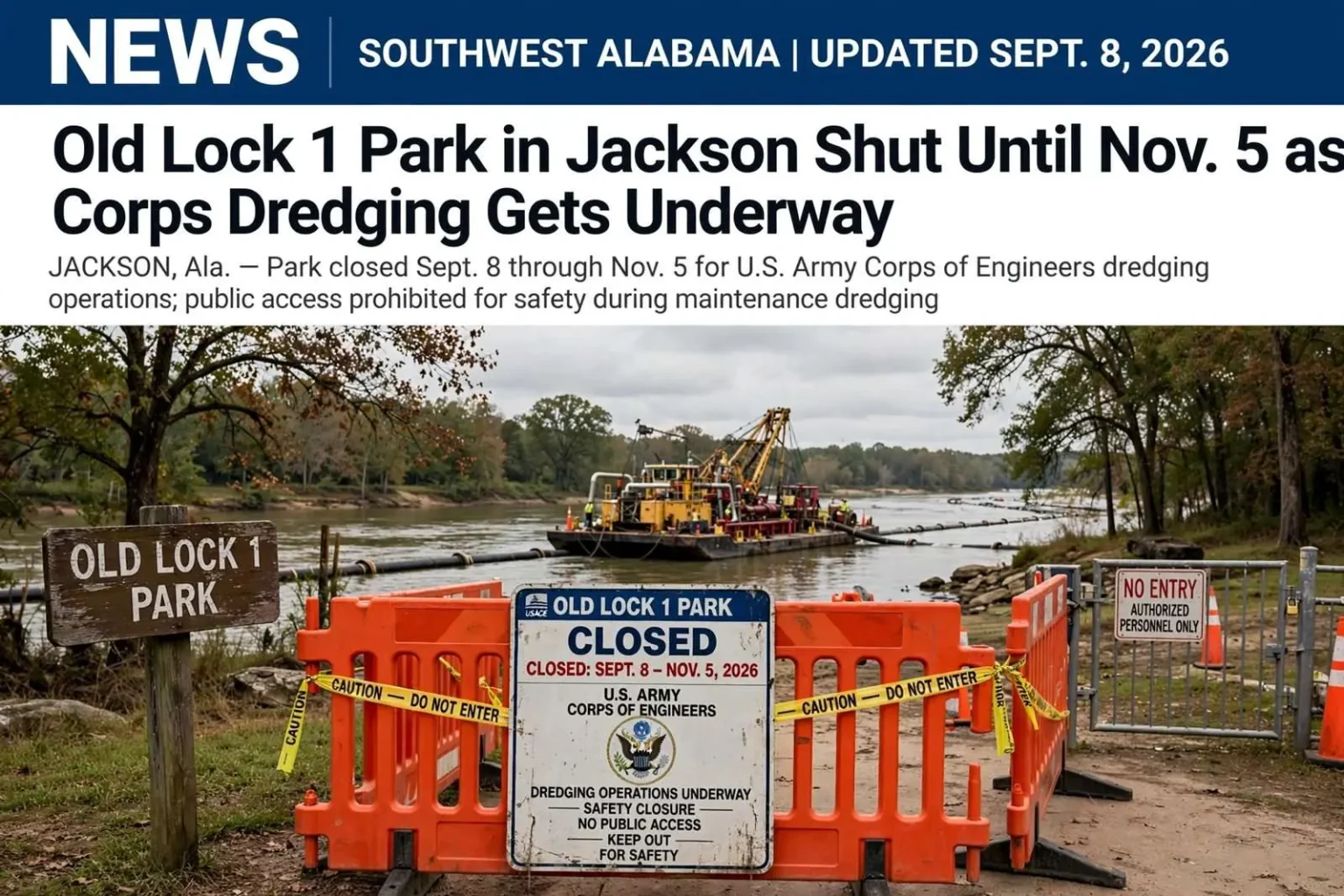
JACKSON, Ala. — Old Lock 1 Park will be off limits to the public for roughly the next two months while dredging work goes on nearby, the U.S. Army Corps of Engineers has announced.
The closure runs from Sept. 8, 2026, through Nov. 5, 2026. During that window, the Corps says visitors will not be permitted to enter the park or any of the surrounding areas covered by the closure. The agency describes the shutdown as temporary and tied directly to scheduled dredging operations in the area.
The stated reason is straightforward: safety. According to the announcement, closing the park is necessary in order to provide a safe working environment both for the personnel carrying out the dredging and for members of the public who would otherwise be in the vicinity. The Corps thanked residents for their patience and cooperation and asked visitors to plan accordingly and stay away from the park for the duration.
That is, in essence, the entirety of the official notice. It is a short document, and it is worth being precise about what it establishes and what it leaves unanswered, because the gaps are as relevant to anyone planning a fall outing as the facts themselves.
What the announcement establishes
Four things are stated plainly. The site is Old Lock 1 Park in Jackson, Alabama. The closure period is Sept. 8 through Nov. 5, 2026. The cause is scheduled dredging operations in the area. And the closing authority is the U.S. Army Corps of Engineers.
The duration is worth pausing on. Sept. 8 to Nov. 5 is a stretch of about 59 days — nearly two full months that covers the tail end of the warm season, the whole of October and the first days of November. For a riverside park in southwest Alabama, that period is not incidental. It brackets some of the most pleasant outdoor weather of the year in this part of the state, which is precisely the time a park like this would ordinarily see steady use.
Jackson sits in Clarke County, in the stretch of southwest Alabama between the Black Warrior-Tombigbee corridor and the Mobile-Tensaw basin to the south. The notice does not identify which waterway, channel or reach is being dredged, nor does it say how close the work will come to the park itself. It says only that the operations are “in the area” and that the park and affected areas around it will be closed.
What the announcement does not say
Readers looking for operational detail will not find it in this notice, and it is better to say so than to guess. The announcement does not name a contractor. It does not give a volume of material to be removed, a disposal location for dredged sediment, or a cost. It does not specify the type of dredge to be used. It does not identify which Corps district issued the notice or which office to contact with questions.
It also does not describe the park itself — what facilities it offers, whether it includes a boat ramp, picnic areas, restrooms or camping, or whether any of those amenities are individually affected. Nor does it explain the origin of the park’s name or the history of the lock the name appears to reference. Those are reasonable questions, and they may well have straightforward answers, but they are not contained in what the Corps released.
One further ambiguity deserves flagging. The notice was distributed with a date of Sept. 8, 2026 — the same day the closure was to take effect. Anyone who had already planned a trip for that week would have had little or no advance warning from the announcement itself. Whether the closure was posted on site or communicated through other channels earlier is not addressed.
Why river channels have to be dredged in the first place
Dredging is one of those public works activities that most people encounter only as an inconvenience, so a short explanation of the underlying problem may be useful.
Rivers move sediment. Every waterway carries a load of sand, silt and clay picked up from its banks and from the land that drains into it, and that material does not stay suspended indefinitely. Where the current slows — at bends, in wider pools, behind structures, near confluences and in navigation channels that have been cut deeper than the natural riverbed — sediment settles out and accumulates on the bottom. This is not a malfunction. It is simply what rivers do.
For a navigation channel, however, accumulation is a problem. A channel is maintained to a specified depth and width so that vessels drawing a known amount of water can pass safely. As sediment builds, the usable depth shrinks. Left alone, shoaling can eventually reduce a channel below the depth commercial traffic requires, or create shallow spots that are hazardous precisely because they are not where mariners expect them to be.
The remedy is maintenance dredging: mechanically or hydraulically removing the accumulated material and restoring the channel to its authorized dimensions. Because sedimentation is continuous, maintenance dredging is recurring rather than one-and-done. A given reach may need attention on a cycle measured in years, with the interval driven by how much material the river deposits there. High-water events that mobilize large quantities of sediment can accelerate the need.
Why the work zone has to be cleared of the public
The Corps’ explanation for closing the park — providing a safe work environment for personnel and the public — is brief, but the reasoning behind that kind of exclusion zone is well established in marine construction generally.
An active dredging operation is an industrial site that happens to be on the water. Depending on the method used, it can involve a dredge vessel working a fixed area, tenders and tugs moving around it, barges receiving or transporting material, and heavy shoreside equipment. Hydraulic dredging typically requires a discharge pipeline running from the dredge to a placement site, and that pipeline may cross the water surface, the bank or both. Mechanical operations involve swinging booms and suspended loads.
Several hazards follow from that. Anchor cables and positioning wires connected to a working dredge can run for a considerable distance underwater and may be under tension where they are not visible from the surface, which is a serious risk to small boats. Pipelines and floating equipment obstruct routes that are ordinarily open. Machinery operators working from a vessel or a bank have restricted sightlines and cannot reliably see a pedestrian, angler or kayaker who wanders into the work area. Shorelines adjacent to dredging or material placement can be unstable.
Keeping the public physically separated from all of that is the simplest and most reliable control. It also protects the schedule: a work zone that has to stop every time someone approaches is a work zone that takes longer and costs more. That is why closures of this kind tend to be blanket rather than partial, and why they generally cover the shoreline and land access points as well as the water.
The agency behind the closure
The U.S. Army Corps of Engineers is the federal agency responsible, through its civil works program, for maintaining much of the nation’s navigable waterway system. Alongside its military construction mission, the Corps designs, builds, operates and maintains navigation channels, locks and dams, and flood risk reduction infrastructure, and it manages a large inventory of recreation areas that sit alongside those facilities.
That last point explains why a dredging notice and a park closure notice are the same document here. Public recreation sites on Corps-managed water bodies frequently exist because the agency built and operates the surrounding infrastructure, and they are administered by the same organization that schedules the maintenance work. When navigation maintenance and public access come into conflict, the agency resolves it by temporarily suspending access.
The Corps carries out this work through geographic districts, each responsible for a defined set of river basins and projects. The current notice does not identify which district office issued it, so residents seeking more detail would need to inquire through Corps channels rather than relying on the announcement.
What it means for visitors this fall
The practical guidance is simple and comes straight from the agency. Do not plan to use Old Lock 1 Park between Sept. 8 and Nov. 5. Access is not restricted to a portion of the site or to certain hours; the notice states that visitors will not be permitted to access the park or the areas affected by the closure during that period.
Anyone who had a fall trip in mind — a family outing, a fishing morning, a gathering that traditionally happens at the park — should assume the site is unavailable for the full window and look elsewhere for the next two months. Because the notice does not describe the geographic extent of the closure beyond the park and “areas affected,” boaters in the vicinity should also be alert to on-water signage, buoys and any posted restrictions near the work.
The closure is described as temporary throughout, with a defined end date rather than an open-ended one. Barring a change the Corps has not announced, Nov. 5 is the date after which the park is expected to return to normal public use. The notice does not commit to a reopening announcement or say whether the schedule could shift if the dredging runs long — a possibility worth keeping in mind, since in-water construction schedules are routinely affected by river conditions and weather.
A short notice, and the value of reading it carefully
There is a temptation, with an announcement this brief, to read past it. But the substance here is real: a public recreation site in Clarke County is closed for the better part of the fall, the reason is federal navigation maintenance, and the end date is fixed and known.
What the notice withholds — the waterway, the contractor, the scope, the volume, the cost — may become clearer as the work proceeds, and residents with specific questions about the operation or the park’s reopening are best served by contacting the Corps directly. Until then, the announcement supports exactly one conclusion for the visiting public: Old Lock 1 Park is shut, and it stays shut until Nov. 5.