University of South Alabama Dauphin Island
Once a Florida Fish, Snook Are Now Showing Up All Over Coastal Alabama
Researchers with the University of South Alabama and Dauphin Island Sea Lab say the common snook, once a rarity this far north, is increasingly turning up in Alabama's coastal rivers and bays.
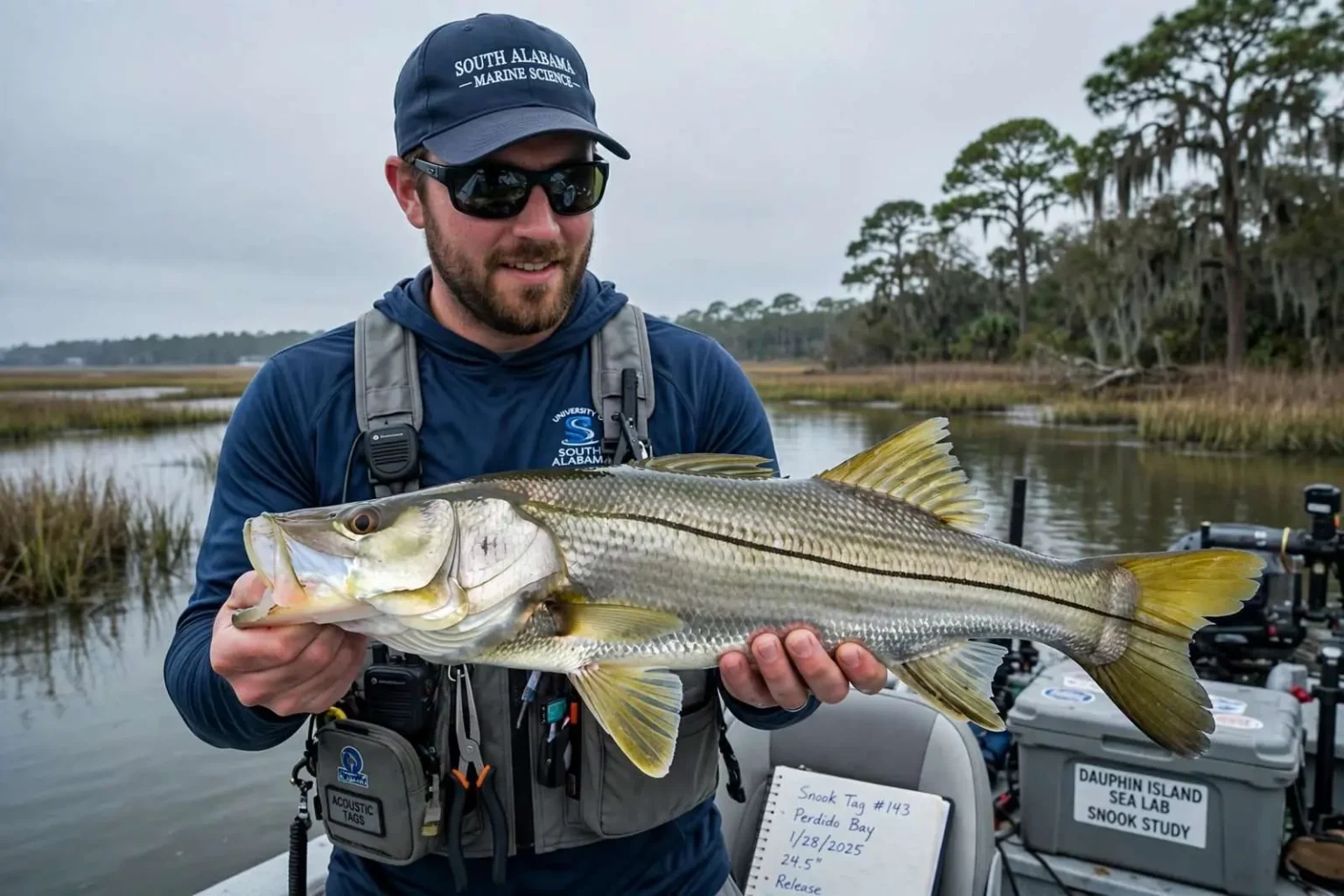
For most of Alabama’s history, the snook was a fish anglers only read about in Florida fishing reports. That is changing. Researchers with the University of South Alabama and the Dauphin Island Sea Lab say the common snook, a species long associated with waters south of Tampa, is now turning up with growing regularity in Alabama’s coastal rivers and bays.
Dr. Charlie Martin, a north Alabama native who earned his doctorate at the University of South Alabama, has been tracking the trend closely. Martin worked on the staff at the University of Florida beginning in 2016, where he first documented large snook near Cedar Key, before returning to Alabama at the recruitment of Dr. Sean Powers. Not long after his return, he began hearing reports of snook showing up along the Alabama coast, then in the Florida Panhandle and even in Mississippi waters near Dauphin Island.
Anglers have self-reported more than 150 snook caught in Alabama waters, a number Martin believes understates the true total. “That’s quite a bit, but that’s just what gets reported,” he said. “There’s likely way more that don’t get reported. There’s a lot of excitement around it, and a lot of the fishing guides are really excited.”
Kevin Anson, director of the Marine Resources Division at the Alabama Department of Conservation and Natural Resources, said tropical species drifting into Alabama waters is not without precedent. Warm winters have previously brought reports of bonefish and more frequent catches of African pompano. Because Florida has conducted most of the existing snook research, and Alabama’s habitat differs in meaningful ways, Anson said it will take time to build a solid body of local data on the species’ age, growth and reproduction in the northern Gulf.
Snook are known for their sensitivity to cold water, which helps explain why they have historically avoided the northern Gulf Coast. Martin said the fish seek out deep, thermally stratified pockets in coastal rivers, where cold water sits on top and warmer water is insulated below, allowing snook to survive short cold snaps. Notably, Martin’s team found snook still present in Weeks Bay and its tributaries even after the January 2025 winter storm that dropped eight to ten inches of snow on the Alabama coast. Reports have also come in from Fowl River, Fish River and other coastal waterways, with the highest concentrations so far centered on the Perdido Bay area of Baldwin County.
According to Martin, snook are more tolerant of freshwater than many anglers realize. The species is part of a family of fish that, globally, tends to favor rivers over open ocean, and snook have been documented surviving in fully fresh water as far inland as the Okefenokee Swamp in Florida. Alabama’s current state record snook, weighing 13.7 pounds, was caught by Adam Rhodes of Elberta earlier this year.
Update: Martin said Alabama is not the only new frontier for the species. Snook populations are also expanding into South Carolina, the Texas Gulf Coast and along Florida’s east coast, suggesting a broader shift in the fish’s range well beyond its historic waters near Tampa. The species’ potential size was on display earlier this year when a 72.6-pound snook was caught off the coast of Costa Rica, far exceeding Alabama’s own 13.7-pound state record.
Martin’s team is now tagging snook with acoustic tags to better understand their movements, particularly where they retreat to during winter. He compared the behavior to manatees, which also rely on specific warm-water refuges to survive cold months. The research also aims to understand what impact a growing snook population could have on the local ecosystem, since the species is an aggressive predator that consumes a wide variety of prey.
Anglers who catch a snook in Alabama waters are asked to report the catch, including the approximate date, general location and a size estimate or photo, to Martin’s research team. Alabama’s Marine Resources Division has already put a conservative regulation in place for the species, setting a one-fish daily bag limit and a 28-inch minimum length, even though snook are not yet considered a routine catch. Anson said the limit was meant to prevent overharvesting as the species appears to be gaining a foothold in the region.
A Fish Shaped by Cold Water
The common snook (Centropomus undecimalis) has long been one of Florida’s most prized inshore game fish, and Florida manages it closely, with seasonal harvest closures, a slot limit and a snook permit required of most anglers who keep one. Cold is the species’ main natural check: a severe freeze in January 2010 killed large numbers of snook in Florida and led state regulators to temporarily close snook harvest statewide while the population recovered.