
One Hurt in Mobile Car-to-Car Shooting Near St. Stephens Road
A passenger was shot when another driver fired into his car near St. Stephens Road and Seal Street in Mobile.
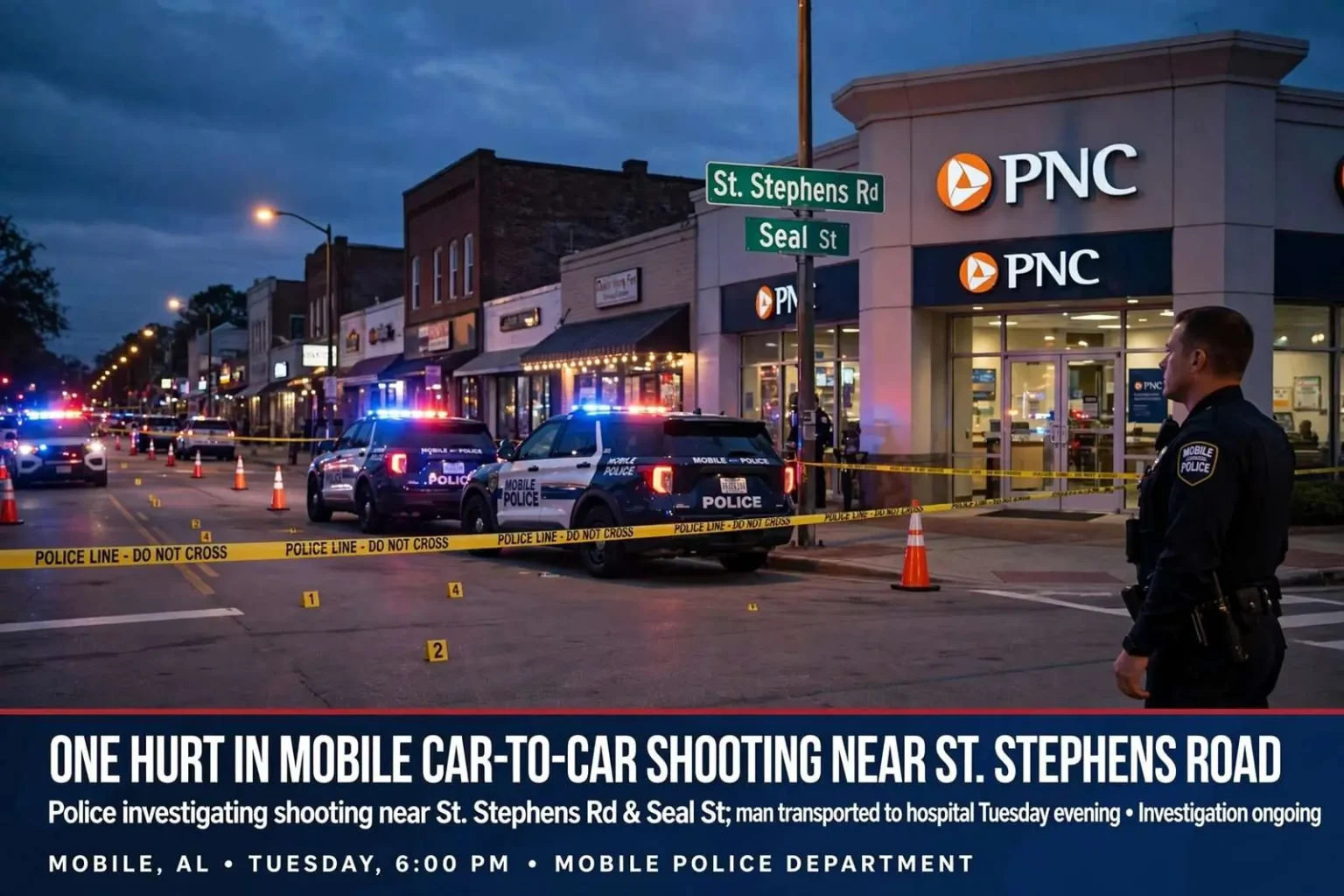
Mobile police are investigating a car-to-car shooting that sent one man to the hospital Tuesday evening. According to the department, an officer was flagged down near St. Stephens Road and Seal Street around 6 p.m. after reports of a person shot near the PNC bank at that intersection.
Officers who arrived in the area found that a man had been wounded while riding inside a vehicle. He was taken from the scene to a nearby hospital for treatment, and authorities have not publicly released details about his condition. The intersection where the officer was flagged down sits along one of Mobile’s busiest northwest corridors, and the timing of the incident, right at the evening commute hour, quickly drew attention from drivers and residents moving through the area.
How the Shooting Unfolded
Police said the victim was riding as a passenger in a vehicle with two other people when a man pulled up alongside them in a second car and opened fire into their vehicle. The wounded passenger was taken to a nearby hospital for treatment. The two other occupants of the car were not hurt.
The episode is the latest example of what investigators call car-to-car or vehicle-to-vehicle gunfire, a form of street violence that presents particular challenges for detectives. Because both vehicles are in motion and the encounter may last only seconds, witnesses other than those directly involved are rare, shell casings can be scattered over a wide stretch of roadway, and surveillance cameras in the area become the most important source of evidence. Detectives typically work backward from the moment the first shot was fired, canvassing businesses and homes along the route for any camera that might have caught the second vehicle before, during, or after the encounter.
In this case, the fact that a passing officer was flagged down rather than a 911 call placed from the scene suggests the shooting ended almost as quickly as it began, with the driver of the victim’s vehicle able to move away or stop near the intersection where help was found. Investigators have not said whether the occupants of the victim’s car returned fire, and the department has not released information about how many shots were fired or whether any other vehicles or buildings in the area were struck.
The Scene: St. Stephens Road and Seal Street
St. Stephens Road is a major artery that runs northwest out of downtown Mobile, carrying traffic toward the Toulminville neighborhood and onward toward Prichard and the communities of northern Mobile County. It closely parallels the historic route of U.S. Highway 43 and has served for generations as a commercial spine lined with banks, churches, storefronts, restaurants, and service businesses. Seal Street intersects St. Stephens Road in the Toulminville area, a residential section of streets that feed into the commercial corridor.
The PNC bank referenced in the police account sits at or near that intersection, and it is the kind of location that generates steady vehicle and pedestrian traffic throughout the day. By 6 p.m. on a Tuesday, the corridor is typically busy with commuters heading home, customers finishing errands, and delivery drivers moving between stops. A burst of gunfire at that hour, in that location, means there would have been no shortage of potential witnesses in passing cars, though many would have been moving too quickly to register details.
Incidents of this kind have an immediate practical effect on the surrounding blocks. When officers seal an intersection to search for evidence, St. Stephens Road traffic backs up quickly in both directions, and businesses along the corridor see customers rerouted for hours. Mobile police routinely ask nearby residents and business owners to review their own doorbell and security footage after shootings in commercial areas, since even a partial view of the suspect vehicle, its direction of travel, or a partial tag can help detectives identify it.
A Suspect Known to Police
Investigators described the shooter only as a “known male subject” and did not release his identity. Police said the case remains an ongoing investigation, with detectives working to locate the suspect and determine what led to the gunfire.
When a department describes a suspect as known, it signals that investigators have some identification of the individual, through prior contacts, records, or evidence gathered in the hours after the shooting, but that naming the person publicly could compromise the case before an arrest. Detectives generally hold off on releasing a name until they are prepared to seek an arrest warrant, both to avoid tipping off the suspect and to protect the investigation from errors while evidence is still being confirmed. In the meantime, patrol officers are briefed on the information, and the individual can be located and taken into custody during any routine stop.
The phrase also matters for residents reading the early reports. A suspect who is known to police but not yet in custody means the public should remain observant. Mobile police, like departments across the region, lean heavily on community tips in cases where the victim and suspect may have some prior connection, and investigators often note that the first hours after a shooting are the most productive for gathering usable information before memories fade and footage is overwritten.
How Mobile Police Handle Shooting Investigations
The Mobile Police Department is the primary law enforcement agency for Alabama’s fourth-largest city, patrolling a jurisdiction that stretches from the waterfront of Mobile Bay north to the city limits shared with Prichard and Chickasaw. St. Stephens Road falls within the department’s northern patrol area, and serious incidents there are worked by the department’s investigative units, which take over from uniformed officers once a scene is secured.
A typical shooting investigation moves through several stages. Uniformed officers first secure the scene, arrange medical care, and interview the occupants of the victim’s vehicle. Evidence technicians then process the location, photographing the area, collecting shell casings, and documenting any damage to vehicles or buildings. Detectives follow up with interviews, check hospital records for the wounded passenger’s condition, and request footage from private cameras as well as city-operated systems. The department also coordinates with the Mobile County District Attorney’s Office as charges are prepared, and with the county’s Major Crimes Task Force when a case involves coordination across jurisdictions.
Mobile has worked for years to confront gun violence through a combination of enforcement and prevention, including focused attention on repeat offenders, cooperation with federal partners on weapons charges, and community outreach programs aimed at interrupting retaliatory cycles of violence. City leaders and police officials have repeatedly emphasized that tips from residents are central to solving shootings, and the department maintains channels for anonymous reporting for witnesses who are reluctant to come forward publicly.
The department’s non-emergency line, 251-208-7211, is the standard contact for passing along information about cases like this one, and tips can also be submitted anonymously. Investigators in shooting cases typically want the same kinds of details: a description of the suspect vehicle, its direction of travel, any partial license plate, and the approximate time the incident occurred.
What Comes Next for the Case
Police said detectives are working to locate the suspect and determine what led to the gunfire. That second question, the motive, remains publicly unanswered. In car-to-car shootings, investigators look at whether the vehicles were traveling together before the encounter, whether the occupants were known to one another, and whether any earlier dispute or incident set the encounter in motion. Those answers usually come from the surviving occupants, from cell phone and location records, and from footage gathered along the route.
The victim’s recovery will also shape the case. Hospitals in the Mobile area treat a steady flow of gunshot patients, and the severity of a wound often determines whether detectives can interview the passenger quickly or must wait until his condition stabilizes. An updated condition, when released, typically becomes the clearest public signal of how serious the injuries were.
Once the suspect is located, the case moves to the prosecutor’s office, where the charging decision will depend on the evidence gathered by detectives and the extent of the injuries. Shooting into an occupied vehicle carries serious potential penalties under Alabama law, and cases where a suspect is identified but remains at large are kept open indefinitely until an arrest is made.
What This Means for Residents of the Area
For people who live in the neighborhoods around St. Stephens Road or who commute through the corridor, the incident is a reminder of both the unpredictability of street violence and the role ordinary residents play in its resolution. No bystanders were reported injured, and the two other occupants of the victim’s car escaped unharmed, but a shooting at a busy commercial intersection during the evening hour shows how quickly a routine drive can intersect with a criminal encounter.
Local residents can take a few practical steps when incidents like this occur nearby. If you were in the area around the time of the shooting and your vehicle or home security camera may have captured the event, preserving that footage promptly is the single most useful thing you can do, since many systems overwrite recordings within days. If you saw the second vehicle, even briefly, noting its color, body style, and direction of travel can help investigators fill in the timeline. And anyone with direct knowledge of the individuals involved is encouraged to contact Mobile police through the non-emergency line or an anonymous tip channel.
Residents should also expect continued police activity in the area as the investigation proceeds, including additional patrols in the commercial corridor and follow-up interviews with business owners along St. Stephens Road. The department has generally discouraged speculation about motive in the early stages of cases like this, and officials often note that the most accurate information about a suspect’s status comes from official releases rather than from social media posts.
The shooting remains under investigation. Mobile police have not announced any arrests, and no further details about the victim, the suspect, or the circumstances that led to the gunfire have been released. Updates are expected as detectives locate the known male subject identified in the case and determine what led to the violence along the St. Stephens Road corridor Tuesday evening.


