Only Two Gulf Coast Schools Crack Alabama’s Top 30 in Latest Rankings
Fairhope High ranked 20th and Saraland High 26th in Niche.com's list of Alabama's top public high schools, the only Gulf Coast schools in the top 30.
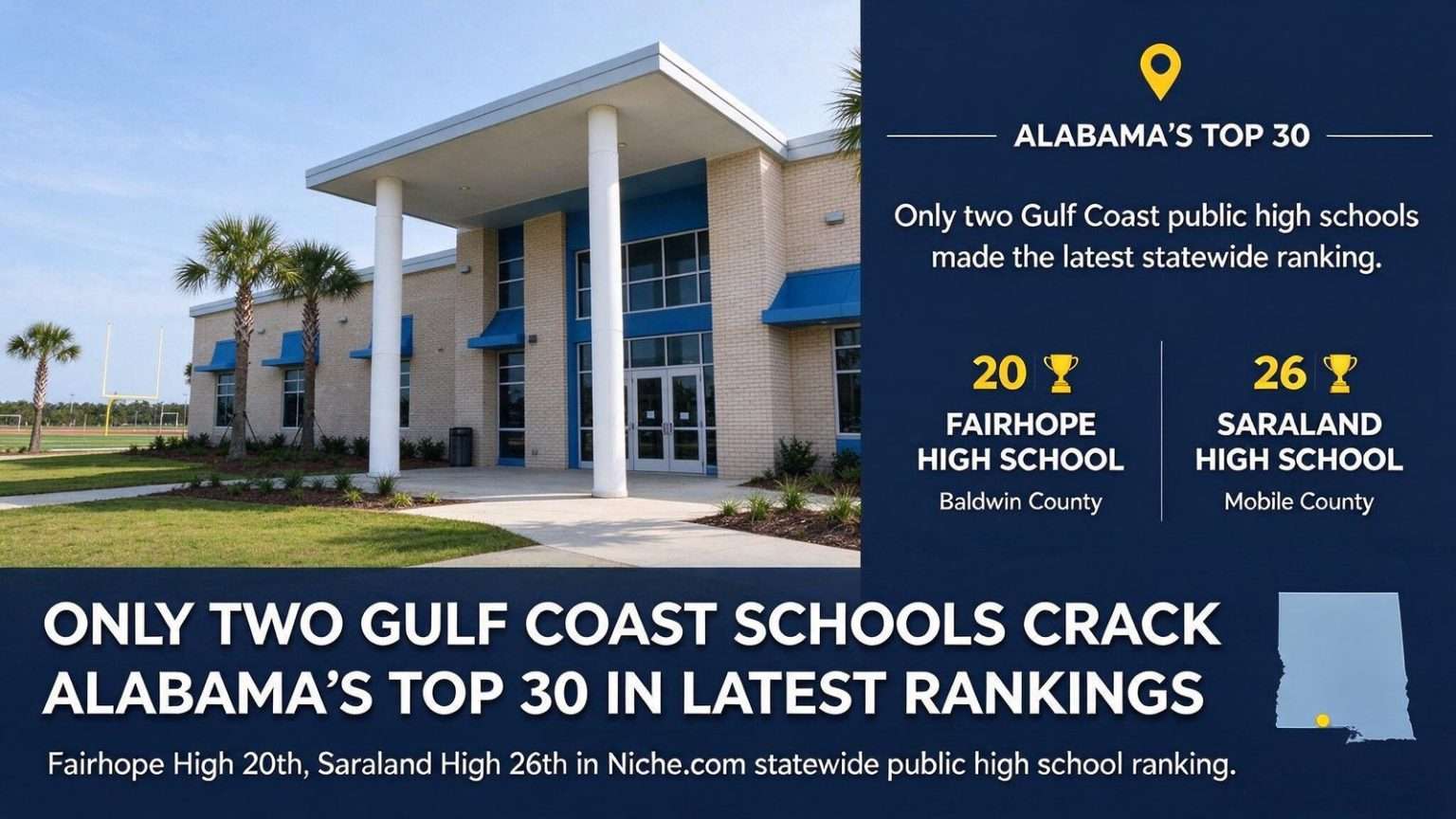
Two schools from the Alabama Gulf Coast placed in the top 30 of a statewide ranking of public high schools released by Niche.com. Fairhope High School in Baldwin County came in 20th, and Saraland High School in Mobile County ranked 26th. No other school in Mobile or Baldwin counties made the top 30, a result that underscores how competitive Alabama’s best-known suburban and city high schools have become even as Gulf Coast campuses continue to climb.
The Niche list ranks hundreds of public high schools across Alabama, drawing on data that reaches well beyond a single test administration. For families along the coast, the appearance of Fairhope and Saraland in the statewide top tier is the kind of recognition that school systems publicize in recruitment materials and that movers check before signing a lease or closing on a house. It also highlights a gap: two of the region’s largest counties produced just two top-30 campuses between them.
Fairhope’s placement continues a run of strong marks for the eastern shore school, which sits in one of Baldwin County’s fastest-growing corridors. Saraland’s finish is arguably the more striking of the two, given how recently the city carved out its own school system and built a high school program from scratch.
What the ranking measures
Niche builds its school rankings from a mix of federal and state education data along with feedback collected from students and parents. Academic performance indicators, test scores, teacher data and survey responses all feed into the final ordering, which means the list reflects a broader picture than test results alone. The company’s methodology weighs factors such as state assessment proficiency, college readiness measures, graduation rates, teacher salaries and absenteeism alongside the qualitative input that families submit through its review platform.
That blend of hard numbers and survey opinion is both the appeal and the caveat of rankings like this one. Standardized results can be verified against state report cards, but the survey component captures perceptions — how safe students feel, how responsive administrators are, whether parents would choose the school again — that official data never quite measures. Schools serving engaged, vocal communities tend to fare well on that half of the equation.
The rankings carry no official weight with the Alabama State Department of Education, which evaluates schools through its own accountability model and report card system. But they are widely cited by families relocating to the region and by real estate agents marketing school zones, giving them real-world influence over home prices, enrollment patterns and the reputations of systems along the coast.
For Fairhope and Saraland, the recognition arrives with expectations attached. Schools that appear on statewide lists attract scrutiny as well as praise, and both communities will be watching to see whether the campuses can hold their positions as enrollment keeps climbing across the Alabama Gulf Coast.
Local context: two very different success stories
Both schools that placed have drawn attention in recent years for enrollment growth and facility investment. Saraland City Schools broke away from the Mobile County system in 2008 and has since built out its own high school program, a split that followed years of negotiations and a citywide vote. Saraland’s separation was part of a wave of municipal splits in Mobile County — Satsuma and Chickasaw followed in later years — as residents sought smaller, locally controlled systems with their own tax bases and school boards.
The bet Saraland made has paid off in visible ways. The city invested in new campuses and athletic facilities, its programs grew rapidly, and the system has become one of the region’s most sought-after enrollment destinations, drawing transfers from neighboring zones and new residents who move to the city specifically for the schools. A 26th-place statewide ranking puts the young system ahead of campuses with decades more history.
Fairhope remains one of the largest high schools in the Baldwin County district, which spans one of the fastest-growing counties in Alabama. Baldwin County’s population boom — fueled by coastal development, retirees and families moving in from Mobile and out of state — has pushed repeated waves of school construction across the county, and Fairhope’s eastern shore zone has been among the busiest. Large schools face inherent trade-offs in rankings like Niche’s, since size complicates everything from class sizes to campus culture, making Fairhope’s top-30 finish notable for a school of its scale.
Why the rest of the coast stayed off the list
The absence of other Mobile or Baldwin County schools from the top 30 reflects the statewide competition as much as any local shortcoming. Alabama’s top of the list is dominated by long-established suburban systems in the Huntsville, Birmingham and Montgomery metro areas — Mountain Brook, Vestavia Hills, Homewood, Madison City and Auburn among them — systems with deep tax bases and generations of academic tradition. For newer or fast-growing systems, cracking that tier is a slower proposition.
Demographics play a role as well. Suburban systems that top statewide lists typically combine moderate class sizes with comparatively high per-student spending and experienced faculties, advantages that accrue over decades. Fast-growing coastal systems spend much of their energy — and capital budgets — simply building enough seats for the students arriving each August. That reality does not excuse weaker outcomes, but it explains why a young system’s climb up any statewide ranking tends to be measured in years rather than semesters.
Mobile County, the state’s largest system by enrollment, serves a diverse urban core alongside suburban zones, and its strongest individual campuses routinely post solid results even when the system as a whole does not crack statewide superlatives. Baldwin County’s sprawling district, the third-largest in the state geographically, balances high-performing eastern shore zones with rapidly growing and more rural areas elsewhere in the county.
How families actually use these rankings
Even though the state department of education does not recognize third-party rankings, parents treat them as a starting point. Families relocating to the Gulf Coast — whether for work at the ports, the shipbuilding industry along the Mobile River, aerospace and defense employers, or the coastal tourism economy — routinely ask about school zones before choosing where to live. Real estate agents along the coast acknowledge that the words “Fairhope” or “Saraland” in a listing do measurable work in attracting buyers, and homes inside those attendance zones typically command a premium over comparable properties elsewhere.
Educators generally advise families to look past a single number. Campus visits, conversations with counselors, review of the state report card, and attention to programs a student specifically needs — advanced coursework, career-technical training, arts, athletics — reveal more than any composite score. Still, rankings shape first impressions, and a top-30 appearance generates the kind of attention that a district cannot buy.
The bottom line for coastal families
For parents weighing a move within or to the region, the practical takeaway is that the two top-30 schools anchor attendance zones with strong track records, while dozens of other campuses across Mobile and Baldwin counties serve their communities well without making a single list. School quality varies block by block in any district, and the data behind a composite ranking can mask strength in individual programs — a career academy, a band program, a robotics team — that matters more to a particular student than a rank. Families are best served by pairing the statewide list with the Alabama State Department of Education’s own report cards, campus visits and direct conversations with the principals and counselors who run the buildings every day.
What comes next for both schools
Growth is the shared challenge. Saraland continues to add students as residential development spreads across the city, and Fairhope’s zone keeps filling as Baldwin County’s population climbs. Both systems have responded with facility investment in recent years, and continued expansion will require more of the same — new classrooms, updated campuses and staff hires to keep pace with enrollment.
For the region’s other school systems, the message of the ranking is that the top 30 is reachable but demands sustained investment in teaching quality, college readiness and campus culture. Mobile and Baldwin counties send tens of thousands of students through their high schools each year, and their economic futures are closely tied to public education — employers considering relocations along I-10 and the coast consistently cite school quality among their top considerations.
Fairhope and Saraland have given the Alabama Gulf Coast two points of pride in the statewide standings and a benchmark for their neighbors. Whether next year’s list adds more coast schools to the top 30 will depend on the same ingredients that put these two there: growing communities that back their schools, administrators willing to invest in facilities and faculty, and families engaged enough to fill out the surveys that make up half the score.