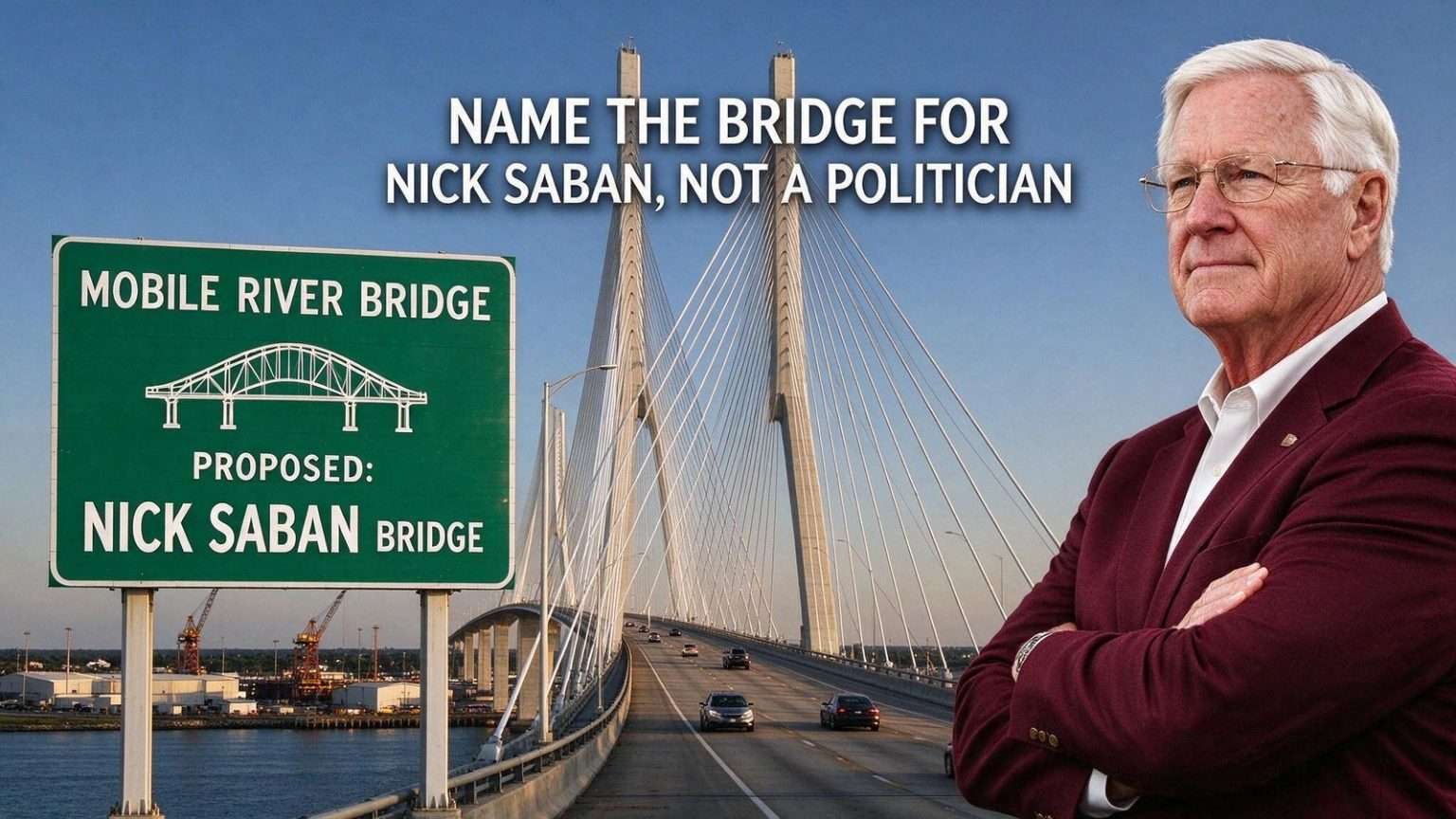
The practice of naming major public projects after sitting politicians needs to stop — and that includes President Donald Trump. Alabama’s massive new Mobile River bridge will stand long after today’s political fights are forgotten. There is no good reason to turn it into another monument to a current officeholder. The state has done this before, including naming the new Governor Kay Ivey Correctional Complex after the sitting governor. Enough. An obvious alternative: If the Mobile bridge needs a famous Alabama name, there is an obvious choice: Nick Saban. Regardless of one’s college football allegiance, Saban’s impact on Alabama reaches far beyond the sport. Don’t name the bridge after a sitting politician. Name it after Nick Saban.
A bridge across the Mobile River is not a ribbon-cutting prop. It is a piece of infrastructure that will carry traffic for a century or more, shaping how the city looks and moves for generations of people who will have no memory of the officials who funded it. That permanence is exactly why the naming question matters. A name attached to concrete and steel outlives the administration that chose it, and when that name belongs to a politician, the structure stops being public works and becomes political advertising on a scale no campaign could buy.
The Problem With Naming Things After Politicians
Alabama has been here before, and recently. The state put the name of Governor Kay Ivey, the sitting governor at the time, on the new correctional complex rising in Elmore County. Whatever one thinks of that facility or that governor, the pattern should trouble everyone: public officials directing public money, then attaching their own names, or the names of their peers, to the results. The practice guarantees that every future photograph of the project doubles as a reminder of the politician, long after voters have had their say about the official’s record.
The temptation is not unique to Alabama. Across the country, highways, courthouses, dams, and federal buildings routinely carry the names of the officeholders who steered the appropriations, often while those officeholders are still in power. The custom feeds the worst instincts of politics, rewarding incumbency with immortality and encouraging officials to think of public investment as personal legacy. President Donald Trump’s name has been floated for projects in the same fashion, and the objection is the same regardless of party: a sitting politician’s name on a public work is a campaign banner made permanent. The people who pay for these projects, the taxpayers, are never consulted, and the name will still be there when the political era that chose it is a footnote.
There is also a practical argument. Political names age badly. The official honored today can leave office in scandal, lose an election, or simply fade, and the structure is stuck with the name while public sentiment moves on. Renaming is expensive and contentious, so states usually live with the embarrassment. Choosing a name apart from current politics avoids the problem entirely.
The Case for Nick Saban
If the Mobile River bridge needs a famous Alabama name, the state happens to have one that no politician can match. Nick Saban came to Tuscaloosa in 2007 and built the University of Alabama football program into the standard for the sport, winning national championships at a rate no modern program had approached and sending a steady stream of players to professional careers. By any measure he became the most celebrated coach of his era, and in Alabama, where football is a shared civic language, his tenure became part of the state’s identity.
But the case for Saban’s name on a Mobile bridge does not rest on championships. His impact on Alabama reached far beyond the sport. The university’s visibility during his tenure coincided with record growth in enrollment and out-of-state applications, as families across the country who first noticed Alabama because of football came to see the campus, the scholarships, and the degree programs. That halo effect drew students, spending, and national attention to a state that had long struggled against stereotypes. Tourism, broadcasting, and merchandising attached to the program fed businesses well beyond Tuscaloosa, and the coach’s profile made him one of the most recognizable ambassadors Alabama has ever had.
Saban’s influence also showed in how he used his platform. He and his wife built charitable work into their Alabama years, and the coach spoke regularly about character, education, and the responsibility of prominent people to the communities around them. Whether or not a particular fan cared for his style on the sideline, the record of his Alabama years included intangibles that a bridge name could honor without embarrassment: discipline, excellence, and an insistence that success is built rather than inherited.
The objection from Auburn fans, and from fans of every other school, is anticipated and answered by the argument itself. Saban’s significance to Alabama is not that he coached one team but that he changed how the nation saw the state, and that change registered with people who never watched a down of football. Naming a bridge for a coach of his stature is not picking a team; it is picking a builder, which is the right standard for a structure that took planning, persistence, and enormous effort to bring into being.
What a Bridge Should Commemorate
The Mobile River bridge will be one of the most consequential public projects in the region’s history, carrying traffic over the working waterfront that built Mobile and linking the Gulf Coast’s interstate network through the city. Structures of that kind have traditionally carried names that mark geography, history, or genuine service: the explorers, founders, veterans, and civic figures whose contributions belong to everyone. A bridge named for the river it crosses, the port it serves, or the generations of Mobilians who worked the waterfront would commemorate something permanent and uncontested.
If the state insists on a single famous individual, the standard should be someone whose fame is not borrowed from office. Saban fits that standard better than any living Alabamian. He earned his prominence in public view, over decades, through results that no critic disputes, and his name carries none of the baggage that attaches to partisan politics. A traveler crossing the bridge in fifty years, knowing nothing of the debates of this era, would see the name and understand that Alabama honors achievement. That is what naming is supposed to do.
The contrast with naming the project for a sitting politician could not be sharper. A politician’s name on the bridge would invite every passerby to relitigate the man’s record; Saban’s name would invite only memories of Saturdays that united a state more reliably than anything at the capitol ever has.
The Choice Before the State
Alabama officials will make the naming decision, and the public’s voice in that decision comes through exactly this kind of argument. The case is straightforward. First, stop naming public works for sitting politicians, whatever their party, because the practice turns infrastructure into permanent political signage. The Governor Kay Ivey Correctional Complex should be the last example, not the latest one. Second, if a famous individual’s name is wanted for the Mobile River bridge, Nick Saban is the obvious and worthy candidate, a figure whose impact on Alabama extends from the football field through the university’s growth to the state’s image as a whole.
Don’t name the bridge after a sitting politician. Name it after Nick Saban. The structure will stand for a century; the name on it should belong to someone who united the state rather than divided it, and to an achievement that every Alabamian, whatever their football allegiance, can point to with pride.
Lessons From Other Names
Alabama’s landscape already tells the story of how naming choices age. Stadiums bear the names of coaches whose careers ended decades ago and whose reputations only grew with time, which is what honoring achievement looks like when it works. But the state’s recent habit of attaching current officeholders to new buildings is different in kind: the honoree controls the budget, cuts the ribbon, and benefits politically from the tribute while still in office. That circularity is what distinguishes a monument from a promotion.
Nationwide, examples abound of buildings named for officials who left office under clouds, leaving agencies to defend names that became liabilities. The lesson learned by other states is that waiting costs nothing. A bridge, a prison, or a courthouse can be named years after construction, once history has rendered its verdict on the people involved. Nothing about the Mobile River bridge requires a political name at the ribbon-cutting, and patience would spare the state any future regret.
The counterargument, that naming for sitting officials honors the leadership that funded the project, understates how much of the credit belongs elsewhere. The bridge will be paid for by tolls and taxes collected from ordinary Alabamians, designed by engineers, built by construction workers, and maintained by future crews whose names will never appear on any sign. A name chosen from outside politics, whether it describes the river or honors a coach, keeps the focus on that shared effort rather than on whoever occupied the governor’s office or the White House when the checks cleared.
What Saban’s Name Would Say
Imagine the sign over the span. A name tied to no party, no administration, and no election returns. Travelers who never followed sports would still know it, because the name has been carried into living rooms across the country for years, attached to a standard of excellence that Alabama exported to the nation. Visitors crossing into Mobile would read it as a statement about what the state values: work, discipline, and results earned over time.
That is the deeper argument for the coach over the politician. Names on public works teach the public, especially young people, what their state considers worthy of permanence. A bridge named for a coach who built greatness through relentless preparation tells a truer Alabama story than a bridge named for whoever happened to hold an office when the money was allocated. Alabama has no shortage of politicians; it has exactly one Nick Saban, and his claim to a permanent place in the state’s iconography was earned in full public view, without ever asking for it.
The Mobile River bridge deserves a name that will still inspire in a hundred years. The case for Nick Saban over any sitting politician, President Donald Trump included, is the case for permanence over politics, for achievement over incumbency, and for a name that unites the state instead of dividing it.