
Orange Beach Firefighters Climb 33 Floors for Names They Never Knew
First responders, families and supporters climbed Turquoise Place on the 25th anniversary of 9/11, each carrying the name of one of the 403 first responders killed that day and ringing a bell at the finish.
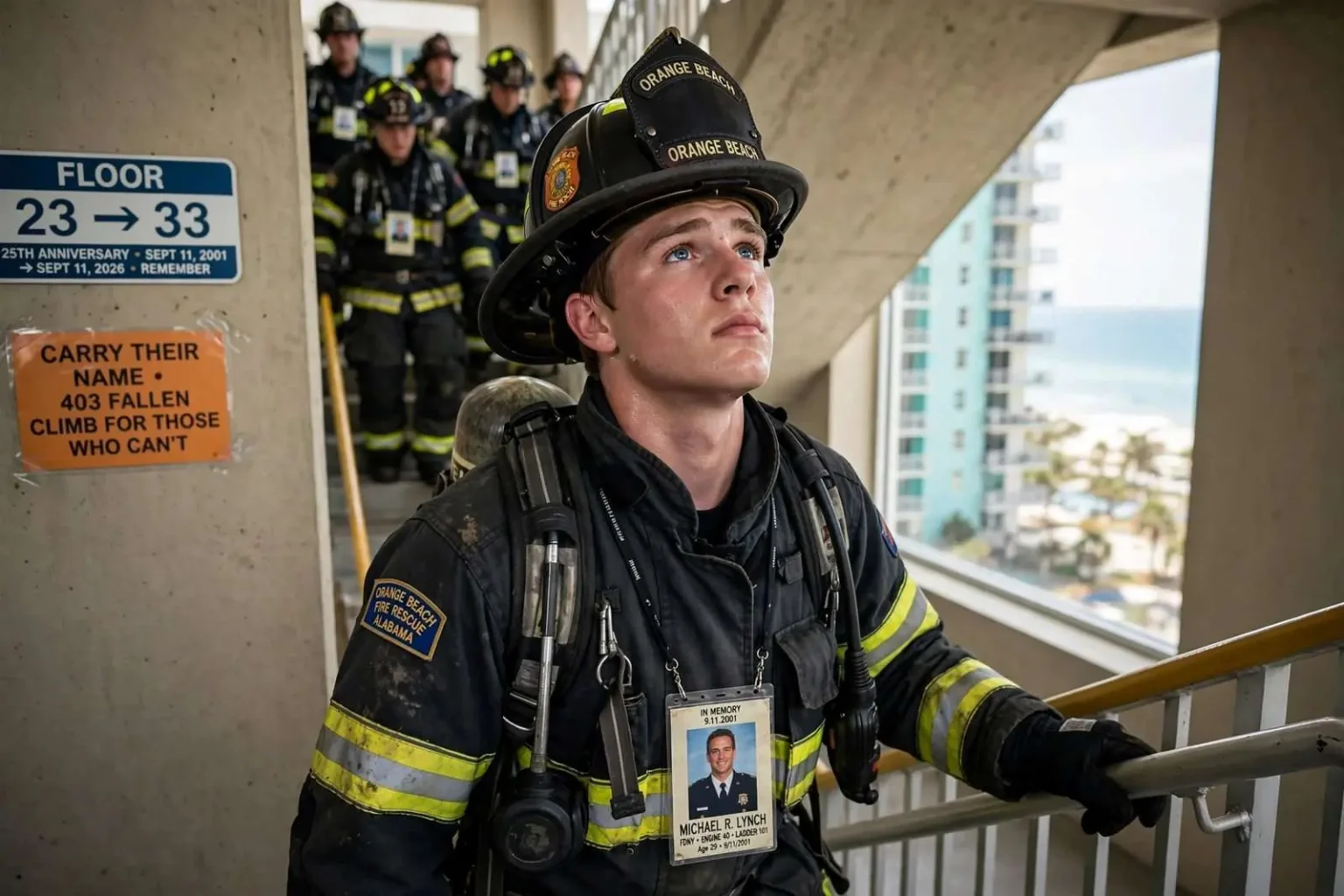
Letson May was not alive on Sept. 11, 2001. On Friday he climbed 33 floors in full firefighting gear to honor men who died before he was born.
The 19-year-old Orange Beach firefighter was one of dozens of first responders, family members and supporters who gathered at Turquoise Place for a commemorative stair climb marking the 25th anniversary of the attacks.
“They wouldn’t quit, so I went out, and I was playing that in my head over and over, and I didn’t quit,” May said. “I couldn’t quit. Those guys were heroes.”
403 Names
The climb was organized by retired Orange Beach firefighter Kevin Lanford, who was less than 10 years into what became a 33-year career when the towers fell.
“As first responders, our emphasis is on the 343 firefighters from FDNY, the 23 New York City Police Department officers and the 37 Port Authority Police Department officers who were killed in the line of duty that day,” Lanford said. “This is a group of first responders, our families and our supporters that are climbing to honor those fallen.”
Each participant received a lanyard bearing the photograph and name of one of the fallen. After finishing the climb, each rang a bell in honor of the person whose name they carried.
That structure is what separates a memorial stair climb from a workout. The climber is not accumulating floors in the abstract; they are carrying one specific person up the stairwell and announcing, at the top, that the person has been remembered.
The Numbers Are Not the Point
Turquoise Towers has 33 floors. Many participants climbed the building repeatedly to reach the equivalent of the World Trade Center’s 110 stories — the standard distance at memorial climbs nationwide.
Lanford was careful not to let the arithmetic become the event.
“What’s important is why we are here and the why we’re climbing,” he said. “That’s a lot more important than numbers and the gear.”
The gear is not incidental, though. Firefighters who climb in full turnout gear and air packs are carrying roughly the same load the FDNY members carried into the stairwells, in Gulf Coast September heat, which is part of why the exercise communicates something a moment of silence cannot.
Teaching a History Some Participants Did Not Live
May first heard about the attacks in second grade. He said it made him angry even then, and that it shaped what he wanted to do with his life — protect people and help them through their worst hours.
“It upsets me to hear about it, and I want to honor those who went up there knowing they wouldn’t come back so other people could live,” May said. “It really bothers me hearing about it.”
Lanford sees that gap between memory and instruction as the reason events like this one still matter.
“I think it’s so important that we talk about history,” he said. “Sometimes we start to forget it and we don’t think about it. But it’s important, especially as a first responder, as a firefighter, law enforcement officer, to understand the sacrifices that were made and decisions that were made and the fact that even though they knew they were going into a terrible situation, they still went.”
Watching From Okinawa
Gulf Shores Police Capt. Nate Harris was in Marine barracks in Okinawa, Japan, when the news reached him — at night, in the middle of a typhoon.
“We were doing what Marines do, enjoying ourselves because we were in the barracks,” Harris said. “But somebody yelled, ‘Come down to the great room,’ and we all went down there and saw what happened, and it unfolded in front of our eyes.”
He did not know then that the moment would redirect the rest of his life and career.
What Harris chose to emphasize 25 years later was not the attack but what followed it.
“We were so unified back then and for the years that followed, and I think as years have gone by, we’ve become more of a divided nation,” he said. “You know, if there was any good thing that came out of that horrible day, I do think it unified us as a country. God forbid something like that ever happens again, and I sure hope it doesn’t, but, you know, we need to find a way, I think, to become unified again without something like that happening.”
‘The Better Time to Talk About Would Be September 12th’
Lanford arrived at the same conclusion by a different route, and offered a reframing of the anniversary itself.
“I think a lot of times we talk about September 11, and I think the better time to talk about would be September 12th, when our country came together,” Lanford said. “Things like your political party, your background, your culture, that didn’t matter. What mattered was that we were a country and we had each other’s back and we took care of each other. It’s kind of sad that we’ve lost that.”
It is a distinction worth sitting with. Sept. 11 is the day something was done to the country. Sept. 12 is the day the country decided how to respond to each other. Only one of those is a choice available to repeat.
Raising Money While Climbing
The event was also a fundraiser. T-shirts were sold at the climb, with proceeds going to a nonprofit first responder support program.
That element is not a footnote. The mental health toll on firefighters, officers and paramedics is a recognized occupational risk, and support programs are frequently funded through exactly this kind of small community event rather than through department budgets.
Organizers said they hope to continue holding events honoring those who died on 9/11.
Why a Beach Town Climbs
Orange Beach is roughly 1,100 miles from Lower Manhattan. The 403 first responders killed that day belonged to departments that no one in Baldwin County worked for.
That distance is the reason the climb happens rather than an argument against it. The fire service treats line-of-duty deaths as a loss to the whole profession, not to a single department, and a 19-year-old in Orange Beach climbing with a stranger’s name around his neck is the mechanism by which that idea gets handed to someone who has no memory of the day at all.