Orange Beach Council to Review Recreation Campus, E-Bike Rules and Pay at Tuesday Work Session
Orange Beach City Council members will discuss park facility planning, an e-bike ordinance, a police drone request and elected officials' pay during Tuesday's work session at City Hall.
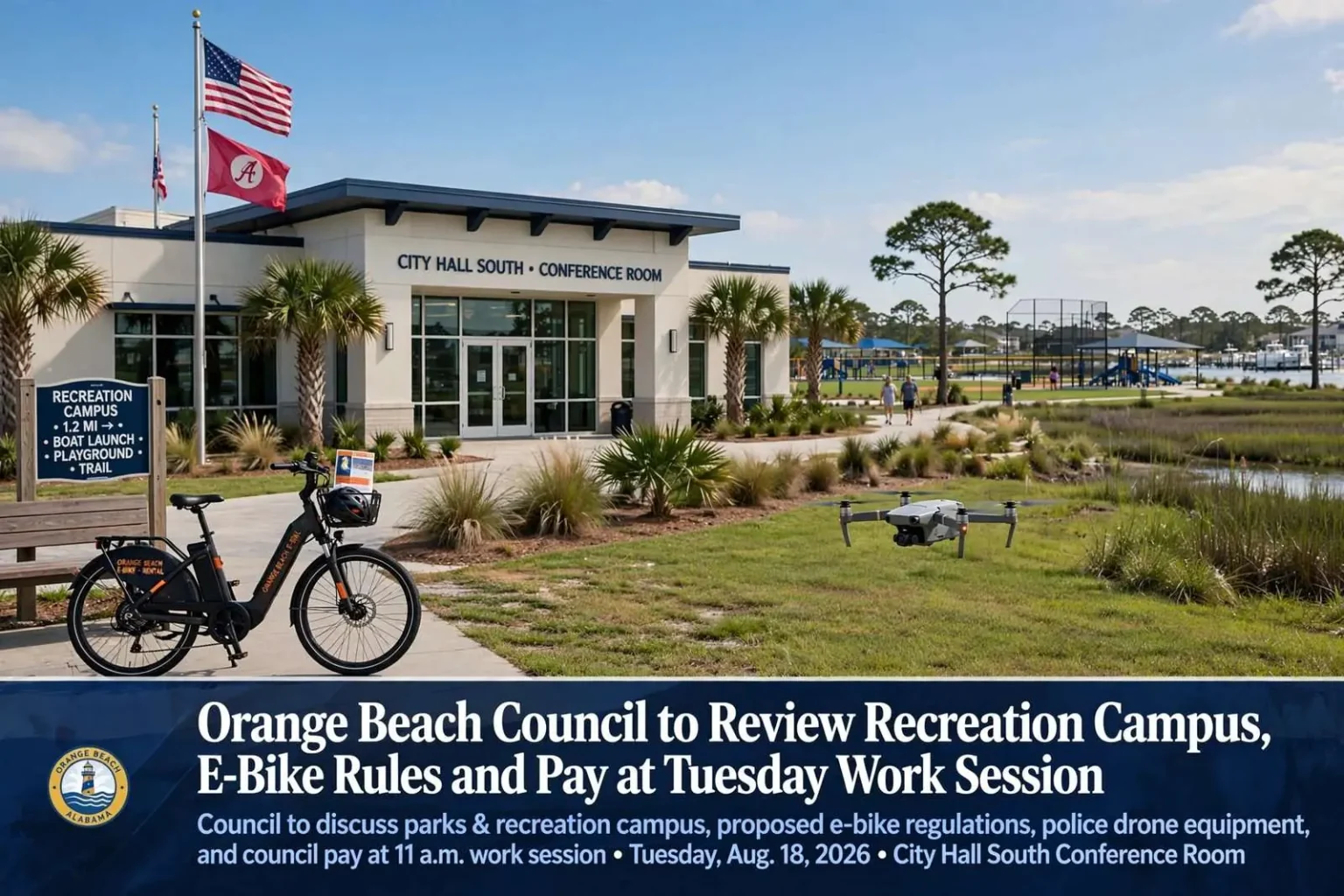
Orange Beach City Council members are set to take up a wide-ranging agenda Tuesday morning, covering everything from long-term planning for the city’s parks and recreation facilities to updated rules for e-bikes on the island. The work session, while not a voting meeting, is where most of the city’s consequential decisions get their first full airing, and this week’s lineup touches nearly every department in city government.
The work session is scheduled for Tuesday, Aug. 18, 2026, at 11 a.m. in the City Hall South Conference Room. Work sessions give council members a chance to discuss upcoming agenda items in detail before they come up for a formal vote at a future council meeting. Residents are welcome to follow along, and the items previewed Tuesday are expected to appear on voting agendas in the weeks ahead.
Orange Beach, a resort city of roughly 8,000 year-round residents that swells dramatically with summer visitors, routinely manages municipal questions that larger cities handle with bigger staffs. Balancing the needs of full-time families, seasonal workers and millions of beachgoers is the backdrop for nearly every item on the city’s agenda, and Tuesday’s session is no exception.
Parks and Recreation Planning
A central focus of the meeting will be the long-term stewardship of the city’s public spaces. Council members are expected to review a comprehensive overview of the city’s current Parks and Recreation facilities, along with a status update on the city’s recreation campus, as part of an effort to support the ongoing revitalization of public spaces across Orange Beach. The overview gives the council a single consolidated picture of ballfields, playgrounds, boat launches, trail segments and community buildings, along with the maintenance demands each one carries.
The recreation campus has been one of the city’s signature public projects, and updates on its status help the council track how quickly planned amenities are coming online. In a city where youth sports, aquatics and community events compete for space with a booming tourism economy, the campus is designed to give residents facilities of their own while also serving the visitors who fill the island each summer. Council members are likely to use the update to weigh what phases come next and how the city budgets for them.
Parks planning in a coastal community also carries practical weight beyond recreation. Public gathering spaces double as evacuation and staging points during hurricane season, green space helps manage stormwater on a barrier-adjacent landscape, and well-maintained facilities factor into the quality-of-life reputation that supports Orange Beach’s property values and tourism brand. The council’s review of facilities is therefore both a recreation conversation and a resilience one.
Governance and Public Safety Items
Beyond park planning, the council will also take up several governance and municipal policy matters, including a review of Mayor and Council salaries, a proposed co-host and responsible party ordinance, an equipment request from the Orange Beach Police Department for drone technology, a safety request for a new pedestrian crosswalk, future plans and usage options for the Old Finance Building, a facility request involving the Orange Beach Event Center, proposed regulations for an e-bike ordinance and a proposal regarding the donation of city promotional items.
The salary review puts the council’s own compensation on the table, a recurring task for Alabama municipalities that must periodically revisit elected officials’ pay as responsibilities grow. The proposed co-host and responsible party ordinance is aimed at rental events and large gatherings, holding identifiable parties accountable when properties are used for parties that spill into neighborhoods — a persistent concern in a vacation-rental-heavy beach town where house parties can overwhelm residential streets and emergency services.
The police department’s drone request reflects how widely the technology has spread through law enforcement. A drone can give officers an overhead view of traffic crashes on Highway 161 or Perdido Beach Boulevard, search shoreline and marsh areas for missing swimmers or boaters, and document large-event crowds without tying up manpower. In a city whose police force patrols both a busy highway corridor and a coastline packed with visitors in summer, an aerial tool can shorten response times considerably.
The pedestrian crosswalk request addresses a safety gap in a city built around corridors that carry heavy seasonal traffic. Improving marked crossings where residents and visitors walk to shops, restaurants and beach access points reduces the conflicts between vehicles and foot traffic that spike during tourist season. The Old Finance Building and Orange Beach Event Center items, meanwhile, deal with how the city uses existing facilities — whether to repurpose aging city space, expand rental programming at the event center or reassign buildings as departmental needs shift.
Where the E-Bike Ordinance Fits
The proposed e-bike regulations respond to one of the most visible changes in recent years on Alabama’s beach communities: the rapid spread of electric bicycles among tourists and residents alike. Rental e-bikes have multiplied along the coast, and riders of all experience levels share paths, sidewalks and roadways that were designed before motorized bicycles became commonplace. Municipalities across Baldwin County have been wrestling with where e-bikes may ride, how fast they may travel and what rules apply to rental operators, since state law offers only broad definitions and leaves most local enforcement questions open.
For Orange Beach, a workable e-bike ordinance has to balance several interests at once: visitors who rely on the bikes as a car-free way to reach the beach, businesses that rent them, residents who worry about fast-moving riders on shared paths, and public safety officers who need clear rules to enforce. An ordinance discussed at the work session would lay out those expectations before any final vote, giving rental companies and residents a chance to weigh in through the council’s normal public process.
The promotional items proposal rounds out the agenda’s smaller items, covering how the city donates branded merchandise and materials — the kinds of giveaways used at festivals, conferences and civic exchanges. Policies governing those donations help the city account for publicly purchased property and ensure promotional spending serves the community’s image rather than private interests.
City work sessions typically allow department heads and staff to walk council members through the details of proposed equipment purchases, ordinance changes and facility requests before they’re scheduled for a council vote, giving elected officials the opportunity to ask questions and request changes ahead of time. That vetting is where the real scrutiny happens: police staff can explain exactly how a drone would be deployed, parks staff can walk through campus timelines line by line, and council members can flag concerns while revisions are still cheap.
Executive Session on Real Property
The council is also expected to enter an executive session to discuss real property matters, including the potential purchase, sale, exchange, lease or market valuation of real estate. Executive sessions allow elected bodies to discuss certain sensitive matters, such as pending real estate transactions or personnel issues, outside of public view, though any formal action must still take place in open session. Alabama’s open meetings law permits the closed-door discussions for narrow purposes, and property negotiations are among them because public bargaining over price can cost taxpayers money.
Real estate questions carry particular weight in Orange Beach, where land values are among the highest in the state and the supply of developable parcels continues to shrink. Whether the city is considering acquisitions for future parks, right-of-way for road projects or disposal of surplus property, decisions made in the coming months will shape what the island looks like for decades. The executive session itself produces no votes, but any resulting transactions would return to the council table for public action.
What Happens After Tuesday
City officials noted that additional topics and items are already slated for upcoming council meeting agendas, suggesting Tuesday’s discussion is likely to carry over into future sessions as plans for the recreation campus and other initiatives continue to develop. Items that receive a smooth review in the work session typically appear on the next regular meeting agenda for a vote, while ones that raise questions may return for further staff analysis.
For residents who want to follow a particular item — the e-bike rules, the police drone request, or the recreation campus timeline — the work session is the stage where positions are formed and amendments are made. Watching it, or reviewing the agenda afterward, offers the clearest preview of what the council will formally decide in the meetings ahead.
Tuesday’s session begins at 11 a.m. in the City Hall South Conference Room. With an agenda spanning recreation planning, public safety technology, rental-event accountability, e-bike rules and behind-closed-doors property talks, the work session offers a compact look at how a small coastal city manages the demands of a resort economy on a barrier island — one item, and one vote at a time.