Orange Beach Council to Weigh Bear Point Stormwater Plan, Micromobility Ordinance
Orange Beach's City Council will review a completed Bear Point stormwater master plan and consider new rules for bicycles, micromobility devices and electric motorcycles at its Aug. 18 meeting.
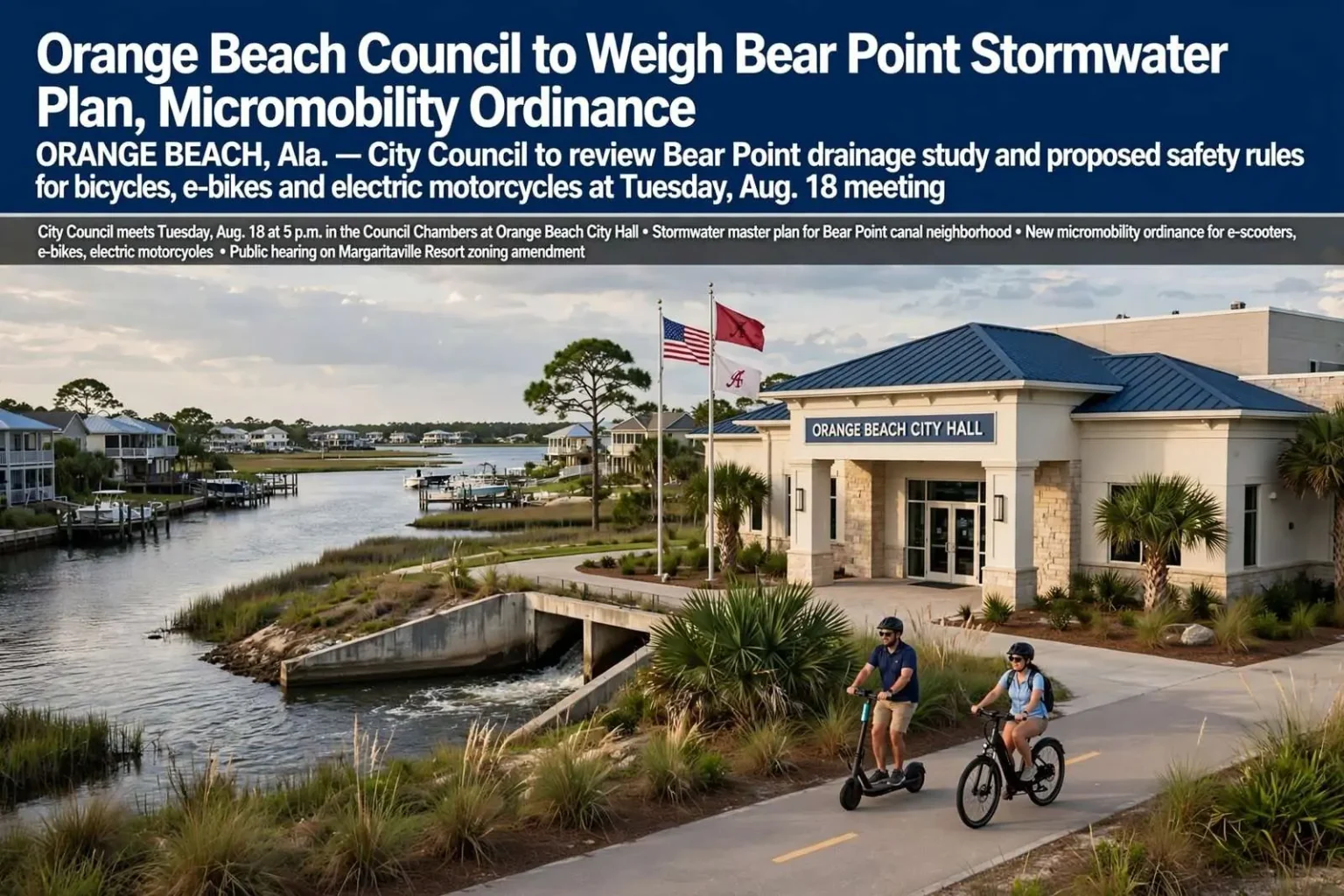
ORANGE BEACH, Ala. — Orange Beach city leaders are set to review a completed drainage study for the Bear Point area and consider new safety rules for bicycles, micromobility devices and electric motorcycles when the City Council meets Tuesday, Aug. 18, at 5 p.m. in the Council Chambers at Orange Beach City Hall. The council’s agenda combines long-term infrastructure planning with immediate neighborhood safety concerns, along with a batch of routine governance items and a zoning case tied to one of the city’s major resort developments. For a coastal resort city, the mix is typical: the same meeting that shapes how stormwater moves through a residential peninsula also decides how scooters and e-bikes share the road with summer traffic.
Bear Point Drainage Study and Stormwater Master Plan
Council members will review the completed Bear Point Drainage Basin Study and Stormwater Master Plan, prepared by Thompson Engineering. The comprehensive presentation outlines strategies intended to optimize water management and strengthen stewardship of the drainage area, giving the city a roadmap for addressing flooding and runoff issues in the Bear Point neighborhood. Bear Point is one of the city’s oldest residential areas, a peninsula of canals and bayfront homes where drainage has long been a recurring concern for property owners.
Stormwater planning has become an increasingly common priority for coastal Alabama municipalities as development along the Gulf Coast continues and heavier rain events put added strain on aging or undersized drainage infrastructure. Communities built decades ago designed their ditches, culverts and retention areas around smaller roofs, fewer driveways and rainfall patterns that no longer describe a typical Gulf Coast summer. As impervious surface accumulates with each new development, the volume and speed of runoff grow with it, and the systems underneath the streets quietly fall behind.
A master plan like the one prepared for Bear Point typically gives city officials a prioritized list of drainage improvements, helping guide future capital spending and engineering work in the area. Rather than reacting to flooded streets one storm at a time, the city gains a documented basis for deciding which projects move first, what they are expected to accomplish and how each fits into the broader budget. Engineering studies of this kind also strengthen the city’s position when pursuing grant funding, since agencies that finance drainage work want to see a defensible plan behind the request.
For Bear Point residents, the study’s arrival marks the transition from complaint to plan. Flooding and runoff problems in canal-front neighborhoods are often the product of multiple small factors — tidal influence, shallow grades, undersized pipes and yard grading — and no single fix addresses them all. A basin-wide study is the tool that sorts those factors out and puts them in order of what can realistically be built and when.
Thompson Engineering, the Mobile-based firm that prepared the study, is one of the region’s most experienced civil engineering practices, with a long track record of municipal drainage and coastal work across south Alabama. Cities typically hire firms like Thompson for basin studies because the work combines field surveying, hydrologic modeling and public input into a single technical document, and the quality of that document follows a city through years of subsequent projects.
Coastal communities face a particular version of the stormwater problem because their drainage is tied to the water around them. Rain that cannot move through the system has nowhere to go when the bays and canals are already high, and tidal influence can back water up into pipes that would otherwise drain freely. Any master plan worth adopting has to account for those tidal dynamics alongside the more familiar variables of rainfall, elevation and pipe capacity.
New Rules for Bicycles, Micromobility Devices and Electric Motorcycles
Alongside the drainage study, the council will address neighborhood safety through a proposed ordinance amending Chapter 70 of the city code. The new Article IX would set updated regulations for bicycles, micromobility devices and electric motorcycles, aiming to ensure safer transit across both residential corridors and commercial hubs in Orange Beach. The ordinance’s reach spans everything from children on pedal bikes to the electric motorcycles that have appeared on coastal roads in growing numbers, and it gives police and code enforcement a current legal framework for handling each category.
The rise of e-bikes, scooters and other micromobility devices in coastal tourist communities has prompted a number of Gulf Coast cities to revisit older traffic ordinances that did not originally account for these vehicles. Rental fleets, resort guests and seasonal workers all put new kinds of devices onto streets and paths that were designed for cars and pedestrians, often without clear rules about where each belongs or how fast each may travel. Officers who stop a rider on an electric skateboard or a throttle-powered scooter need categories in the code that actually describe what the device is.
An updated ordinance gives Orange Beach a clearer framework for regulating how these devices can be used on city streets and pathways. In a city whose population swells each summer with visitors unfamiliar with local roads, predictable rules are a safety tool in themselves. Riders who know where they are permitted, and drivers who know what to expect on shared corridors, reduce the conflicts that occur when both sides are guessing.
The proposal also fits a pattern among Alabama’s beach communities, which have spent recent years updating codes written before the current generation of electric devices existed. Municipal attorneys and police departments have pushed for clearer statutory language, and cities that act early give themselves enforceable standards rather than improvised arguments at the roadside. Orange Beach’s position as a high-traffic resort city makes the update especially consequential during the months when visitor traffic dominates local roads.
Zoning Case for Wharf Landing and Margaritaville Resort
In addition to the infrastructure items, city officials will hold a public hearing and conduct a first reading of a zoning amendment for the Amenity District PUD at Wharf Landing. The proposal, filed under Case No. 0703-PUD-26, would amend Zoning Ordinance No. 172 for the Margaritaville Resort development. Planned unit development amendments of this kind adjust the specific mix of uses, densities or site standards within a master-planned resort, and the public hearing portion of the process is where adjacent property owners and residents get their formal chance to weigh in before the council votes.
First readings are the opening step of the council’s zoning process rather than the decision point, so the item will return for further consideration once the hearing record is complete. For a development with the footprint and profile of Margaritaville at The Wharf, even technical amendments draw attention, because changes to an amenity district can shape traffic, event activity and the guest experience across the surrounding entertainment complex.
The Wharf itself has become one of the defining entertainment destinations on the Alabama coast, mixing a marina, concert venue, shopping and dining with condominium and resort development along the Intracoastal Waterway. Amendments to its amenity district ripple through that whole ecosystem, which is why the city’s public hearing process gives the surrounding community a formal role before any change is adopted.
The Shrimp Festival’s 53rd year underscores how deeply the event is woven into the city’s calendar. The festival draws visitors from across the Gulf Coast each fall for days of seafood, music and arts vendors near Perdido Pass, and the city’s use agreement with the chamber spells out the operational details — from security and sanitation to stage placement — that keep a crowd of that size functioning inside a residential community.
Community Events and Other Business
The council will also consider approval of a Special Events Retail Liquor License application from Wharf Restaurant Group LLC for the “Gulf State Collectors” event, scheduled for Sept. 15, 2026, at the Orange Beach Event Center on Wharf Parkway West. Special events licenses allow alcohol sales at one-time gatherings under the city’s oversight, and they are a routine but necessary piece of putting on the collector shows, concerts and festivals that fill the Event Center calendar year after year.
Other items on the agenda include adoption of the City of Orange Beach FY2027 Transportation Plan, intended to guide future transit improvements and position the city to pursue state funding opportunities, as well as execution of a formal use agreement with the Coastal Alabama Business Chamber for the upcoming 53rd Annual National Shrimp Festival, one of the region’s signature annual events. The transportation plan gives the city a documented framework for transit decisions and puts it in line for state programs that require an adopted plan before dollars can flow, while the chamber agreement sets the formal terms under which the festival uses city facilities and services each October.
Council members will also consider a resolution amending the city’s Employees’ Pay Plan and job listings, intended to simplify job titles within each municipal grade, alongside routine business such as approval of vendor check payments and minutes from previous Work Session, Regular Council Meeting and Committee of the Whole meetings held July 21, 2026. Pay plan housekeeping rarely makes headlines, but clean job classifications matter for recruiting and for keeping the city’s personnel structure aligned with what employees actually do, particularly in a municipal workforce that staffs everything from public safety to resort-quality parks and event venues.
Taken together, the Aug. 18 agenda is a portrait of a resort city managing growth on every front at once — drainage on an aging peninsula, new vehicles on shared streets, zoning for an expanding resort complex and the annual machinery of festivals, transit planning and personnel policy. Residents can attend the meeting at Orange Beach City Hall, where the drainage presentation and the zoning hearing both offer scheduled opportunities for public input on decisions that will shape the city’s next several years.