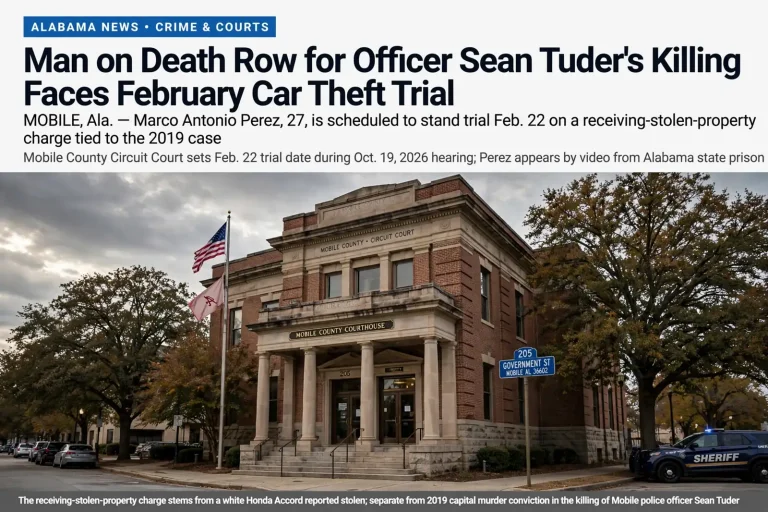
Orange Beach Police Made 147 Arrests During 2008 Widespread Panic Run at The Wharf
Orange Beach police made 147 arrests, mostly for minor drug and alcohol offenses, during a three-night Widespread Panic run at The Wharf's amphitheater in 2008.
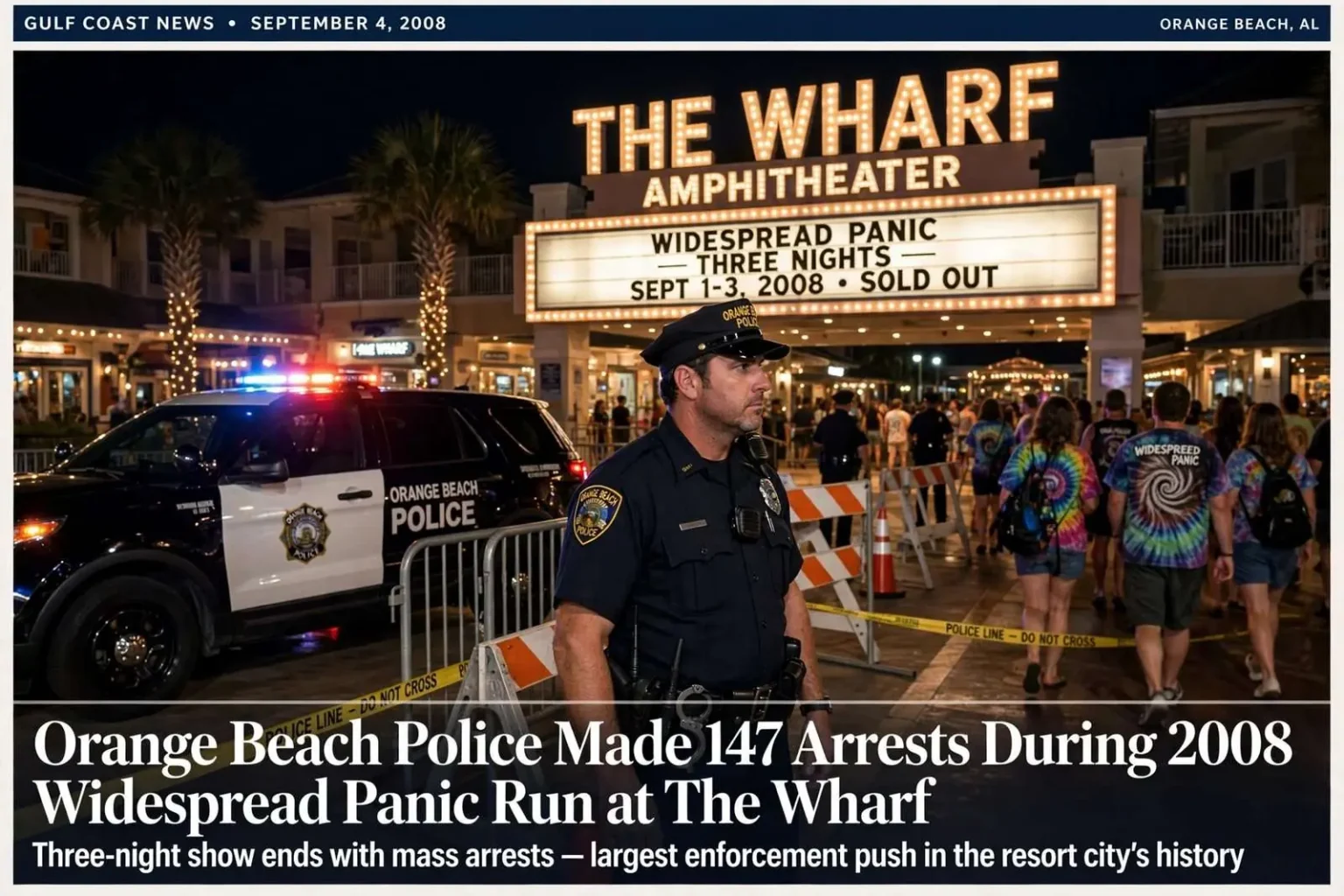
A three-night stand by the jam band Widespread Panic at The Wharf’s amphitheater in Orange Beach ended with 147 arrests by Orange Beach police, marking one of the department’s largest enforcement pushes tied to a single concert engagement. The sheer scale of the operation made the run a benchmark in the city’s experience with large-scale concert policing, and it became a reference point whenever promoters and city officials discussed what big touring acts would bring to the beach town.
The bulk of the arrests stemmed from non-violent, relatively minor offenses — underage drinking, drug possession and paraphernalia charges — rather than violent crime, according to local news coverage of the show. Officers working the venue and the surrounding roads made most of the arrests over the course of the three nights, with the totals climbing steadily as each show emptied into the parking areas and access roads. The pattern mirrored what other Gulf Coast communities had seen when the band’s traveling following came to town: crowds that were largely peaceful, but with a significant minority of concertgoers whose conduct put them on the wrong side of the city’s enforcement lines.
Orange Beach police have long carried a reputation among concertgoers and locals alike for aggressive traffic and drug enforcement around major events in the city, including holiday weekends and large gatherings at The Wharf. The department polices a resort city whose population swells dramatically during peak season, and its officers are accustomed to enforcing the rules against crowds that include thousands of visitors unfamiliar with local ordinances. Around major concerts, that posture intensifies: roadblocks, saturation patrols and visible enforcement around venue entrances and exits are standard features of the department’s event planning.
An echo of Operation Don’t Panic
The scale of the crackdown echoed an earlier, larger enforcement effort several years prior. In 2002, Birmingham-area law enforcement carried out “Operation Don’t Panic” around a separate Widespread Panic performance, arresting roughly 200 people in a coordinated operation that drew statewide attention and sparked debate about how communities should police the band’s shows. The multi-agency operation became a defining example of the friction between the band’s following and the authorities in the towns it visited, and it hung over every subsequent Panic engagement in Alabama, including the Orange Beach run.
The Orange Beach total, while smaller, still represented a significant number of arrests for a single three-night run in a city the size of Orange Beach. A small coastal city’s police force — however experienced with tourist-season crowds — does not process nearly 150 arrestees without strain, from booking and jail space to court calendars and evidence handling. The volume required planning and mutual support that few events in the city had ever demanded, and it demonstrated how a single booking decision could effectively consume a department’s attention for a weekend.
The band’s history at The Wharf’s roughly 10,200-seat amphitheater began with a sellout two-night run in 2007, an immediate signal of how strongly the act would draw on the Gulf Coast. Widespread Panic, formed in Athens, Georgia, had spent decades building one of the most devoted touring followings in American rock, with fans who plan vacations around multi-night runs the way others follow a sports team. The promise of a beach-town venue with that drawing power made the band a marquee get for The Wharf — and made the logistics impossible for anyone in Orange Beach to ignore.
The 2008 three-night engagement proved to be the most demanding yet for Orange Beach police and fire resources, and it left a lasting mark on the relationship between the city and the venue. Fire and rescue crews handled their own share of the workload — heat-related calls, medical emergencies in the dense crowd, and the ordinary accidents of thousands of people moving through a resort complex at night. The combined public-safety footprint of the run set a standard against which future events at the amphitheater would be measured, and it sharpened the questions the city asked whenever a large show came up for booking.
In the aftermath, reports indicated The Wharf’s management was asked by city officials not to book Widespread Panic again. The request reflected a straightforward municipal calculation: whatever revenue the shows generated, the enforcement bill and the strain on city services had come to outweigh it. Whether the request amounted to an informal blacklist or a simple expression of the city’s expectations, it made clear that in Orange Beach, the relationship between a venue and its city government carried real consequences for who got booked and who did not.
The economics of a beach-town concert
For a beach town whose economy depends heavily on tourism dollars generated by The Wharf’s shops, restaurants and hotels, the arrest total underscored an ongoing tension between the economic benefit of hosting large touring acts and the strain those crowds can place on local police and fire departments during peak season. The Wharf is one of the largest entertainment complexes on the Alabama coast, and its amphitheater anchors a calendar of shows that fills hotel rooms and restaurants along the beach highway. Big acts bring big weekends — and big weekends bring traffic, crowds and calls for service that a small city must absorb.
Venues across the country navigate the same trade-off, and the terms of the deal are usually negotiated long before a show is announced: security staffing, off-duty officer requirements, medical teams on site and cost-sharing for extraordinary enforcement all get written into event agreements. When those arrangements work, a city captures the revenue while the venue absorbs the cost of its own crowd. When a particular act’s following has a reputation like the one that followed Widespread Panic from Birmingham in 2002 to Orange Beach in 2008, the math gets harder — and the city’s patience gets shorter.
The 147 arrests became the number most often cited in discussions of concert enforcement on the Alabama coast, a figure that circulates whenever promoters, residents or city officials debate what the amphitheater should book. It stands as both a record of a single chaotic weekend and a case study in how a small resort city manages the collision between its two economic engines: the tourism that fills its hotels and the entertainment calendar that draws the crowds. For Orange Beach, the lesson of the 2008 run was not that big shows are bad for business, but that every big show carries a public-safety price tag — and some acts carry a bigger one than others.
Widespread Panic’s multi-night runs are a distinctive feature of the band’s touring model. Rather than playing a single show in each city, the band traditionally books two, three or more consecutive nights at venues it favors, and its fans routinely attend the entire run, renting rooms and patronizing local businesses for the full stay. That model makes the band especially attractive to destination venues — a three-night engagement functions like a small festival, concentrating days of visitor spending in one community — and equally demanding, because the crowds stay through every show rather than passing through once.
The amphitheater at The Wharf, built as part of the larger retail and entertainment development along the Intracoastal Waterway, gave the Alabama coast a mid-sized outdoor venue capable of hosting national touring acts that previously bypassed the area in favor of larger inland markets. Concerts there draw from Mobile, Pensacola and the beach communities in between, with many attendees making a full weekend of a show. For Orange Beach, the venue diversified a tourist economy built around the beach itself, adding a night-time entertainment draw that keeps visitors in the city after the sun sets.
Policing a resort city during peak season is its own specialty, and Orange Beach officers get more practice at it than most. Summer weekends already bring heavy traffic enforcement, alcohol-related calls and crowd management at restaurants and bars, and the department scales up with seasonal staff and mutual-aid arrangements. A concert weekend layered on top of peak season multiplies every category of call at once, which is why the 2008 run’s demands on both police and fire resources were remembered long after the final encore. The episode remains a case study in how a small city absorbs a big event — and in how the decisions made in its aftermath shape the entertainment calendar for years to come.
The contrast between the two Alabama episodes — Operation Don’t Panic’s roughly 200 arrests in Birmingham in 2002 and Orange Beach’s 147 in 2008 — illustrates how much policing philosophy matters in these encounters. The Birmingham operation was a planned, multi-agency sweep that drew criticism for its scale and tactics, while the Orange Beach effort played out as concentrated enforcement around a venue during a busy tourist season. In both cases, though, the underlying dynamic was the same: a band whose following includes a visible minority of drug users, a host community determined to enforce its laws, and an arrest count that became the story. For Orange Beach, the 2008 numbers settled the question of what a Widespread Panic weekend would cost the city, and the answer was more than the city was willing to pay twice.