Orange Beach Wildlife Center Draws Over 60 Volunteers at First Orientation as Patient Numbers Surge
More than 60 residents turned out for the Orange Beach Wildlife and Rehabilitation Center's first volunteer orientation, a boost the center badly needs as 2026 admissions surge nearly 70% over last year.
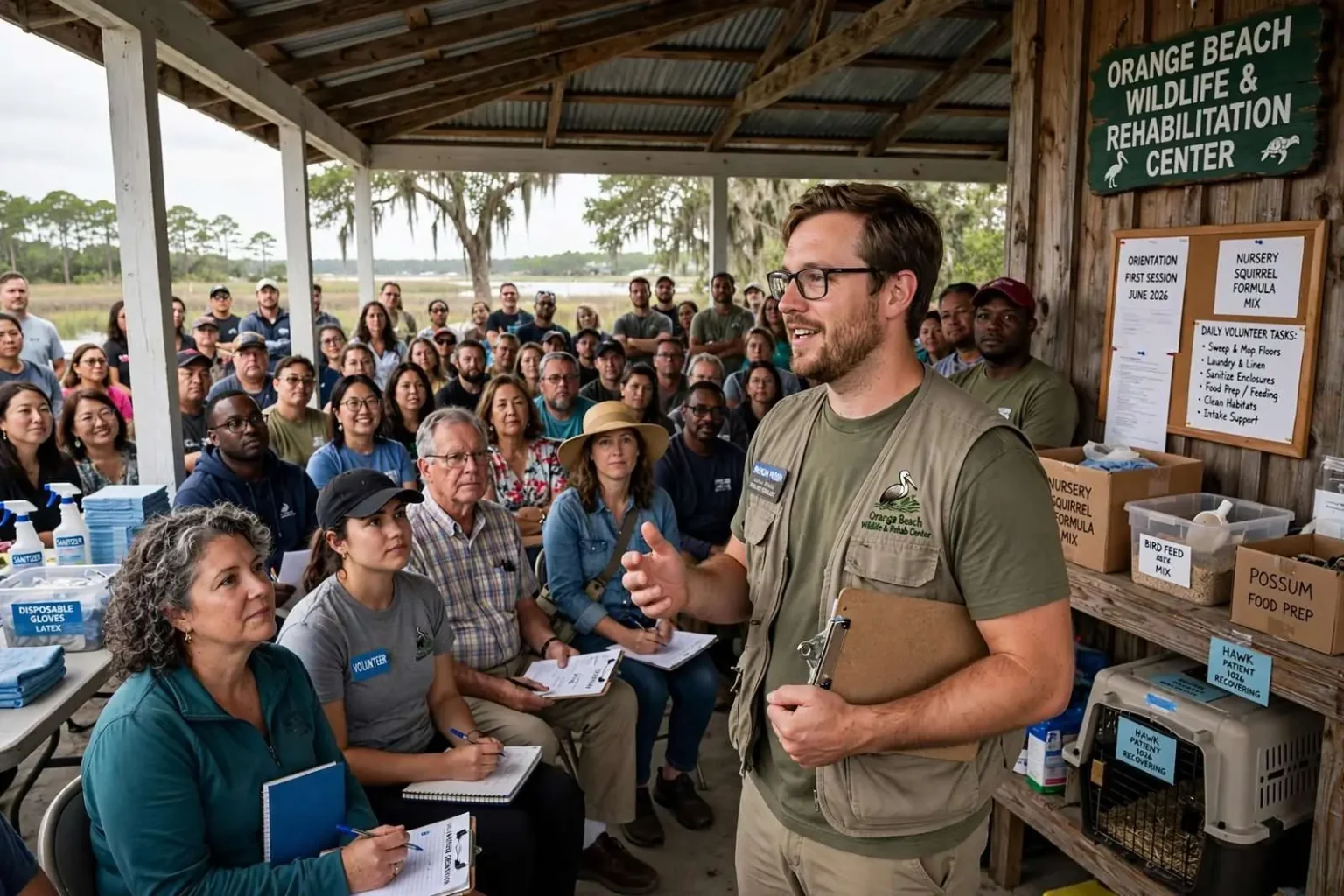
The Orange Beach Wildlife and Rehabilitation Center had a good problem on its hands last week: not enough chairs. More than 60 residents packed into the dog trot of the facility’s main building for the center’s first-ever volunteer orientation, far exceeding what staff had expected.
“We ended up having a pretty big turnout compared to what we initially expected,” said Brendan Paquin, a wildlife rehabilitation specialist at the center. “We had a little over 60 people come out. We knew that there was going to be a lot of interest in this first orientation given. We definitely ended up having more people coming out than we had initially planned for.”
The overflow crowd at the first orientation says as much about the community as it does about the center. Orange Beach, a Gulf-front city at Alabama’s southern tip on the Baldwin County coast, is a place where residents live in unusually close contact with wildlife — herons and ospreys fish the bayside shallows, deer and alligators move through the maritime forest, and sea turtles nest on the sugar-white beaches each summer. When a resident finds an injured hawk on a golf course fairway or an orphaned squirrel after a storm, the wildlife center is where that animal ends up, and the people who brought it in are often the same people who showed up wanting to help.
Not-so-glamorous but essential work
Much of what new volunteers will do isn’t glamorous. Sweeping, mopping, doing laundry, wiping down surfaces and refilling soap and latex glove dispensers make up the bulk of the daily task list.
“It’s not the most glorious work, but is the majority of what we do here and is crucial to the well-being of the animals in our care,” Paquin said. “While our volunteers are crucial in helping us in our normal daily tasks, we want our volunteers to really understand what we do and why we do it to help further our communities’ understanding of wildlife rehabilitation as a whole.”
The emphasis on sanitation is not incidental. Wildlife rehabilitation clinics house animals from dozens of species in close quarters, and disease can move through a ward of weakened patients faster than through any wild population. Clean floors, fresh laundry and sanitized enclosures are the unglamorous foundation of every recovery story the center tells. The orientation makes that case to recruits up front, so that volunteers arrive understanding that the mopping is not a chore appended to the mission — it is the mission, most days.
Volunteers will also learn to mix food for animals across different life stages, including in the center’s “nursery,” which currently houses large numbers of squirrels, possums and various birds. Diets in a wildlife nursery are precise and species-specific: the wrong formula or the wrong feeding schedule can be fatal to a young animal, which is why food preparation is treated as a trained skill rather than a drop-in task. Spring and summer are the nursery’s busiest seasons, when storm-displaced litters and fledglings arrive in waves.
The center treats bald eagles, osprey and hawks — two injured hawks are recovering there now — along with other mammals and reptiles brought in by residents after being found orphaned or in distress. The raptor caseload reflects the health of the coastal food chain. Bald eagles, once scarce across Alabama, have staged a decades-long recovery in the state, and the Baldwin County waterways they hunt are now home to a resident and wintering population that draws birders from across the region. Ospreys nest on channel markers and cell towers around Orange Beach and Perdido Bay, and hawks ride the coastal thermals along the Gulf flyway during migration. When one of those birds is grounded by a collision, fishing line or gunshot, the center is often its only chance.
A front-row seat to recovery
Despite the routine chores, volunteers won’t be shut out of the more rewarding parts of the work. Staff plan to involve them in triage of new animal intakes and in the releases of rehabilitated wildlife back into their natural habitats.
“We want our volunteers to experience the exciting part of wildlife rehabilitation as well,” Paquin said. “We encourage volunteers to watch as we triage new intakes and make sure they are included when we release animals to get them more involved.”
Release days are the emotional engine of any rehabilitation center. An animal that arrived emaciated, injured or orphaned is returned to habitat — a bayou, a pine stand, a stretch of beach — where it was found, and the moment is deliberately shared with the volunteers who cleaned its cage and mixed its food. The design is strategic. Staff know that a volunteer who has watched a hawk go back to the sky is a volunteer who comes back next week, and who talks about the center at church, at school pickup and at work.
A record year for admissions
The push for more volunteer support comes as the center faces a sharp rise in the number of animals it’s treating. In a Facebook post, the center announced it had surpassed 1,000 wildlife patients admitted so far in 2026.
“We have officially crossed over 1,000 wildlife patients admitted in 2026,” the center said in the post. “For reference, we admitted 866 patients for the entirety of 2025. We are seeing a nearly 70% increase in admissions from our previous busiest year.”
The arithmetic behind that jump is easy to sketch. Orange Beach and the surrounding Baldwin County coast are among the fastest-growing areas in Alabama, and every new subdivision, roadway and boat dock converts habitat that wildlife relied on the year before. Growth brings more people into contact with animals — more vehicles, more windows, more fishing line, more pets outdoors — at the same time that a larger population produces more residents who know the center exists and bring animals in. Storms compound the pattern along the coast, where hurricane seasons regularly scatter nests and flood burrows.
That climbing caseload is making the extra hands from the community increasingly valuable to a small staff already stretched thin.
“Volunteers are incredibly important to how we operate and how we plan to continue to grow as a center and program,” Paquin said. “Having volunteers doing boots-on-the-ground work in the center allows those interested to get a look at how much work goes into wildlife rehabilitation, while also experiencing how rewarding it is to see these animals recover and grow.”
The economics are straightforward. A rehabilitation center’s budget can buy feed, formula and medicine, but it cannot easily buy the hundreds of staff-hours that daily husbandry requires. Volunteers convert community goodwill directly into capacity, and each trained volunteer effectively extends the center’s staff without extending its payroll. With admissions running roughly 70 percent ahead of the previous record, that conversion is the difference between treating every animal that arrives and turning some away.
Returning animals to the wild
At its core, the center’s mission is about giving injured, sick or orphaned animals a path back to their natural environment.
“Our mission and goal at the center is purely to be able to help as many animals as possible return to the wild to help our environment and ecosystems thrive,” Paquin said. “Having volunteers helps the individual animals get the care that they need while allowing the center to operate in ways we do not have the time and resources to without their help.”
The return-to-the-wild goal matters for reasons that go beyond any single animal. Wildlife rehabilitation is a public service in ways that are easy to overlook: raptors help regulate rodent populations, scavengers clean carrion out of neighborhoods, and healthy predator and prey populations are indicators of functioning ecosystems across the bays, beaches and bottomlands of the Gulf Coast. A center that can treat more than 1,000 animals a year is, in effect, running an emergency room for the region’s environment.
It is also an educational service. Coastal residents who learn why a fledgling bird on the ground usually does not need rescuing, or why feeding wildlife does more harm than good, prevent injuries before they happen. Every phone call the center fields is a chance to head off the next admission.
Paquin said he hopes the newly trained volunteer corps will also become ambassadors for the center’s work, helping raise awareness across the Orange Beach community about wildlife rehabilitation and why it matters.
“They learn more about what wildlife rehabilitation can offer to the community and can help spread the word to those who might be unaware of wildlife rehabilitation and what we do as a center,” Paquin said. “The more people understand the importance of wildlife rehabilitation, the more we can do for the animals, which is our ultimate goal.”
That ambassador corps may prove to be the most valuable output of last week’s packed orientation. Sixty-plus trained volunteers spread across a city of Orange Beach’s size — and the neighboring communities of Gulf Shores, Perdido Key and the Baldwin County shore — represent an informal network of residents who know what to do when they find an animal in trouble, and who can pass that knowledge to neighbors who never attended a single orientation. For a small center facing a record year, that may be the difference between a busy season and an unsustainable one.