Overturned Vehicle Reported on Dauphin Street I-65 Overpass in Mobile
Emergency crews responded to an overturned vehicle on the I-65 overpass on Dauphin Street in Mobile Tuesday morning; injury details were unavailable.
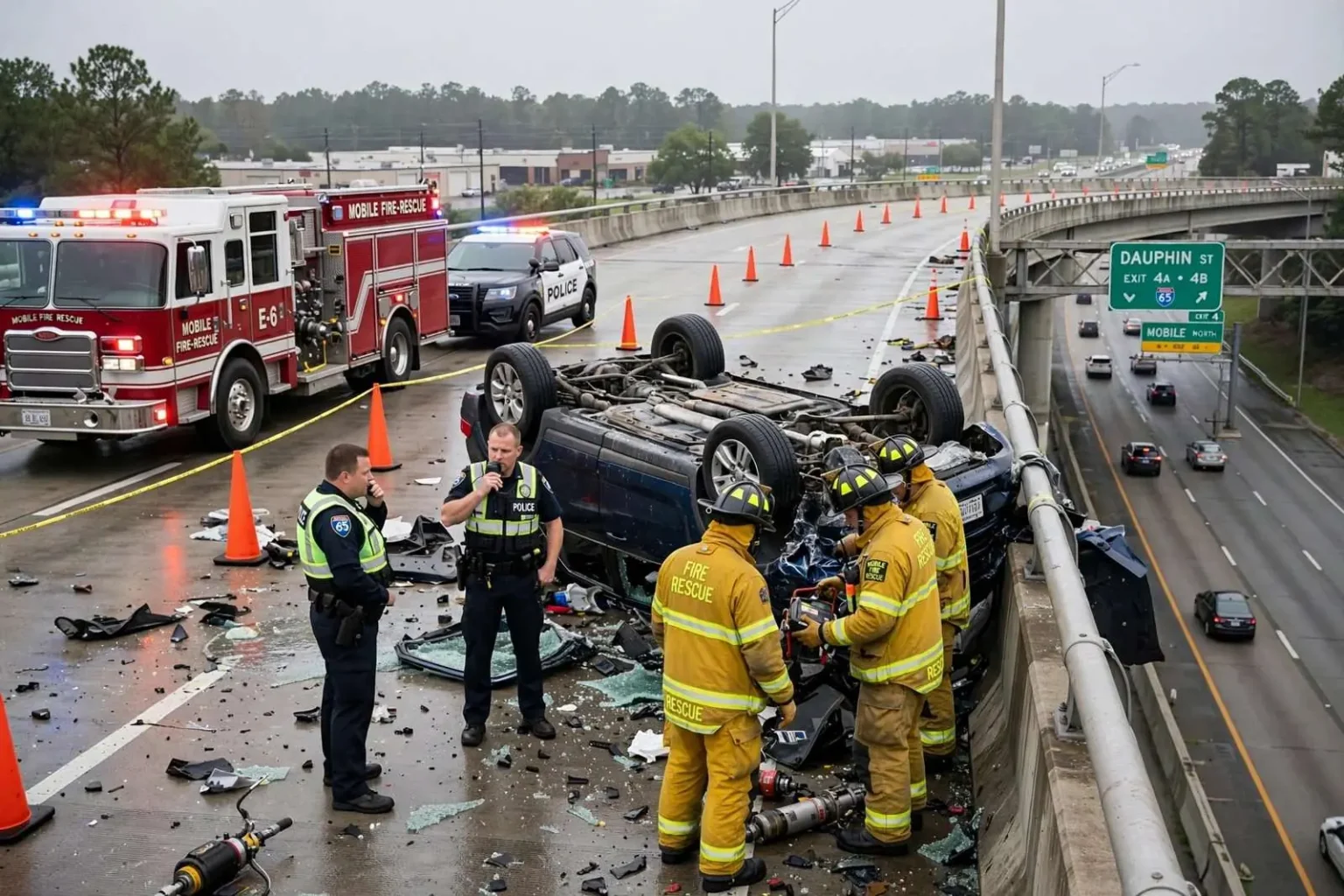
MOBILE, Ala. — Emergency crews rushed to one of west Mobile’s busiest interchanges Tuesday morning after an overturned vehicle was reported on the Dauphin Street overpass above Interstate 65, bringing rush-hour attention to a stretch of roadway that concentrates traffic in tight quarters.
The report placed the overturned vehicle on the Dauphin Street bridge over Interstate 65, between the interstate’s ramps — the narrow, curving section of the overpass where drivers entering and exiting I-65 merge into the surface street’s traffic lanes. Emergency personnel responded to the scene, where the vehicle had come to rest on its roof or side, and began working the incident as the morning developed.
There was no immediate word on the extent of any injuries. Authorities had not released details about how many people were in the vehicle or what condition they were in, and the information picture remained incomplete as crews stabilized the scene and worked to clear the wreckage.
The incident was developing as authorities worked the scene — a phrase that captures the reality of morning crash response, when the facts arrive gradually: first the location and the nature of the crash, then the injured and their conditions, then the cause and the cleanup timeline. For drivers passing through the interchange during those early hours, the only certainty was delay.
Anatomy of the Interchange
The Dauphin Street overpass at Interstate 65 is one of the busiest crossing points in west Mobile. Dauphin Street runs as a major east-west arterial through the city’s western districts, and where it crosses the interstate, the interchange’s ramps deliver and collect streams of traffic in quick succession. Northbound and southbound ramp terminals sit within a short distance of each other on the overpass approaches, compressing merging, turning, and through movements into a compact stretch of pavement.
Interchanges of this design are natural crash concentrations. Drivers entering the overpass from a ramp are accelerating into traffic; drivers exiting are decelerating across lanes; and through traffic on Dauphin Street itself is often moving at arterial speeds. The bridge deck adds its own hazards — drainage that can hold water in heavy rain, railings that channel errant vehicles, and the elevated exposure of any incident that occurs on the structure itself.
An overturned vehicle on that deck is therefore more than a routine crash. It blocks lanes on a structure with limited room to maneuver around it, and it draws emergency equipment onto a bridge where staging space is scarce. Morning commuters and local traffic alike funnel into the disruption, and the delay propagates along Dauphin Street in both directions and onto the interstate ramps that feed the overpass.
Rollover Crashes and How They Happen
Overturned vehicles account for a disproportionate share of serious traffic injuries. National crash data has long shown that while rollovers represent a small percentage of all crashes, they produce a much larger share of fatalities, because the violent motion of a vehicle rolling exposes occupants to forces — and to ejection risks — that ordinary crashes do not.
The mechanics of a rollover usually begin with a tripping event: a vehicle leaves its tires’ grip or strikes something that arrests its lower body while its upper body continues moving. Curbs, guardrail bases, soft shoulders, ditch banks, and the tires of other vehicles all serve as trip points. Sport utility vehicles, pickup trucks, and vans — vehicles with higher centers of gravity — roll more readily than sedans when cornering forces spike, which is why SUV crashes so often end upside down.
Speed multiplies every rollover risk. A vehicle traveling at arterial speeds that drops one wheel off the pavement or clips a curb at an exit ramp has far more kinetic energy to dissipate than one moving slowly, and the result can be the violent multi-rotation crash that emergency crews found themselves working Tuesday morning on the overpass.
Until investigators determined the vehicle’s path and the tripping point, the cause of the Dauphin Street rollover remained open — as did the possibilities that routinely follow such crashes: driver error, excessive speed for the interchange’s curves, a mechanical failure, a medical emergency, or the behavior of another vehicle whose driver never stopped.
The Emergency Response Sequence
When a rollover is reported, the emergency response follows a sequence refined across thousands of incidents. Dispatch sends law enforcement, fire-rescue, and medical units simultaneously, because an overturned vehicle carries multiple unknowns: whether anyone is trapped, whether fuel is leaking, whether the vehicle is stable, and how many patients there will be.
Fire-rescue crews approach an overturned vehicle with stabilization as the first task. A vehicle resting on its roof or side is inherently unstable, and the struts and cribbing that shore it up must be in place before rescuers can safely cut, lift, or extract anyone inside. If occupants are trapped, extrication tools — the hydraulic spreaders and cutters familiar from rescue scenes — open the crushed structure around them.
Medical teams then assess and treat patients according to their conditions, with injuries from rollover crashes running the full range from minor cuts to severe trauma. The absence of immediate information about injuries in Tuesday’s incident reflected the reality of those first minutes: responders were still performing their assessments while the scene was being secured, and official word on conditions would follow the work rather than precede it.
Police investigators closed out the response sequence by documenting the scene — the vehicle’s path, its final position, the damage, any debris field, and the statements of witnesses who saw the crash occur. That documentation becomes the basis for the investigation’s eventual conclusions about cause, and any citations or charges that follow.
Traffic and the Morning’s Ripple Effects
For the drivers who encountered the scene Tuesday morning, the overpass crash translated into the familiar geometry of a blocked arterial. Traffic backed up on the approaches as lanes narrowed past the wreckage, and the interchange’s ramps absorbed overflow in patterns that shifted as authorities closed or reopened lanes. Drivers who knew alternate routes took them; those who did not sat through the delay.
Incidents on the Dauphin Street overpass ripple across west Mobile’s road network because there are few parallel alternatives. The arterial carries local traffic between residential districts, commercial centers, and the interstate, and any closure on the bridge diverts vehicles onto streets never designed for the full volume. The longer the scene work takes, the wider the ripple spreads.
Clearing a rollover takes time for reasons beyond the towing itself. Fluids from a crashed vehicle — oil, transmission fluid, coolant, and fuel — must be absorbed and cleaned from the roadway before lanes can safely reopen, and an inverted vehicle deposits those fluids liberally. Debris from the crash, from broken glass to vehicle parts, must be collected, and any damage to the bridge’s railings or surface must be assessed by highway crews.
By the time the overpass returns to full traffic, the incident has usually been absorbed into the morning’s routine for most drivers — another delay in a commute that produces them regularly. But for the people in the overturned vehicle, and for the crews who worked the scene, Tuesday morning on the Dauphin Street overpass was the day’s defining event, and its full story waited on the investigation that followed the wreckage away from the bridge.
What Investigators Will Examine
The investigation into an overturned vehicle follows a standard evidentiary path. Investigators map the scene precisely — the positions of the vehicle, its debris, and any marks on the pavement — because those measurements, analyzed afterward, reveal the vehicle’s speed and path before and during the rollover. The damage pattern on the vehicle itself tells its own story: the sequence of impacts with the roadway and any fixed objects can be read from the direction and depth of the damage.
Investigators will also seek witnesses. Interchanges at morning rush generate many potential witnesses, and the accounts of drivers who saw the vehicle in the seconds before it overturned often supply the facts the physical evidence cannot — what lane the vehicle was in, whether it was speeding, whether another vehicle forced it out of its lane, and whether the driver appeared to lose control suddenly or drift gradually into the tripping event.
Camera evidence has transformed these investigations. Businesses near major interchanges typically operate security systems, and traffic cameras maintained by the state monitor the interstate approaches. Footage that captures the crash shortens the investigative path from reconstruction to observation.
The driver’s condition and conduct complete the investigative picture. Standard practice includes screening for impairment in crashes involving injury, reviewing whether a medical emergency contributed, and examining the vehicle for mechanical failures — a tire blowout, brake failure, or steering problem — that could explain a sudden departure from the driver’s control.
Overpass Incidents and Highway Safety Design
Crashes on overpasses and in interchange areas have shaped decades of highway safety engineering. Guardrails and bridge railings are designed and tested to redirect vehicles that strike them, and their placement at ramp terminals and bridge approaches reflects the known crash patterns of these locations. Impact attenuators — the energy-absorbing barrels and units positioned ahead of rigid hazards — exist because vehicles stray into exactly the places Tuesday’s crash occupied.
Roadway lighting, signage, and pavement markings at interchanges are similarly calibrated to the traffic they carry. The state and city agencies that maintain the Dauphin Street interchange review crash history at the location the way doctors review a patient’s chart: clusters of similar incidents prompt engineering reviews, and engineering reviews produce changes — signal timing, lane assignments, warning signage — aimed at the specific failure modes the record reveals.
Vehicle design has changed the outcomes of rollover crashes as well. Electronic stability control, which detects and corrects the loss of directional control that precedes many rollovers, has been standard on new vehicles for years and has driven rollover rates down significantly. Roof strength standards have increased, and side-curtain airbags that deploy in rollovers have improved occupant protection during the crash phase that once produced the most severe injuries. Seat belts remain the single most important factor: the majority of rollover fatalities involve occupants who were ejected, and ejection requires that a belt not be worn.
The Information Gap and How It Closes
The phrase “no immediate word on the extent of any injuries” describes the standard interval between a serious crash and official information about it. Emergency crews do not broadcast patient conditions while they are still treating them, and police do not release details they have not verified. The gap usually closes in stages: a confirmation that patients were transported, then a description of injuries as minor or serious, then — sometimes hours or days later — the investigative conclusions about cause.
For the public following the incident, the developing report Tuesday morning was the recognizable first chapter of that sequence. The location was known: the Dauphin Street overpass at Interstate 65, between the ramps. The event was known: an overturned vehicle. The response was known: emergency crews on scene, the incident being worked. Everything else — the number of people involved, their conditions, the cause of the rollover, the clearance time — would arrive as the authorities completed their work.
That patience is the price of accuracy in crash reporting, and it is also the mechanism by which the incident’s facts eventually become solid: verified injuries rather than rumors, a determined cause rather than speculation, and a cleared bridge rather than an open question. By the time the Dauphin Street overpass carried its full Tuesday traffic again, the work of turning a morning crash report into a complete account was underway — carried on, as such work always is, by the investigators and responders who make the clearance of a wrecked vehicle look routine and its explanation anything but.