

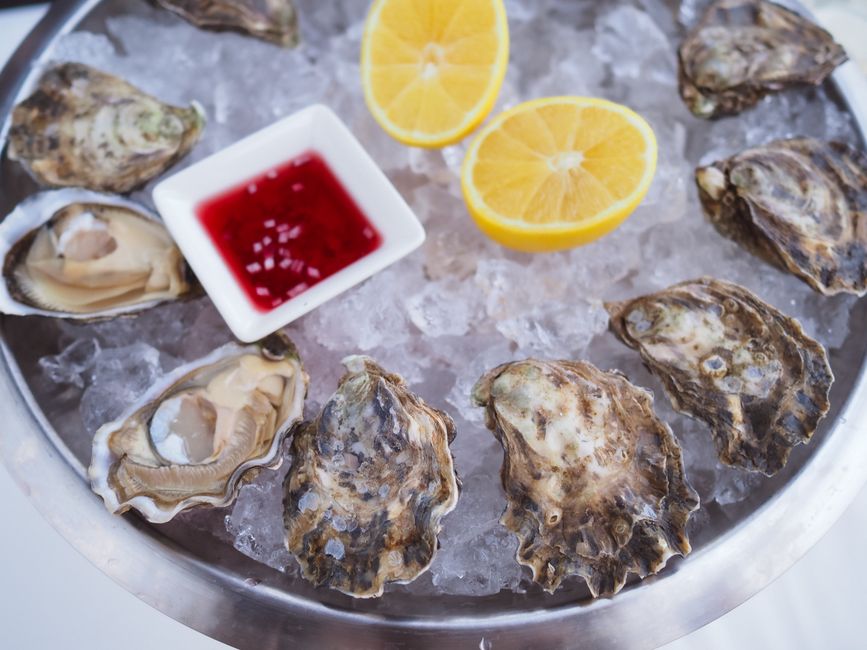
Along the Gulf Coast, oysters are never just food. They mark the celebrations — Valentine’s Day tables, Thanksgiving spreads, Christmas Eve, New Year’s toasts — and they have done so for as long as humans have lived near the water. Evidence of oyster harvesting reaches back 165,000 years to Mossel Bay, South Africa, where oyster farming continues today. Greek myths mention them, Florida’s prehistoric shell mounds are built from them, Romans farmed them, and oyster beds were cultivated to help support the foundations of China’s first stone bridge.
Living on the Gulf Coast means fresh oysters are available all year long — a privilege built on a young industry. Alabama’s first oyster farm opened in 2009; today 18 farms operate in state waters, with five more in Pensacola Bay. A bushel of fresh Gulf oysters is a short drive to the seafood market away.
The only hard part is getting them open. Executive Chef Jason Hughes of Atlas Oyster House in Pensacola has shucked enough oysters to fill a dumpster many times over, and he insists the skill is learnable in an afternoon. Below is his step-by-step method, with the safety notes that matter most.
Set up your station first
Shucking goes wrong when people improvise. Gather everything before you touch a knife:
Fresh Gulf oysters — scrubbed clean of mud and grit with a vegetable brush.
A folded dish towel — your grip and your armor.
Cut-resistant gloves — non-negotiable for beginners.
An oyster shucking knife — short, stiff and blunt-tipped, not a fillet knife.
A shallow container or tray — to hold shucked oysters on ice.
A large bowl — for the spent shells.
Work on a stable surface with good light, and keep the towel dry where your hand grips the shell; wet towels slip, and slipping is how knives end up in palms.
Step 1: Find the hinge
Every oyster has a narrow end and a wide end. The “hinge” is the point at the narrow end where the top and bottom shells meet and are held together. The “bottom shell” is the deeper-cupped of the two — that cup holds the oyster liquor, the briny liquid that makes a raw oyster worth shucking carefully.
Step 2: Grip and insert
Wrap the oyster in the folded dish towel, cut-resistant gloves underneath. Hold the oyster with the bottom shell in your palm, cup side down, and the top shell facing upward — this orientation preserves the liquor while you work.
Position the shucking knife parallel to your palm and work the tip into the hinge, where the two shells meet. Keep the blade angled toward the hinge, never toward your hand. The knife should go in no more than about half an inch; deeper risks cutting the oyster meat.
Step 3: Pop it
Firmly hold the oyster and rotate the knife clockwise to pop the shells apart. You will feel the adductor muscle’s hold release with a distinct give. This is the moment beginners overdo — a firm quarter-twist does the work; forcing the blade like a pry bar breaks shells and stabs thumbs.
Step 4: Slide and clean
Run the knife along the inside of the top shell, gradually, to separate the shells fully. Remove the knife and wipe the blade clean before continuing — shell grit travels on dirty steel.
Step 5: Free the top
Use the knife to pry open the top shell, then sever the top adductor muscle — the small, strong muscle that anchors the oyster to the shell above it. Discard the top shell into your scrap bowl. The goal is to keep the oyster’s liquor in the bottom cup, so work with the oyster level.
Step 6: Detach the bottom
Scrape the knife along the bottom shell to cut the bottom adductor muscle. The oyster should now sit loose in its cup, swimming in its own liquor. Slide the blade under gently and lift to check that nothing is still attached.
Step 7: Keep them cold
Store the shucked oysters on ice in your shallow container or tray in the refrigerator until serving. Oysters are best the day they’re shucked, and the colder they stay, the better they taste.
A note on where they come from
The oysters on Alabama tables increasingly come from farms rather than wild reefs. Since that first farm opened in 2009, off-bottom aquaculture has spread across coastal Alabama, producing the singles, or cocktail oysters, that now appear on raw bar menus from Bayou La Batre to Fairhope to Orange Beach — plus the five farms now operating in Pensacola Bay. Farm-raised oysters tend to be uniform, deep-cupped and consistently briny, and they take well to the shucking method above.
However you serve them — raw with cocktail sauce and horseradish, roasted, fried or in a dressing — the shucking is the same. Grip the towel, respect the hinge, keep the liquor, keep everything cold. After a dozen oysters, your hands will know the motion, and by the second dozen you’ll understand why Gulf Coast families have treated shucking as a social event for generations: it’s slow enough to talk, and the reward is the best thing the water sends up.