

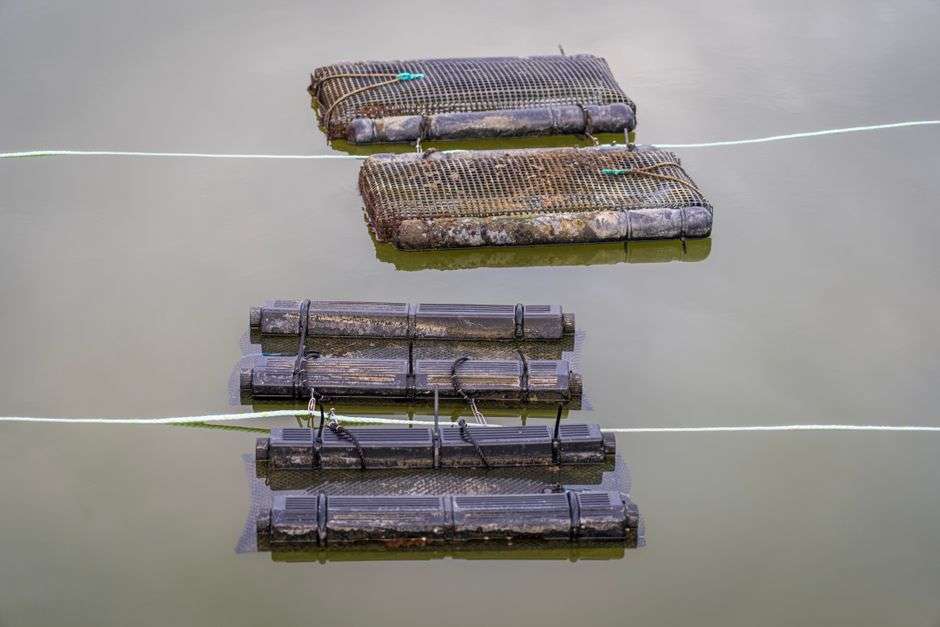
On a five-acre water column in Pensacola Bay, a former environmental scientist raises oysters named — indirectly — after his sons. Grayson Bay Oyster Company, the tide-to-table farm operated by Brandon and Natalie Smith, has become one of the Emerald Coast’s most recognizable boutique oyster brands, and its sister company, ECOyster Mobile Raw Bar, hauls the harvest to private parties from Pensacola to the coastal Alabama line.
An unlikely route to the water
Brandon Smith did not grow up on the water. He grew up in Phoenix, Arizona, and drove a 1974 Volkswagen Super Beetle to Key West in 2000 to attend Florida Keys Community College — an adventure, he says, more than a plan. A friend talked him into transferring to the University of West Florida in Pensacola, where he studied environmental science and marine biology and met Natalie, a Dallas native enrolled at UWF straight out of high school.
His early career ran through environmental consulting — greenfield surveys for wind farms across the American West — before he returned to Pensacola to spend a decade in Gulf Power’s environmental department, running water and aquatic studies for surface water compliance around three power plants. Every summer he hired two interns, and every summer they got a boat and a season of field sampling.
A long runway and a hurricane
Oyster farming in Florida is not a quick-entry business. The state requires years of water sampling before an area can open to shellfish growing, and an aquaculture lease application can take twelve months to clear the Florida Department of Agriculture and the state cabinet. Smith spent more than two years as a weekend warrior on the water while still at Gulf Power. When Hurricane Sally struck in 2020, he was on storm duty with the utility and watched friends scramble to salvage what they could of his crop, stacking oyster bags in his driveway. Even with the storm’s eye more than seven miles away, the farm lost 75 to 80 percent.
He left the utility for good in June 2022 to farm full time. His lease runs ten years on five acres, of which roughly a third is under cultivation — room, he says, to keep expanding.
How the farm works
The oysters grow in mesh bags on long-line cages anchored to the bay bottom, a system Smith favors because the cages lift easily onto his pontoon boat for sorting and cleaning. The biology runs on a schedule: spat to harvest in six to fourteen months, with sorting every four weeks as the oysters grow like, in his words, popcorn popping in a bag. Tumblers in winter help the oysters cup deeply — the shape shuckers and diners prize. Farm-raised oysters are sterile, so there is no spawning pause in the calendar.
Pensacola Bay’s bottom is nearly pure quartz sand with no mud, which Smith credits for the clean flavor of his oysters, marketed under the Tidal Guides name — a nod to the way tidal flow changes the taste from harvest to harvest. The farm started with about 100,000 oysters and has grown to roughly 600,000, harvesting at two and a half to three inches. The boys the farm is named for, Grayson and Baylen, now share a brand with the Gulf they live beside.
ECOyster: the traveling raw bar
The Smiths took over ECOyster Mobile Raw Bar in April 2023 after its founder, Thomas Derbes, stepped away to become Santa Rosa County’s Sea Grant agent and judged the oyster business a conflict of interest. The catering operation brings a full raw bar to birthday parties, corporate events, and wedding receptions — shucking raw, grilling, and working events with a minimum of 300 oysters. The busy season runs October through New Year’s, when holiday parties stack up on the calendar.
The company has also found a stage beyond private events. Smith joined the Murder Point Experience at The Hangout in Gulf Shores, an oyster showcase that gathered growers from Florida, Alabama, Mississippi, South Carolina, and Virginia with chefs from across the Southeast serving raw and grilled preparations. And a Tidal Guides draft beer — named for the oysters — pours at Pensacola’s Odd Colony Brewing Company.
Restoration on the horizon
Smith works with researchers at the University of West Florida and Auburn, and he is watching a larger story unfold in his home bay: a major oyster restoration effort planned for Pensacola Bay and Perdido Bay, with NOAA involvement, that will test different oyster strains and track survivability. For a farm whose motto is tide-to-table, the health of the wild bay matters as much as the crop inside the cages.
The arithmetic of an oyster keeps him humble: each oyster filters up to fifty gallons of water a day, and a season’s crop can be undone by a storm or a flood of freshwater from the rivers. But five years in, the farm that survived Sally is shipping oysters across the Gulf Coast — and the raw bar van is booked most weekends from October through the holidays.