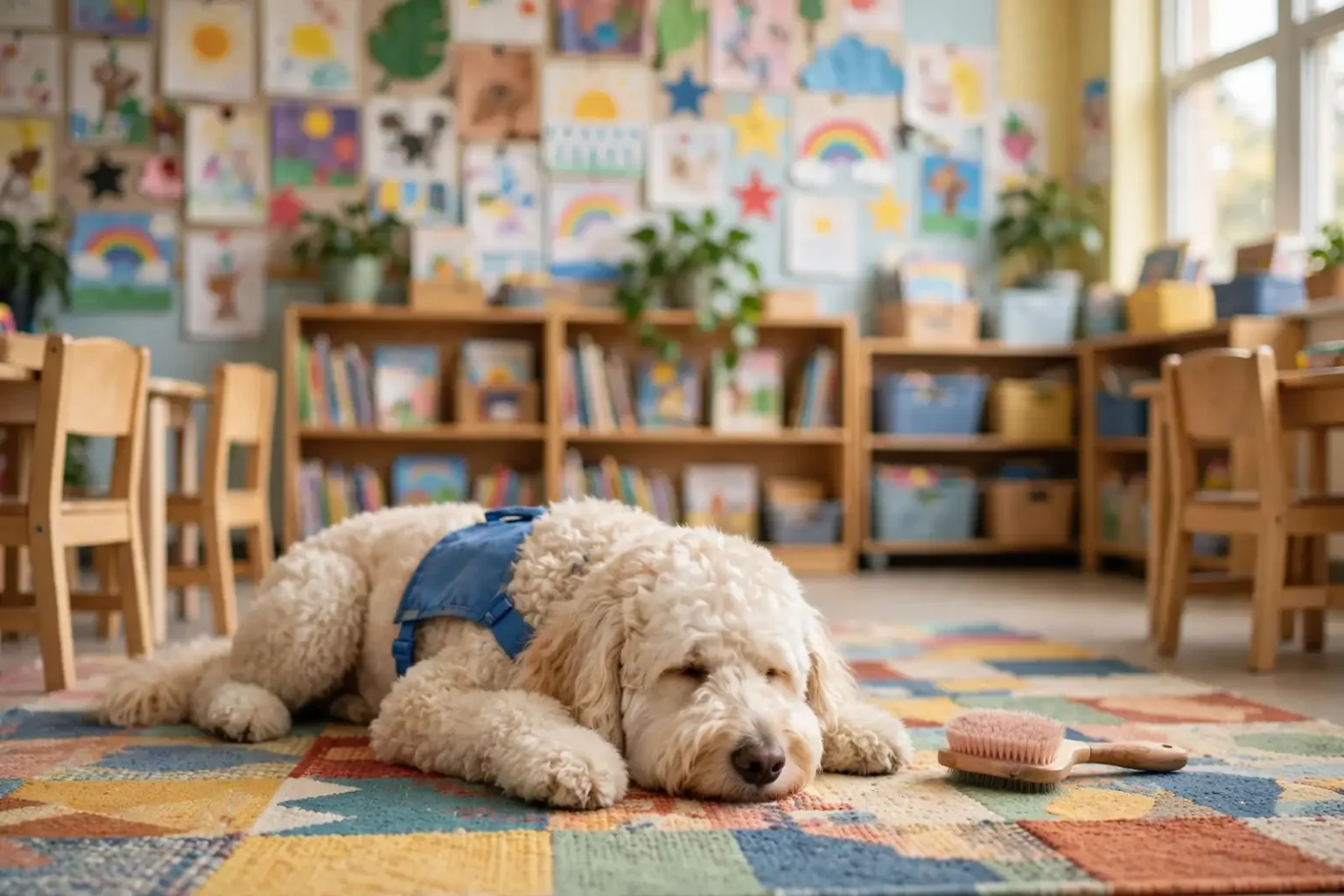
SARALAND, Ala. — Once a week, a few four-legged visitors make their way down the halls of Saraland Elementary School, and for some students, those visits have become a bridge to confidence, communication and friendship. The Pawtism Project, a school dog program that began at Saraland Elementary more than 15 years ago, brings specially trained dogs into special education and general education classrooms alike.
Teachers say the visits let students get to know the dogs at their own pace while helping the wider school community understand what specially trained dogs can do.
Small steps that mean a lot
Stephanie Mullins teaches a self-contained special education class at Saraland Elementary, where she has worked for 10 years. The dogs have been part of the school throughout her time there, and this year they have been visiting her classroom every week.
Over time, Mullins has watched her students grow more relaxed around the animals. She recalled one girl who was nervous when the visits began. Week after week, the student watched the dogs, until one day she walked over, picked up a brush and began brushing one of them.
“That was a huge deal,” Mullins said.
The dogs can also help when a student becomes overwhelmed. For one of Mullins’ students, taking a dog for a walk offers a way to settle down — and something more.
“Her body relaxes, it’s the most calm I see her all day,” Mullins said. “But it also gives her a purpose and a job.”
That walk also gives the student a natural way to interact with other people around the school, Mullins said.
A conversation starter in the hallway
The benefits do not stop with the student holding the leash. When other children see the dogs in the hallway, they often stop to ask whether they can pet them. Those moments, Mullins said, create easy openings for students to talk with one another and build relationships, because the attention shifts to the dog.
“They’re not focused on the difference of their peer,” she said. “They’re more focused on the dog.”
That was exactly the idea behind the program from the start.
How the Pawtism Project began
Charles Turberville, who oversees training for the Pawtism Project, said the effort began more than 15 years ago as a way to connect students in special education with their peers in general education classes.
It was started by Scott Parks, a special education teacher at Saraland Elementary who saw a need for more ways to help students connect with others and come out of their shells. His idea grew into a partnership with Teddy Bear Golden Doodles, which raises and trains the dogs that now visit classrooms throughout the school.
The goal, Turberville said, was to see whether dogs could help students become more engaged and interact with each other. Early results were encouraging.
“We were able to see the kids be more involved,” he said. “They were engaging with the other students back and forth.”
Turberville said some students have spoken their first words to the dogs, while others have been encouraged to get up and walk with them.
Moving at the student’s pace
Not every child is comfortable around dogs at first, and the program is built with that in mind. Turberville said students who are hesitant are given time and are never rushed.
“We move at the pace of the student,” he said.
A nervous child might spend several visits simply watching classmates interact with a dog before deciding to come closer. Over time, Turberville said, some students who once said they were afraid of dogs become comfortable petting them and spending time with them.
The dogs also visit general education classrooms, where students learn what specially trained dogs do and how to behave around them. Turberville said that shared understanding is part of the project’s larger goal of bridging the gap between classrooms.
Raised for a special purpose
For the people who raise and train the dogs, the school visits are a rewarding part of the work. Sherry Smeraglia, whose family dog, Fletcher, visits Saraland Elementary, said she and her team raise and train dogs for families and try to match each dog’s personality to the needs of the people it will serve.
Smeraglia said the school partnership started after she met the project’s founder, who was looking for a way to help children open up. She remembered her answer: “We would love to partner with you and do that.”
Seeing the dogs at work with students, she said, is the payoff for all the effort that goes into raising them.
“We raise, train, love on these babies, knowing that they have a very, very special purpose,” Smeraglia said, “and then watching it be fulfilled with these kids. Oh my gosh, you just can’t beat it.”
Turberville said the dogs’ calm, nonjudgmental presence is at the heart of what makes the program work.
“They love no matter what,” he said. “And the kids just, they feel that, and it’s amazing.”
Hoping to reach more schools
Saraland Elementary is part of Saraland City Schools, the north Mobile County district that the city formed in 2008 when it separated from the Mobile County Public School System. The Pawtism Project has been part of the elementary school’s culture for most of the district’s history.
Now, Turberville said, the project would like to help other school systems bring the program to their own students. Schools interested in learning more can contact the Pawtism Project to talk about setting it up.
Mullins, for one, would recommend it.
“The Pawtism Project has been super beneficial for me and my students and for our whole school,” she said. “I think it’s something that would benefit all schools.”
At a glance
- Program: The Pawtism Project
- Where: Saraland Elementary School, Saraland City Schools
- Started: More than 15 years ago by special education teacher Scott Parks
- Partner: Teddy Bear Golden Doodles, which raises and trains the dogs
- How it works: Specially trained dogs make regular visits to special education and general education classrooms, letting students interact with them at their own pace
- Goal: Build confidence and communication skills and help students in different classrooms connect with one another