Loans of $190,000 Fuel Peavy’s Late Push in Mobile Runoff
John Peavy's campaign spent more than $250,000 in a month and took out $190,000 in loans, guaranteed by a group of Mobile businessmen, to close the gap on Sam Jones before the runoff.
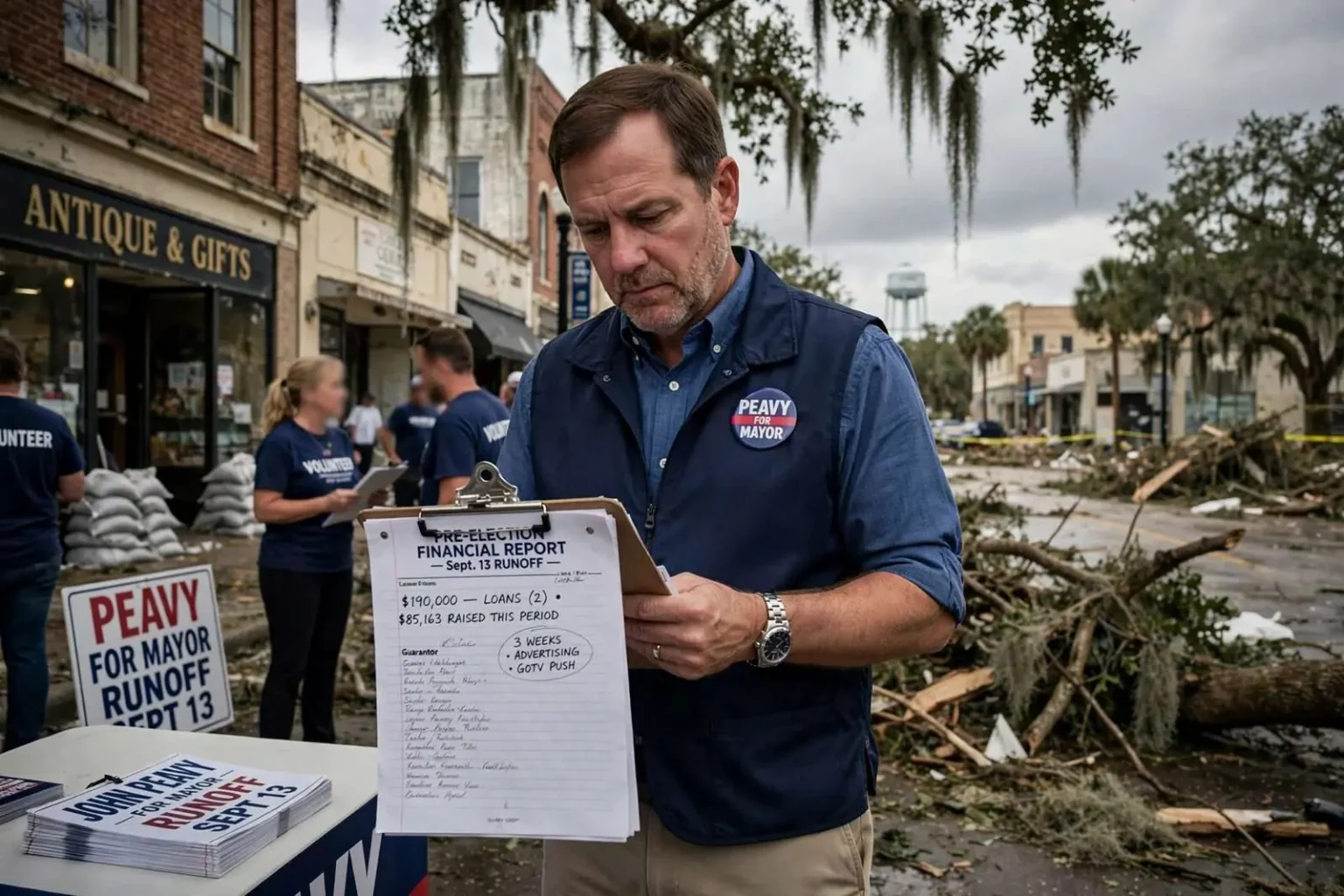
John Peavy’s campaign to overtake Sam Jones and claim the Mobile mayorship spent more than a quarter of a million dollars in a month — and borrowed $190,000 to do it — according to the pre-election financial report filed on the eve of the Sept. 13 runoff. The numbers laid bare, in dollars and signatures, just what it would take for a trailing councilman to close one of the widest gaps a Mobile runoff candidate had ever faced. They also captured something particular about Alabama politics at the moment: a campaign financed in large part by the personal credit of its own backers.
Borrowing to Compete
The councilman’s campaign raised $85,163 during the reporting period and secured two loans, one for $140,000 and another for $50,000. The larger loan was guaranteed by a group of Mobile businessmen and professionals: Doug Anderson, Russell Buffkin, John P. Case, Braxton Counts, Palmer Hamilton, Lamar Harrison, Dr. Mike Maitre, Matt McDonald, Peavy himself, Tommy Tyrell, Mike Thompson, Richard Weavil, Todd Martin and Mickie Russell. The $50,000 loan carried many of the same guarantors, excluding Hamilton, McDonald and Harrison, and adding Michael Tew.
That list was itself a map of Mobile’s civic and business establishment — developers, physicians, attorneys, bankers and longtime figures in the city’s civic organizations. A guarantor roster like that does more than secure a loan. It signals to other donors, to party-aligned voters, and to the city’s informal leadership networks exactly who has decided the race is worth backing.
Personally guaranteed campaign loans are a familiar instrument in Alabama politics and a revealing one. They allow a campaign to spend money it has not yet raised, and they signal that a candidate’s closest backers are willing to put their own credit behind the outcome. They also carry obvious risk: a losing campaign leaves guarantors holding the note. In a race against a front-runner who had already outpolled Peavy by more than twenty points, every name on those loan documents was a wager that three weeks of advertising could change a fixed arithmetic.
The Arithmetic Peavy Faced
The borrowing was a response to a hard number. In the Aug. 23 primary, Jones took 47.8 percent to Peavy’s 25.3 — a gap of more than twenty points. Jones had fallen just short of the fifty percent plus one needed to win the office outright, sending the race to a runoff and giving Peavy three weeks to close a very wide margin. Runoff math in local elections is unforgiving: the front-runner needs only to hold his coalition together, while the challenger must win over nearly everyone who voted against him.
Former City Councilwoman Bess Rich and civic leader Ann Bedsole together drew about 27 percent of the first-round vote. Both endorsed Peavy for the runoff. Those endorsements mattered beyond the signal they sent — Rich, in particular, had built a devoted constituency on the city’s western side through years of council work, and her voters were precisely the ones Peavy needed to inherit. On the other side of the ledger, four-term incumbent Mayor Mike Dow lined up behind Jones, giving the front-runner the weight of the sitting administration at the moment it counted most.
Who Funded the Push
Political action committees provided a substantial share of the receipts, including $9,500 from RSVP PAC, $5,000 from Rossler and Redditt LLC, $3,000 each from the Contractors Political Action Committee and T-Town PAC, $2,000 from South Alabamians for Good Government, and $1,000 each from DVA/HC PAC, Offshore Inland Services and ABC PAC. PAC money of that shape is the standard currency of a competitive Alabama municipal race — organized interests positioning themselves with whoever sits in the mayor’s office next, or defending relationships with the administration already in place.
The largest individual contribution came from Matt Metcalfe at $15,000. Others giving $1,000 or more included Thomas B. Clement ($2,000), Palmer Hamilton ($2,500), Matt McDonald ($2,500), Dr. Daniel A. Dennis III, Buffy Donlon, J.H. Faulkner, Ladye Gwynn, T.A. Horst Jr., Clifton C. Inge, John Lawler, Tony and Ryan Marcopulos, Charles McNeil Sr., Vaughn Morrissette, John Roberts ($1,500), Mickie Russell, Thomas Taul Jr., Chad and Julia Williams, Edward Williams, Rick and Trelle Williams and Howard Yeager. Several names appear on both the donor list and the guarantor list — the same people, in effect, lending the campaign money and giving it more.
Among the notable entries was $1,250 from Leonard and Bess Rich — the runoff endorsement translated into cash. In the grammar of Alabama campaigns, an endorsement followed by a check is the strongest statement a former rival’s household can make. It told observers that Rich’s backing of Peavy was active rather than perfunctory.
Businesses and firms contributing $500 or more included Hosea O. Weaver and Sons, DRC Inc., Volkert and Associates, Frank Cockrell’s Body Shop, McGuire Oil Co., McGwire Food Marts and the Quackenbush Family Partnership, alongside a long list of individual donors across the professions. The mix — a heavy-construction contractor, an engineering firm with decades of municipal work, fuel distributors, convenience stores, a body shop — traced the practical economy of Mobile, the firms whose fortunes rise and fall with city contracts, permits and growth decisions.
The Stakes on Tuesday
Mobile’s runoff would decide who succeeded Dow after sixteen years and who would set the city’s course on drainage, public safety, annexation and downtown development. Sixteen years is an era in municipal politics: a generation of Mobile residents had never voted for anyone else for mayor, and the city’s physical landscape — its rebuilt waterfront, its expanding suburbs, its long-running arguments about stormwater and streets — bore Dow’s imprint. Whoever followed him would inherit both the momentum and the unresolved complaints.
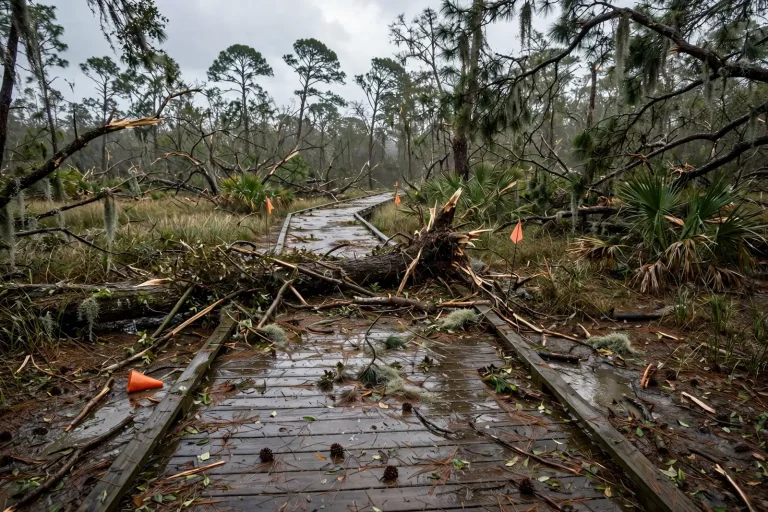
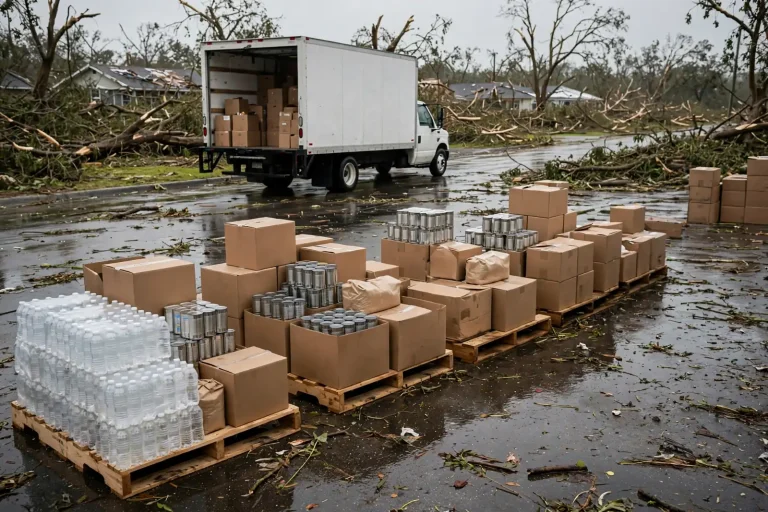
The race also arrived in the shadow of Hurricane Katrina, which had struck the central Gulf Coast two weeks before the first round and left campaigns worrying that voters’ attention was elsewhere. Mobile had taken serious damage — downed trees, weeks without power, neighborhoods across the city littered with debris — and thousands of households were still dealing with insurance, repairs and displaced relatives on the day they were asked to vote. Turnout in a runoff is always thinner than a primary’s; a runoff two weeks after a hurricane made the guesses about who would show up even harder.
For Peavy, the storm cut both ways. It swallowed the news cycle and complicated every campaign event, but it also put city government’s basic competence — drainage, police response, debris removal — at the center of the conversation, terrain a longtime councilman could argue he knew firsthand.
Reading the Report
Peavy’s report described a campaign willing to mortgage its future on a single day’s voting. There was no gradual path to the number he needed; there was advertising, organization and name recognition, bought at once, in the window between the primary and the runoff. Campaigns that spend that way either make up ground fast or leave their guarantors with the bill and nothing to show for it.
Whether $250,000 in late spending, financed substantially by borrowed money and backed by the personal guarantees of more than a dozen supporters, could move twenty points in three weeks was the question Mobile voters would answer at the polls. The financial filing could not resolve it. What it showed was a city’s business and civic leadership split into camps, a challenger’s operation betting everything it had on the last three weeks, and a runoff that would be decided by whoever could still find their way to a polling place in a city still cleaning up from a hurricane.
How Money Moves in a Mobile Mayor’s Race
Municipal races in Alabama are, by law, nonpartisan, which changes what campaign finance looks like on the ground. With no party label to organize donations, the money organizes around people and networks instead — law firms, construction interests, neighborhood associations, physician groups, and the PACs that bundle the same constituencies. The donor list on a filing like Peavy’s is therefore less an ideological document than a social one: it shows which parts of the city’s leadership class had decided the moment had come to move on from the incumbent mayor’s chosen successor or, in this case, to fight for the seat against him.
Loan guarantees occupy a distinctive place in that system. A cash contribution is capped and spent; a guarantee mobilizes the banking relationship and credit of a supporter without a same-day outlay, which is why late-surging campaigns lean on them. It also concentrates risk in a way that pure fundraising does not. A dozen guarantors on a $140,000 note are, in effect, co-investors in a three-week advertising blitz, and their willingness to sign reflected a shared judgment that the runoff was winnable despite the primary arithmetic.
The timing of the filing mattered too. Pre-election reports land in the final days before the vote, when there is still time for the numbers to shape the story — proof of momentum, or proof of desperation, depending on how a campaign spins them. An $85,163 month of receipts paired with $190,000 in borrowing reads either as a campaign ascending on fresh money or as one borrowing against a verdict it had not yet earned. Partisans on each side read it exactly that way.
What the document preserved, whatever Tuesday brought, was a portrait of a Mobile campaign in its final hour: every PAC receipt, every firm that gave, every professional who co-signed a note, all of it filed in the open as state law requires. The runoff would decide the mayor’s office. The report had already decided what the fight cost, and who was willing to pay for it if it failed.