
Pedestrian Struck and Killed by Two Vehicles on Cottage Hill Road in Mobile
A pedestrian was struck by two vehicles and killed while crossing Cottage Hill Road near University Boulevard in Mobile in July 2019.
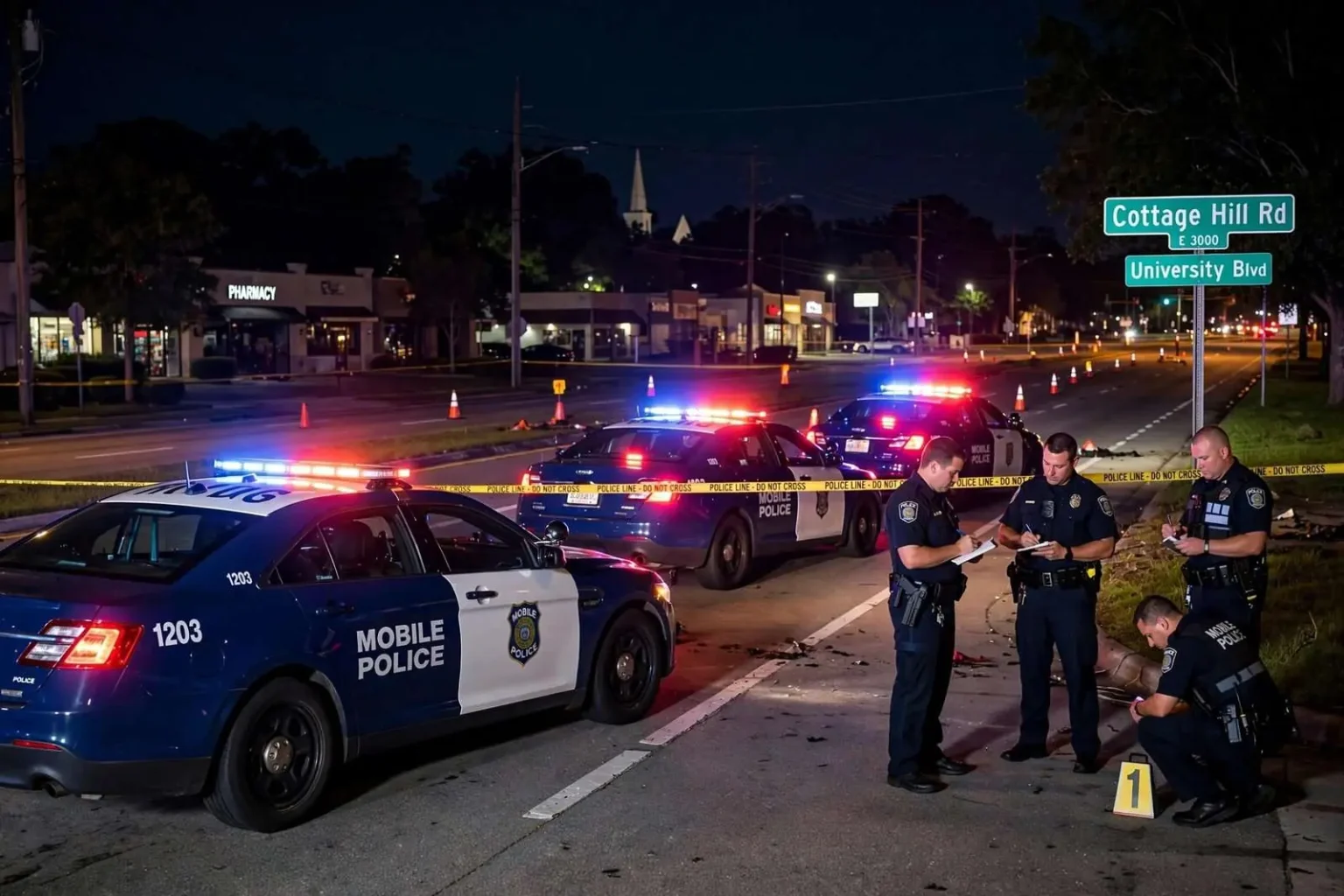
Mobile police investigated a deadly pedestrian strike on Cottage Hill Road in July 2019 after a person crossing the busy west Mobile thoroughfare was hit by two vehicles. Officers at the scene said the victim was crossing Cottage Hill Road just east of University Boulevard when they were struck Wednesday night. The victim was pronounced dead following the impact. Authorities did not release the victim’s name pending notification of family, and details about the drivers and vehicles involved were not immediately available as officers worked the scene along one of the city’s busiest east-west corridors.
The crash unfolded on a stretch of Cottage Hill Road that thousands of Mobile drivers travel every day. Cottage Hill Road runs east-west across west Mobile, lined with subdivisions, shopping centers, churches and schools, and its traffic grows heavy at the evening hours when the strike occurred. Just east of University Boulevard, one of the corridor’s major crossroads, the roadway carries multiple lanes of traffic moving at speeds that leave little margin for a person on foot. Wednesday night, in July 2019, that traffic included the two vehicles that struck the pedestrian in succession.
Being struck by two vehicles is a pattern that haunts urban pedestrian crashes. On a multi-lane road after dark, a driver who hits a pedestrian may not realize what has happened, and following vehicles may not see the person in the roadway in time to stop. The second impact compounds injuries that the first may already have made fatal. Investigators must untangle which vehicle struck the victim first, whether either driver stayed at the scene and what each driver saw, which is why officers spent the night working the scene and gathering accounts before details were released.
Officers said the victim was crossing Cottage Hill Road when the strikes occurred. Whether the pedestrian was in a crosswalk, crossing mid-block or in the roadway for another reason was not immediately detailed by authorities, and that question — central to any pedestrian crash investigation — remained open as police processed the scene. The victim was pronounced dead following the impact, and the name was withheld pending notification of family, the standard practice that shields loved ones from learning of a death through the news.
Cottage Hill Road and the challenge of crossing it
Cottage Hill Road is one of the defining east-west corridors of west Mobile. Stretching from neighborhoods near Interstate 65 westward through a string of residential communities, it connects homes to schools, grocery stores and workplaces along its length. Its intersection with University Boulevard sits in the middle of that web, surrounded by retail plazas and dense housing, and pedestrians cross the area on foot every day — some by choice, some because they have no other way to get where they are going.
Wide, fast roadways like Cottage Hill Road present the classic conditions for pedestrian danger. Traffic engineers have documented for decades that multi-lane roads with high traffic volumes are the most hazardous environments for people on foot, because crossings take longer, drivers’ sightlines are complicated by adjacent lanes and a pedestrian in the roadway may be hidden by one vehicle from the driver in the next. After dark, those risks multiply: headlight illumination has limits, and a person crossing a wide thoroughfare can be effectively invisible until a vehicle is close.
July in Mobile adds its own conditions. Darkness falls late, but the night hours bring reduced visibility all the same, and summer evenings put more people out walking in neighborhoods where sidewalks are inconsistent. West Mobile developed largely as an automobile-oriented suburban landscape, and pedestrian infrastructure has not always kept pace with the number of people who walk along and across its commercial corridors.
Mobile police handle pedestrian fatalities on corridors like Cottage Hill Road with a full investigative response. Traffic homicide investigators document the scene with measurements and photographs, examine both vehicles for damage and evidence of braking, and canvass nearby businesses for security camera footage that may capture the moments before and after the impact. In a two-vehicle strike, that footage can be decisive in establishing the sequence and identifying both drivers.
What authorities released, and what remained unknown
The identity of the victim, once family had been notified, would be confirmed by police, and any decisions about charges would follow the investigation rather than precede it. Alabama law requires drivers involved in a crash resulting in injury or death to remain at the scene, and investigators must establish whether every driver involved did so. The distinction matters deeply to the outcome of the case: a driver who struck a pedestrian unknowingly is treated differently from one who fled, and the evidence gathered at the scene is how that difference is established.
For the family of the victim, the hours after such a crash carry a particular weight. The notification process that police follow exists to bring the news in person rather than through rumor, and the delay in releasing a name reflects that obligation. Meanwhile, the investigation continues whether or not the public knows who the victim was.
Pedestrian safety on Mobile’s corridors
The crash on Cottage Hill Road joined a longer list of pedestrian deaths on Mobile’s arterial streets, a list that city and state officials have wrestled with for years. Corridors like Cottage Hill Road, Government Boulevard, Airport Boulevard and Highway 98 carry the combination that safety data flags most consistently: high traffic volume, multiple lanes, moderate-to-high speeds and frequent crossings by people on foot. Pedestrian fatalities along such roads are among the most stubborn traffic safety problems the city faces.
Engineering responses exist and have been applied in places: marked crosswalks, pedestrian signals, improved lighting and medians that give crossing pedestrians a refuge halfway. Each measure reduces risk, and each requires investment and prioritization across a roadway network that spans the entire city. In the aftermath of fatal crashes, residents along the affected corridor often ask for specific improvements, and crash investigations feed directly into those decisions by establishing where and how the danger materialized.
For drivers, the lessons of crashes like this one are concrete. Scanning the road ahead for pedestrians, not just for other vehicles, matters most on wide corridors after dark. Slowing down in areas where people cross between intersections — a reality on any commercial street — buys reaction time that speed takes away. And a driver who does strike or nearly strike a pedestrian should stop, call 911 and remain until authorities arrive, both because the law requires it and because the minutes immediately after a crash can determine whether the person struck survives.
For pedestrians, safety agencies offer their own guidance without placing responsibility for these crashes solely on the person on foot. Crossing at intersections and crosswalks where they exist, wearing or carrying something reflective at night, and avoiding crossings mid-block on multi-lane roads all reduce risk. But the fundamental asymmetry remains: a vehicle protects its occupants with tons of steel, and a pedestrian has nothing between them and the impact, so the heaviest responsibility always falls on the people behind the wheel.
The investigation’s path forward
Once Mobile police completed their scene work on Cottage Hill Road that Wednesday night, the investigation moved into its longer phases: vehicle examinations, toxicology results, camera footage analysis and witness interviews. Fatal pedestrian cases can take weeks or months to close, and the findings eventually go to the district attorney’s office for a determination on any charges. Until then, the public record holds only the outline authorities released in the immediate aftermath.
What officers at the scene said publicly was limited, and deliberately so. The victim was crossing Cottage Hill Road just east of University Boulevard when struck Wednesday night, was pronounced dead following the impact, and had not been named pending family notification. Details about the drivers and vehicles involved were not immediately available — a phrase that captures the early hours of a fatal pedestrian investigation, when the scene itself must be worked before questions about the vehicles can be answered.
The outline is enough to convey the shape of the loss. A person crossing one of west Mobile’s busiest east-west corridors on a summer Wednesday night was struck by two vehicles and died from the impact, just east of an intersection thousands of residents pass through daily. Family members learned of the death through the careful process that follows such crashes, and the drivers and vehicles involved remained part of an active investigation rather than a public narrative.
For the community along Cottage Hill Road, the crash was one more entry in an ongoing conversation about how the corridor is used and how it can be made safer. Every fatal pedestrian strike on a street like this one sharpens that conversation, prompting residents, city engineers and police to look again at the crossings, the lighting and the speeds that define daily life on the road. The investigation into the July 2019 crash followed that pattern, and its conclusions became part of the record that shapes what comes next on one of Mobile’s busiest streets.


