Florida Panhandle Santa Rosa County
Pensacola Businessman Gary Lowry Killed in High-Speed Santa Rosa Sound Boating Crash
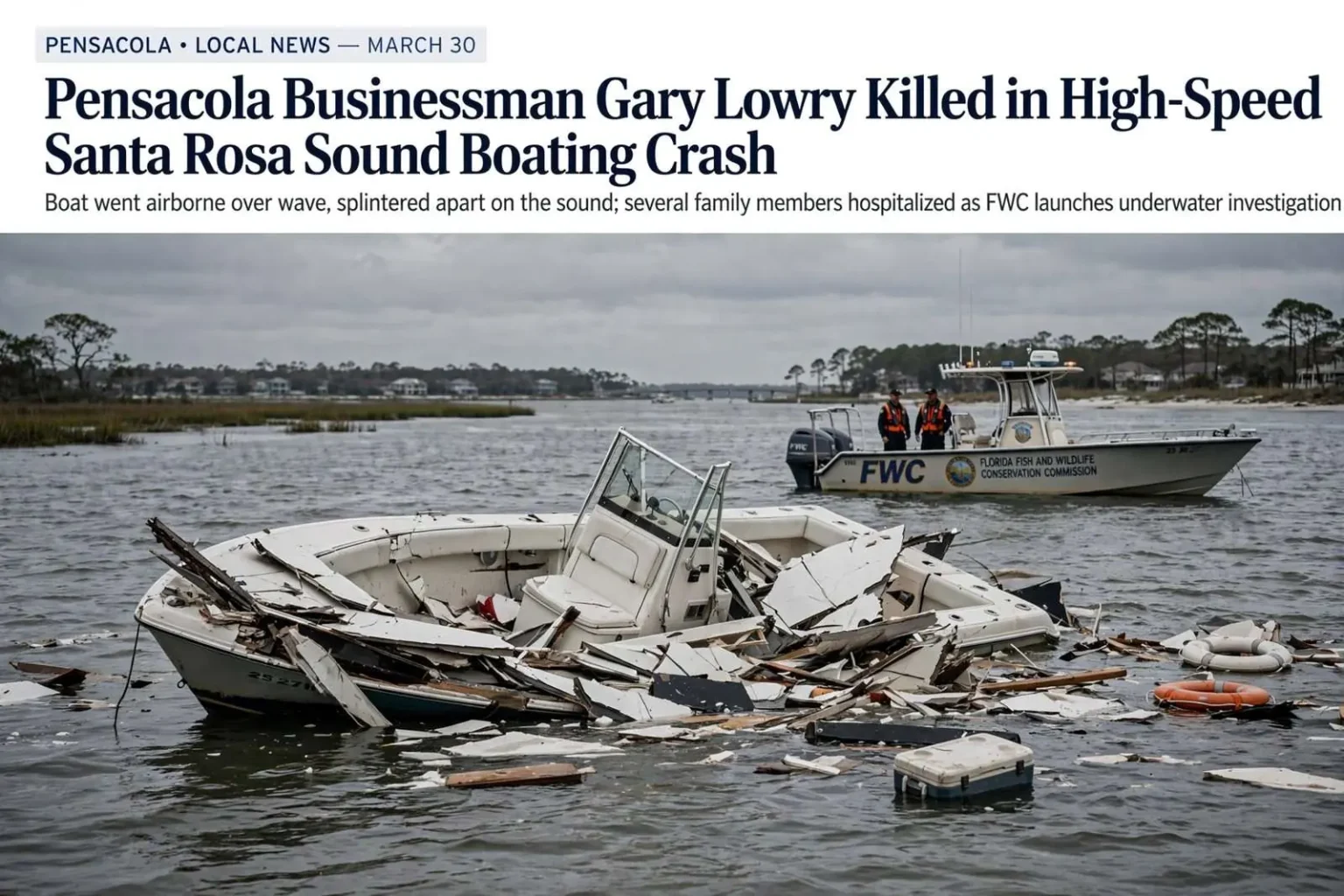
A prominent Pensacola businessman died and several family members were hurt when his boat went airborne over a wave, slammed down and splintered apart on Santa Rosa Sound on Saturday, March 30.
Witnesses told investigators the vessel was traveling so fast that it launched off a wave before crashing down into the chop. Portions of the boat still rest at the bottom of the sound.
Gary Lowry’s fishing buddy of 15 years, Ron Johnson, spoke on behalf of the family and remembered him as an experienced, careful captain — which is part of what makes the crash so hard to accept.
“Great guy, great friend, good father, good businessman. He had it all going for him. We’re going to miss him,” Johnson said. “He has been in all kinds of weather, and knows and understands the seas… He was a very safe boater, and how something like this could happen? It’s hard to understand.”
Family members hospitalized
Everyone aboard was injured in the crash. Lowry’s teenage granddaughter Cierra suffered vertebrae injuries; Johnson said doctors expect her to fully recover and return to cheerleading. Lowry’s son Scott, who works in the family construction business, was also hospitalized with a severely broken jaw that will remain wired shut for six to eight weeks. Johnson said he expects everyone injured to recover.
The Florida Fish and Wildlife Conservation Commission said it will conduct an underwater crime scene investigation at the wreckage site as it works to determine what caused the vessel to leave the water at such speed.
Santa Rosa Sound, where the crash occurred, is the long, narrow body of water that separates Santa Rosa Island — home to Pensacola Beach and the undeveloped stretches of Gulf Islands National Seashore — from the mainland of Santa Rosa County. Protected from the open Gulf by the island, the sound is a favored corridor for recreational boaters: its waters are typically calmer than the Gulf, its shores are lined with homes and launches, and on warm weekends it carries steady traffic of fishing boats, pontoon boats, and personal watercraft. That same protected character can breed a false sense of security. A sound that seems placid can still build a short, steep chop when wind opposes current or when boat traffic stacks wakes on top of waves — conditions in which a hull running at high speed can catch air in an instant.
The physics of a wave-launch crash are unforgiving, and they are well understood in boating-safety circles. A planing hull at speed rides on the water’s surface rather than through it; when the bow leaves a wave crest with no water beneath it, the boat becomes momentarily airborne, its propeller racing unloaded. What happens next depends on the boat’s attitude when it lands — bow-down entries can dig the hull under and flip or cartwheel the vessel, while flat landings transmit the full impact of re-entry through hull, machinery, and occupants. Passengers experience the deceleration of a car crash multiplied by the instability of a vessel breaking apart around them, and the debris field that results — as the wreckage on the sound’s bottom illustrates — can be scattered over a wide area.
The FWC’s investigation will follow the protocol the agency applies to serious boating accidents statewide. Investigators will map and photograph the debris field on the sound bottom — the “underwater crime scene” the commission described — using divers or remotely operated cameras to document hull sections, engines, and steering components in place before recovery. Investigators will reconstruct speed and heading from witness accounts, hull damage, and where pieces came to rest, and they will examine the engine’s throttle and steering assemblies for failure. Toxicology testing, interviews with the injured survivors, and review of the vessel’s maintenance and ownership records round out a process that typically takes weeks to months before a final accident report is issued.
Nationwide, the circumstances described in this crash — excessive speed in relation to conditions — rank among the leading contributing factors in fatal boating accidents, alongside operator inattention, inexperience, and alcohol. Federal statistics collected by the U.S. Coast Guard consistently show that collisions involving vessels at speed produce some of the highest injury counts of any accident type on the water, and that bow-riding, wave-jumping, and running at speed in chop are recurring themes in the reports. Safety agencies’ messaging on the subject is blunt: boats do not have seat belts or airbags, so speed management is the only crash protection aboard, and operators are responsible not just for their own wake-reading but for the passengers whose bodies absorb every landing.
For families aboard, the risks compound with the number of passengers. Loading affects a boat’s handling — a heavily laden hull rides lower, planes later, and responds more sluggishly to trim and throttle — and passengers seated forward or on the bow take the worst of any impact. Safety instructors urge operators to brief passengers on handholds and seating before getting underway, to keep children and teens seated away from the bow at speed, and to slow well before conditions change, since a wave that a boat at trolling speed would ride over comfortably can launch the same hull at speed. None of that guidance, friends of an experienced captain would be quick to say, is news to someone who has run boats for decades — which is part of why accidents like this one resist the easy lessons people reach for afterward.
The human toll of the crash extended through a family and a business community that knew the Lowry name. In Pensacola’s close-knit construction and business circles, where family firms pass from fathers to sons and friendships span decades of shared work, the news moved quickly through the networks that Gary Lowry had spent a lifetime building. The outpouring that followed — tributes from fellow businessmen, prayers posted for his granddaughter’s recovery, the community of fishermen who had shared his boats — reflected the reach of a man remembered in the terms his friend chose: great guy, great friend, good father, good businessman.
The injuries his family members carried home from the sound will outlast the headlines. Spinal injuries of the type his granddaughter suffered are evaluated carefully in the days after trauma, with imaging to rule out unstable fractures and braces or therapy where recovery is expected — as doctors reportedly anticipate in her case. A jaw wired shut for six to eight weeks, as her father faces, dictates a liquid diet and a careful recovery through the better part of two months. For the family, the arithmetic of the crash — one life lost, a granddaughter expected to cheer again, a son healing on a schedule measured in weeks — is the accounting that no accident report will fully capture.
The wreck site itself remains part of the story. Portions of the vessel on the bottom of the sound present both an investigative resource and a hazard: investigators will want the wreckage documented and raised as evidence, while the debris field in a navigable body of water poses a collision risk to other boaters until it is fully charted and cleared. Agencies responding to such crashes typically mark the area while salvage proceeds, and the recovery of major pieces — engines, hull sections — is coordinated between FWC investigators and commercial salvors working under the agency’s direction.
As the investigation proceeded, the details that matter most to the final report — the vessel’s speed relative to the wave train, the hull’s condition, the exact sequence of the launch and impact — remained in the sound itself, on the bottom, waiting for divers. What was already clear was the outline the witnesses described: a boat running fast in chop, a launch, a shattering impact, and a family whose day on the water ended in a grief that no experience on the helm could have foreseen.
Emergency response on the sound that Saturday drew on the resources of a coastal county practiced in water rescues. Calls reporting a boating crash with injuries bring a multi-agency response: sheriff’s marine units, fire-rescue boats with paramedics, and typically Good Samaritan vessels from among the recreational traffic that converges on any distress scene in the sound. Patients are stabilized on the water or shuttled to waiting ambulances at the nearest ramp or dock, and in serious trauma cases, air medical transport stages nearby. The distance across the sound is short by boat but long by road — the barrier island has limited access points — which makes the marine response the difference in minutes that trauma outcomes are measured in.
Boating-safety educators in the Panhandle have long used crashes like this one in their outreach, not to assign blame before the facts are in, but to illustrate the conditions that every operator will eventually face. The Gulf Coast’s boating season concentrates enormous traffic into protected waters — the sounds, bays, and Intracoastal segments from Pensacola to Mobile Bay — and the wakes of other boats, layered on wind chop, create the wave conditions that high-speed hulls can catch. The Florida wardens who teach the state’s boating-safety course emphasize reading water ahead, trimming the boat for conditions, and slowing when visibility or traffic demands it; the FWC’s post-accident reports, published each year, cite speed and lookout failures so routinely that the lessons can read as boilerplate until a crash like this reminds boaters why they exist.
The phrase “underwater crime scene,” unusual as it sounds, is standard terminology in serious boating-accident investigations. Evidence on the bottom is fragile in its own way: hull fragments shift with currents and tides, metal parts corrode, and the position of components relative to one another — a steering cable, a throttled lever, a sheared transom — can establish whether mechanical failure contributed to the loss of control. Documenting everything in place before recovery, as investigators planned here, mirrors the care land-based investigators apply to a scene, adapted to an environment where silt, current, and time work against them. The findings from such work end up in an FWC report that families receive, insurers rely on, and, where a case warrants, prosecutors review.
The loss also marks the community of anglers and boaters who knew Lowry from the water. Fifteen years of shared fishing trips — the network of a man’s favorite hours — produces its own kind of grief, one that spreads through tackle shops, marinas, and boat ramps where news of a crash is parsed in the shorthand of people who know the water it happened on. In the days after the crash, the details that circulated among them — that the boat went airborne, that parts are still on the bottom, that a safe and experienced hand was at the throttle — were retold as the cautionary reality of the sport: that the sound everyone crosses casually on a Saturday can, in one wave, become the scene no one forgets.